On eBird ↗
Red-crested Finch
Live sightings near you, the range map, bar charts of when it is seen, and Macaulay Library photos and recordings.
Red-crested Finch
Coryphospingus cucullatus
The red pileated finch (Coryphospingus cucullatus), also known as the red-crested finch, is a species of bird in the family Thraupidae. It is found in Argentina, Bolivia, Brazil, Ecuador, French Guiana, Guyana, Paraguay, Peru, on the eastern side of the Andes. Its natural habitats are subtropical or tropical dry forests, subtropical or tropical moist lowland forests, subtropical or tropical dry shrubland, and heavily degraded former forest. This is a common species, and the International Union for
From the article Red pileated finch on Wikipedia (CC BY-SA), quoted section by section
Description
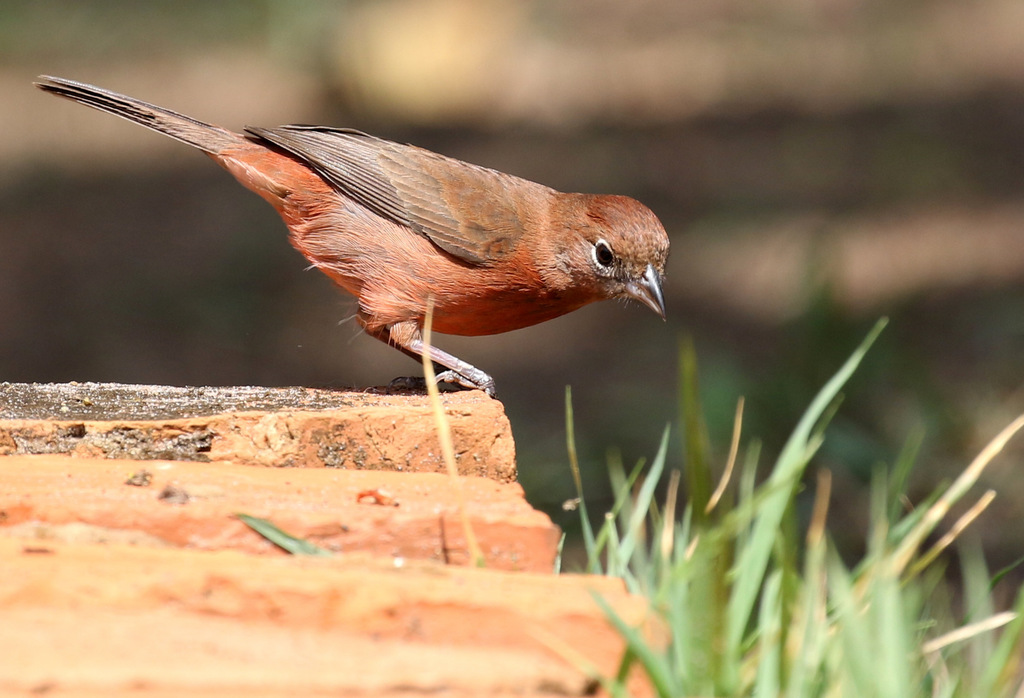
The red pileated finch is about 13.5 cm (5.3 in) long and weighs 11 to 18 g (0.39 to 0.63 oz). It has a shortish tail and a longish bill. The species is sexually dimorphic. Adult males of the nominate subspecies C. c. cucullatus have a black crest with a red central stripe; the crest is usually held flat. Their face is grayish with white crescents above and below the eye and usually browner ear coverts. Their nape and upperparts are warm brown and their wings and tail a blackish brown. Their throat is red, their breast a richer red, and the rest of their underparts mostly reddish with a gray wash on the flanks. Adult females have a brown head with no red or black but with the same eye crescents as males. Their upperparts, wings, and tail are brown with a reddish wash on the rump. Their underparts are a paler brown with a reddish wash on the breast. Juveniles are similar to adult females but are slightly more olive and have some streaking on the underparts. Subspecies C. c. rubescens has richer red underparts and a smaller and thinner bill than the nominate. C. c. fargoi has browner, less reddish upperparts and duller red underparts than the nominate. Both sexes of all subspecies have a dark brown iris, a blackish maxilla, a horn to pale bluish gray mandible, and brownish legs.
Range & habitat
The red pileated finch has a highly disjunct distribution: Each subspecies is separate from the others and some have gaps within their ranges. They are found thus:
C. c. cucullatus: south of the Amazon River in northeastern Brazil's eastern Pará (but see below) C. c. rubescens: southern Brazil south and west of an arc roughly from Rondônia east to Goiás and western Minas Gerais and then south to the Atlantic in São Paulo state and into eastern Paraguay, Uruguay, and northeastern Argentina C. c. fargoi has multiple separate subranges: Marañón River valley in extreme southern Ecuador's Zamora-Chinchipe Province, upper Marañón valley straddling the Cajamarca - Amazonas border in northwestern Peru, Urubamba River valley in southeastern Peru's Cuzco Department, and in Bolivia, western Paraguay, and northern Argentina south to northern Buenos Aires Province. (but see below) Birds of the World states that C. c. cucullatus is found in Guyana and that there are historical records in Suriname. However, the South American Classification Committee (SACC) has no records in Guyana and only unconfirmed reports in Suriname. The SACC and AviList place C. c. fargoi also in Colombia. The IUCN, the IOC, Birds of the World, and McMullan's Field Guide to the Birds of Colombia do not. All three subspecies of the red pileated finch inhabit somewhat dry and open landscapes. …
Wikipedia: “Distribution and habitat”
What it does
The red pileated finch's diet has not been studied. It forages on the ground near, under, and in shrubs and other low vegetation. It usually is seen singly or in pairs but might form small flocks in the non-breeding season.
Wikipedia: “Feeding”
Listen
Looking for field recordings…
Where it lives
Recorded sightings
—
geo-referenced records in GBIF, from museums, herbaria and field observers.
Drag the globe to turn it. Dots are where records exist, not a range map; darker means more records.
In the stacks
Searching the stacks…
Every page naming Coryphospingus cucullatus in the Biodiversity Heritage Library →
This page is assembled live from iNaturalist, GBIF, Wikipedia, the Source Library and the Internet Archive. It is not yet part of the hand-edited codex. iNaturalist taxon 10310.