- Animals
- ›Cnidarians
- ›Sea Anemones and Corals
- ›Hexacorallians
- ›Stony Corals
- ›Caryophylliidae
- ›Heterocyathus
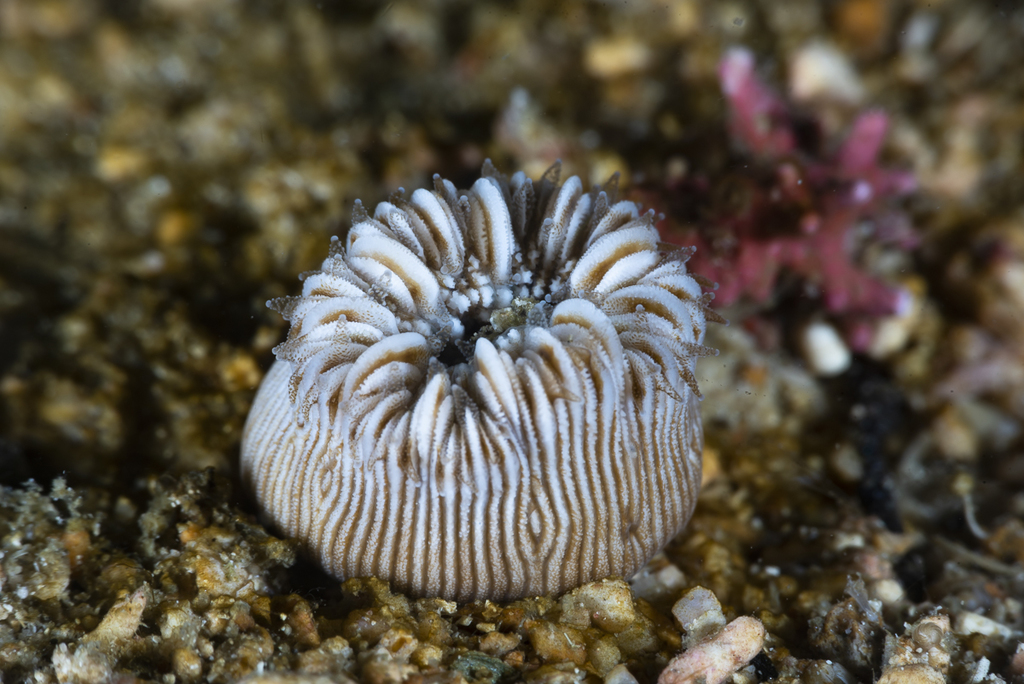
Heterocyathus aequicostatus
Heterocyathus aequicostatus is a small species of coral in the family Caryophylliidae in the order Scleractinia, the stony corals. It is native to the Indo-Pacific region. It is a large polyp, solitary, free-living coral and is usually found on soft substrates.
From the article Heterocyathus aequicostatus on Wikipedia (CC BY-SA), quoted section by section
Description
Heterocyathus aequicostatus is a small, solitary, free-living coral with a flat base. The polyp sits in a roughly circular corallite (stony cup) which has up to four cycles of toothed septa (stony ridges) radiating from it, making 48 septa in total. These continue over the rim of the corallite as prominent costa (ridges) down to the smooth, flat base. This coral grows to a maximum diameter of 1.5 cm (0.6 in) and is a pale brown colour, often with a pale green oral disc.
Range & habitat
Heterocyathus aequicostatus is native to the tropical and sub-tropical Indo-Pacific region, its range extending from Madagascar and the Arabian Peninsula to Indonesia, Australia, the Philippines and Japan. It is found at depths of at least 20 m (66 ft) and sometimes down to 100 m (330 ft) on level or gently sloping sandy or gravelly shelves between reefs.
Wikipedia: “Distribution and habitat”
What it does
This coral sometimes harbours photosynthetic, single-celled dinoflagellates called Zooxanthellae in its tissues. The polyps extend their tentacles at night to feed, normally remaining retracted by day. The larvae are planktonic, and when fully developed they are attracted to settle on the shells of tiny gastropod molluscs, gradually enveloping the molluscs as they grow into juvenile corals. In Australia, this coral often lives in symbiosis with the sipunculid worm, Aspidosiphon muelleri. The worm often has an entrance hole on the oral disc through which it can extend its introvert to feed. Another hole in the base of the coral is used by the worm to move the coral about on the sandy seabed, preventing the coral from becoming buried.
Wikipedia: “Ecology”
Where it lives
Recorded sightings
—
geo-referenced records in GBIF, from museums, herbaria and field observers.
Drag the globe to turn it. Dots are where records exist, not a range map; darker means more records.
In the stacks
Searching the stacks…
Every page naming Heterocyathus aequicostatus in the Biodiversity Heritage Library →
This page is assembled live from iNaturalist, GBIF, Wikipedia, the Source Library and the Internet Archive. It is not yet part of the hand-edited codex. iNaturalist taxon 102703.