On eBird ↗
Cuban Bullfinch
Live sightings near you, the range map, bar charts of when it is seen, and Macaulay Library photos and recordings.
Cuban Bullfinch
Melopyrrha nigra
The Cuban bullfinch (Melopyrrha nigra) is a songbird species of the monotypic genus Melopyrrha. Sometimes classified in the bunting and American sparrow family (Emberizidae), more recent studies have shown it to be part of the tanager family (Thraupidae). Therein, it belongs to the lineage of tholospizan "finches", which also includes the famous Darwin's finches.
From the article Cuban bullfinch on Wikipedia (CC BY-SA), quoted section by section
Description
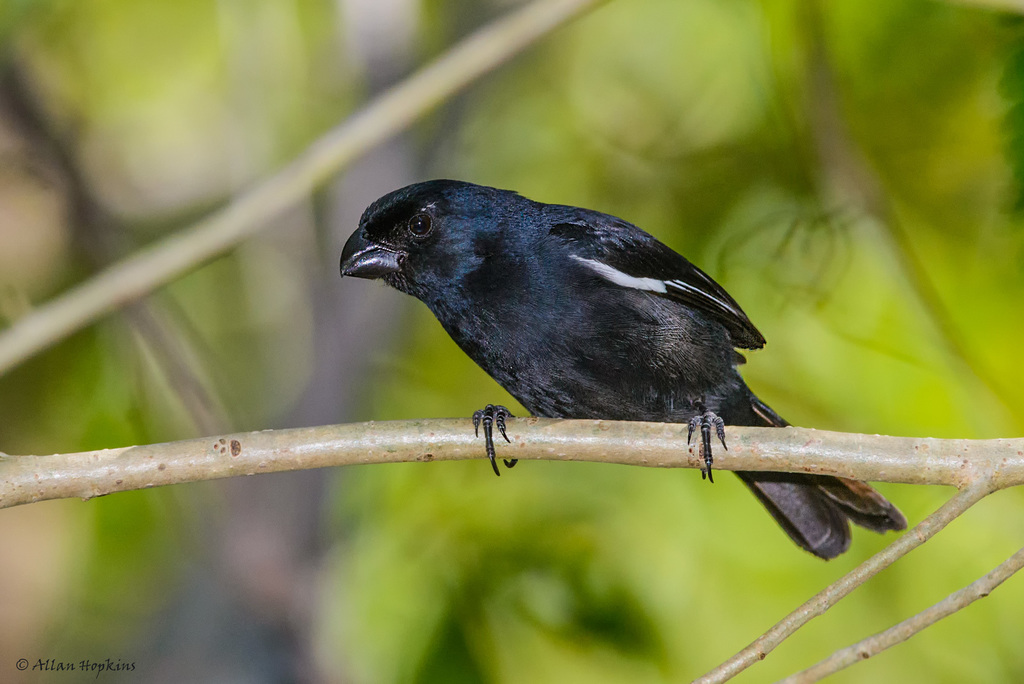
The Cuban bullfinch is 13.8 to 15.0 cm (5.4 to 5.9 in) long and weighs about 12 to 20 g (0.42 to 0.71 oz). The species is sexually dimorphic though not dramatically so. Adult males are glossy black except for white edges on the flight feathers that show as a wide patch on the closed wing; its underwing coverts are also white. Adult females are usually a duller, more grayish black than males and have a smaller wing patch. Both sexes have a dark brown iris, a short, thick black bill, and black legs and feet.
Range & habitat
The Cuban bullfinch is found on the main island of Cuba, on Isla de la Juventud (Isle of Pines), and on many small islands in the Sabana-Camagüey and Canarreos archipelagos. It inhabits a wide variety of landscapes including semi-deciduous and evergreen woodlands, pine forest, riparian forest, shrublands, and mangroves. It is found at all elevations.
Wikipedia: “Distribution and habitat”
What it does
The Cuban bullfinch feeds on fruits, seeds, flower buds, insects, and nectar. It is known to feed on more than 70 plant species. It forages singly, in pairs, and in family groups, from near the ground to the forest canopy. In winter it sometimes joins mixed species feeding flocks.
Wikipedia: “Feeding”
Listen
Looking for field recordings…
Where it lives
Recorded sightings
—
geo-referenced records in GBIF, from museums, herbaria and field observers.
Drag the globe to turn it. Dots are where records exist, not a range map; darker means more records.
In the stacks
Searching the stacks…
Every page naming Melopyrrha nigra in the Biodiversity Heritage Library →
This page is assembled live from iNaturalist, GBIF, Wikipedia, the Source Library and the Internet Archive. It is not yet part of the hand-edited codex. iNaturalist taxon 10266.