On eBird ↗
Red-legged Honeycreeper
Live sightings near you, the range map, bar charts of when it is seen, and Macaulay Library photos and recordings.
Red-legged Honeycreeper
Cyanerpes cyaneus
The red-legged honeycreeper (Cyanerpes cyaneus) is a small songbird in the family Thraupidae, the tanagers and allies. It is regularly found in Mexico, every Central American country, Trinidad and Tobago, and every mainland South American country except Argentina, Chile, Paraguay, and Uruguay. It has also occurred as a vagrant in the United States, Argentina, and some southern Caribbean islands.
From the article Red-legged honeycreeper on Wikipedia (CC BY-SA), quoted section by section
Description
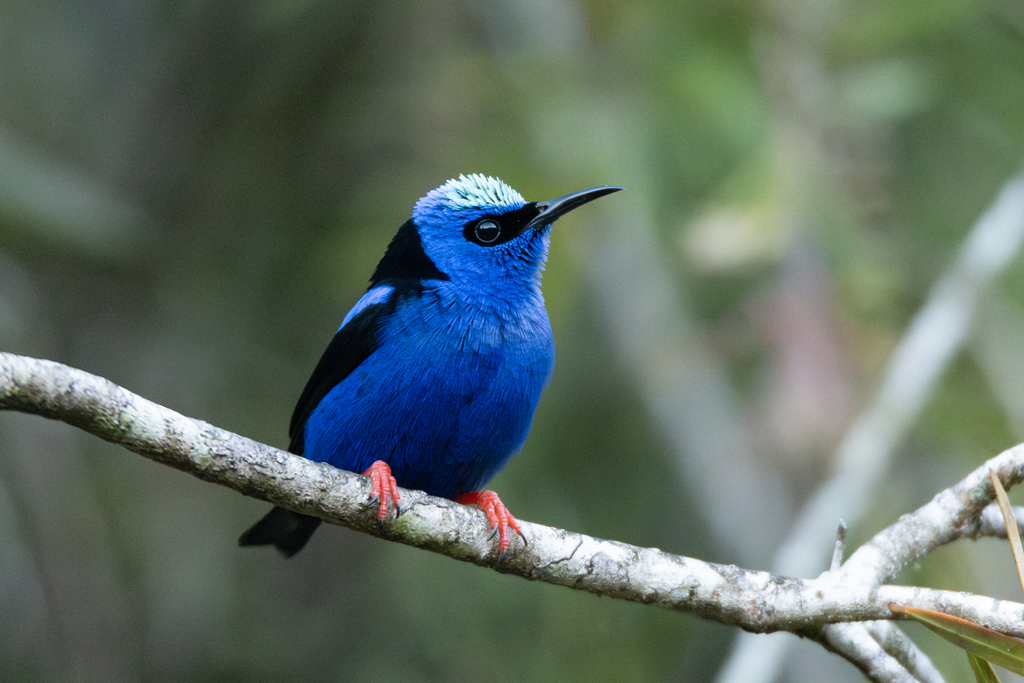
The red-legged honeycreeper is 11 to 13 cm (4.3 to 5.1 in) long and weighs 11 to 18 g (0.39 to 0.63 oz). It has slender decurved bill. The species is sexually dimorphic. Adult males of the nominate subspecies C. c. cyaneus in breeding plumage are mostly bright purplish blue. They have a shaggy azure-blue crown. They have a small black mask from the lores to just past the eye, a large triangular black patch on the nape and mantle, and a black tail. Their upperwing coverts and the upper side of their flight feathers are black; their underwing coverts and the flight feathers' undersides are bright yellow. Adult females have a dull olive-green crown, nape, and upperparts. They have a faint whitish supercilium and dusky green lores whose color continues as a thin line through the eye on an otherwise light yellow face with thin greenish and dusky streaks. Their upperwing coverts, flight feathers, and tail are dusky with olive-green edges. Their throat is grayish white, their breast and belly light yellow with faint thin greenish streaks, and their undertail coverts light yellow. Males in non-breeding plumage retain their wings' and tail's breeding colors but are otherwise like adult females. Both sexes of all subspecies have a dark brown iris and a blackish bill. …
Range & habitat
The subspecies of the red-legged honeycreeper are found thus:
C. c. carneipes: Gulf-Caribbean slope from San Luis Potosí in east-central Mexico south through Belize, Guatemala, and Honduras into Nicaragua; Pacific slope from Oaxaca in southern Mexico south through Guatemala, El Salvador, Honduras, Nicaragua, and Costa Rica; along both slopes of Panama and into the upper Sinú River valley in northwestern Colombia's Córdoba Department; Mexico's Cozumel Island and Panama's Coiba and Pearl islands C. c. pacificus: Pacific slope from central Chocó Department in Colombia south into northwestern Ecuador to northern Manabí Province C. c. gigas: Gorgona Island off western Colombia C. c. gemmeus: northern Colombia's Guajira Peninsula C. c. eximius: northern Colombia's Santa Marta region; Serranía del Perijá on the Colombia-Venezuela border; western Zulia, central Falcón, and Yaracuy in northwestern Venezuela; intermittently on both slopes of Venezuelan Andes; Venezuelan Coastal Ranges from Carabobo to Sucre; Venezuela's Margarita Island C. c. tobagensis: Tobago C. c. cyaneus: Trinidad; from Venezuela's Monagas, Delta Amacuro and Bolívar states east through the Guianas and northern Brazil from the Negro River east to the Atlantic in Pará C. c. …
Wikipedia: “Distribution and habitat”
What it does
The red-legged honeycreeper feeds primarily on fruits and arthropods and on lesser amounts of nectar. In a study on Trinidad, about a third of the species' diet was Miconia berries. It forages in pairs during the breeding season and outside it often in groups of up to about 15 individuals. It regularly joins mixed-species feeding flocks. It forages mostly in the forest's middle to upper levels, hyperactively hopping, flying back and forth, and flicking its wings. It takes much of its insect prey by gleaning from leaves and branches, sometimes hanging upside down to reach them. It also regularly takes prey in mid-air with sallies from a perch. In the Trinidad study it took 40% of its insect prey in the air. In addition to taking fruit from trees and vines, it regularly visits feeders and is known to take it from restaurant tables.
Wikipedia: “Feeding”
Listen
Looking for field recordings…
Where it lives
Recorded sightings
—
geo-referenced records in GBIF, from museums, herbaria and field observers.
Drag the globe to turn it. Dots are where records exist, not a range map; darker means more records.
In the old herbals & bestiaries

In the stacks
Searching the stacks…
Every page naming Cyanerpes cyaneus in the Biodiversity Heritage Library →
This page is assembled live from iNaturalist, GBIF, Wikipedia, the Source Library and the Internet Archive. It is not yet part of the hand-edited codex. iNaturalist taxon 10262.