On eBird ↗
American Redstart
Live sightings near you, the range map, bar charts of when it is seen, and Macaulay Library photos and recordings.
American Redstart
Setophaga ruticilla
The American redstart (Setophaga ruticilla) is a New World warbler. It is only distantly related to the Old World (common) redstart, with both belonging to the order Passeriformes.
From the article American redstart on Wikipedia (CC BY-SA), quoted section by section
Description
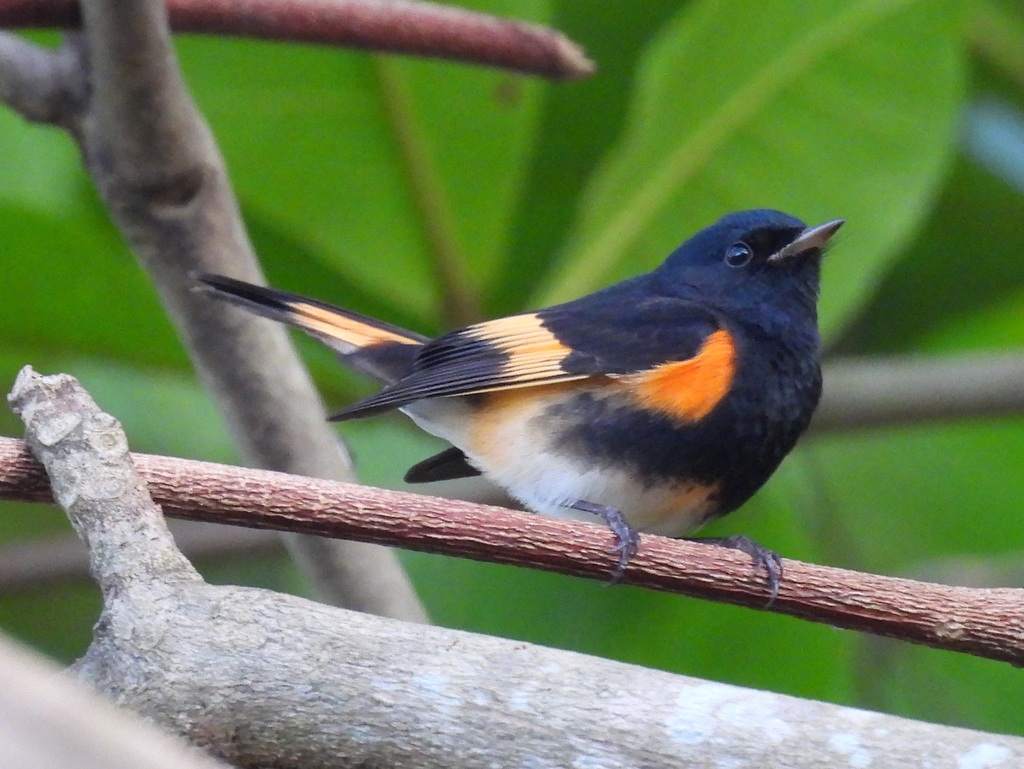
The American redstart is a smallish warbler. It measures 11 to 14 cm (4.3 to 5.5 in) in total length and has a wingspan of 16 to 23 cm (6.3 to 9.1 in). Its length is boosted by a relatively long tail and it is one of the lightest birds in its family. Weight is considerably less in winter than in summer. Males weigh an average of 8.6 g (0.30 oz) in summer but drop to 7.2 g (0.25 oz) in winter, while females drop even more from an average of 8.7 g (0.31 oz) to an average of 6.9 g (0.24 oz). Among standard measurements, the wing chord is 5.5 to 6.9 cm (2.2 to 2.7 in), the tail is 4.9 to 5.8 cm (1.9 to 2.3 in), the bill is 0.7 to 0.9 cm (0.28 to 0.35 in) and the tarsus is 1.5 to 1.9 cm (0.59 to 0.75 in). The breeding males are unmistakable, jet black above apart from large orange-red patches on their wings and tails. Their breast sides are also orange, with the rest of their underparts white. In their other plumages, American redstarts display green in their upperparts, along with black central tails and grey heads. The orange patches of the breeding males are replaced by yellow in the plumages of the females and young birds. …
Range & habitat
Although perhaps not as common as in the past, the redstart appears to be one of the most stable and abundant species of New World warbler; its numbers exceeded in total by the common yellowthroat, yellow warbler and yellow-rumped warbler, because of much wider natural breeding ranges in those species and perhaps exceeding those in sheer density within appropriate range. Their breeding is in North America, spanning southern Canada and the eastern United States. They are migratory, wintering in Central America, the West Indies, and northern South America, and are very rare vagrants to western Europe. During the breeding season, the redstart inhabits open-canopy, mostly deciduous forests, second growth, and forest edges. It is insectivorous, often sharing its foraging habitats with other warblers, and is found feeding in the mid to lower regions of a tree or shrub. A wide range of habitats are occupied during migration, including many shrubby areas. On its wintering grounds in Central and South America, the redstart may be found in nearly all woody habitats but tends to avoid non-forested agricultural areas. It is often found in shade-grown coffee plantations, which provide native trees and shrubs, as well as coffee trees. Elevations occupied vary by location, with redstarts found at elevations up to 3,000 m (9,800 ft) in South America, but only 1,500 m (4,900 ft) in Jamaica.
Wikipedia: “Distribution and habitat”
What it does
The redstarts feed almost exclusively on insects which are usually caught by flycatching. American redstarts also have been known to catch their insect prey by gleaning it from leaves. This is a very active species. The tail is often held partly fanned out. These birds have been observed flashing the orange and yellow of their tails on and off to startle and chase insects from the underbrush. Overall, this species is a very flexible, opportunistic feeder that can easily adapt to varying habitat, season, insect community, vegetation structure, and time of day. The diet consists largely of caterpillars, moths, flies, leafhoppers and planthoppers, small wasps, beetles, aphids, stoneflies and spiders. Few berries and seeds are consumed, but are most often from barberry, serviceberry, and magnolia.
Wikipedia: “Feeding”
Listen
Looking for field recordings…
Where it lives
Recorded sightings
—
geo-referenced records in GBIF, from museums, herbaria and field observers.
Drag the globe to turn it. Dots are where records exist, not a range map; darker means more records.
In the old herbals & bestiaries

In the stacks
Searching the stacks…
Every page naming Setophaga ruticilla in the Biodiversity Heritage Library →
This page is assembled live from iNaturalist, GBIF, Wikipedia, the Source Library and the Internet Archive. It is not yet part of the hand-edited codex. iNaturalist taxon 10247.