 NL·0320
Herbarium of the Nature Library
- Name
- Passerina ciris
- Family
- Cardinalidae
- Native to
- Breeds in two separate populations — the south-eastern Atlantic coast (North Carolina to Florida) and the south-central US and northern Mexico; winters in Florida, the Bahamas, Cuba, Mexico and Central America to Panama
- Habitat
- Shrubland, Woodland edge, Coastal scrub
On eBird ↗
Painted Bunting
Live sightings near you, the range map, bar charts of when it is seen, and Macaulay Library photos and recordings.
Painted bunting
Passerina ciris
Also calledColorín sietecolores (Spanish, Mexico) · Mariposa (Spanish, Cuba) · Nonpareil (Louisiana French / English) · Passerin nonpareil (French)
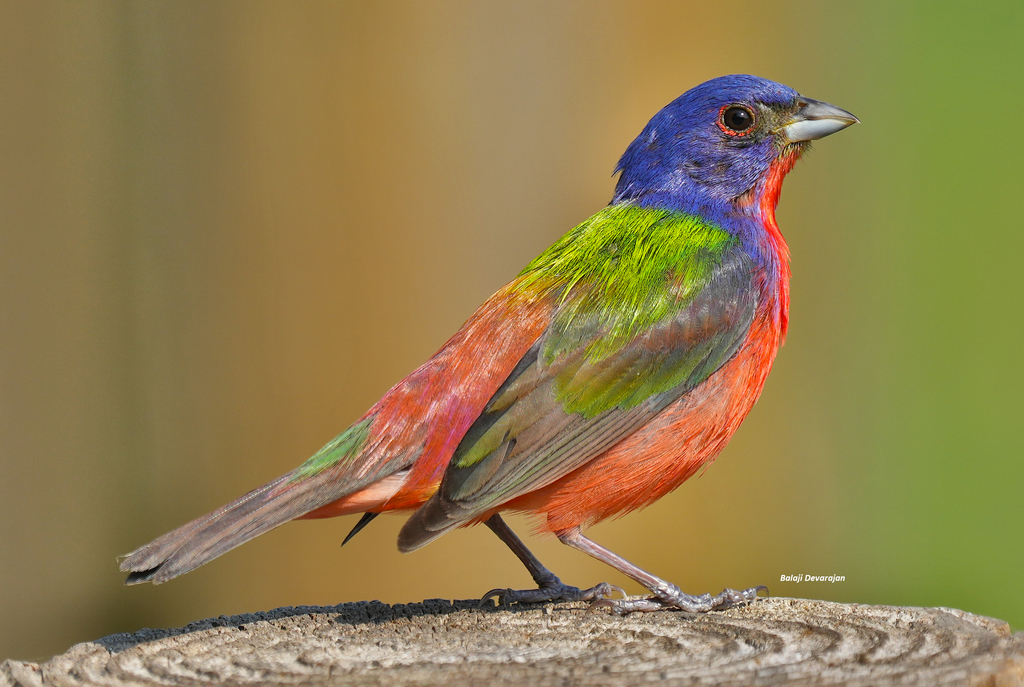
The male is perhaps the most colourful songbird in North America — blue head, red underparts and a lime-green back. Females are the only bright green finch-like bird in their range, and the species was long trapped as a cage bird.
The painted bunting is a species of bird in the cardinal family, Cardinalidae. It is native to North America. The bright plumage of the male develops beginning in the second year of life; in the first year, they can be distinguished from the female only by close inspection. Wikipedia
What it can do
- iWestern birds pause in the south-western US and north-western Mexico to moult before finishing migration — an unusual 'moult migration'
- iiMales do not reach full colour until their second autumn; first-year males look like females
- iiiMales fight fiercely over territories, sometimes drawing blood
In the field
Field marks
- aAdult male: deep blue head, red eye-ring, red underparts and rump, yellow-green back
- bFemale and immature: bright, uniform yellowish-green with a pale eye-ring
- cShort conical bill typical of buntings
- dSmall, compact size
- Voice
- A sweet, high, run-on warble of musical notes; call a soft 'chip'.
- Not to be confused with
- Female Indigo Bunting is brown, not green. Varied Bunting males are dark purple with a red nape. Green female could suggest a vireo or warbler, but the stubby conical bill identifies it.
- Where to see it
- Coastal thickets of South Carolina, Georgia and north-east Florida; Texas Hill Country; feeders in south Florida in winter.
- When
- Summer visitor in the US, Apr–Sep; winters in Florida and the tropics
Listen
Looking for field recordings…
Life & habits
- Diet
- Grass and weed seeds; insects in the breeding season
- Habitat
- Brushy thickets, woodland edges, maritime scrub and overgrown fields
- Size
- 12–14 cm; 13–19 g
- Lifespan
- Banding record about 12 years
Despite the male's colours, it is secretive and sings from within cover more often than from open perches.
Where it lives
Recorded sightings
—
geo-referenced records in GBIF, from museums, herbaria and field observers.
Native range
Breeds in two separate populations — the south-eastern Atlantic coast (North Carolina to Florida) and the south-central US and northern Mexico; winters in Florida, the Bahamas, Cuba, Mexico and Central America to Panama
Drag the globe to turn it. Dots are where records exist, not a range map; darker means more records.
In the old herbals & bestiaries
Woodcuts and engravings matched from the Source Library’s scanned books by name. Plates marked “relative” show a close kin rather than this exact species. Click a plate to read the page it came from, with translation.

In the stacks
Searching the stacks…
Every page naming Passerina ciris in the Biodiversity Heritage Library →
Marginalia
Mark Catesby painted it as 'The Painted Finch' in the 1730s, and it was exported to Europe as a cage bird; in the Caribbean and Mexico trapping for the pet trade continues to threaten it.
Curiosity
Its French name nonpareil means 'without equal'.
Kinship


Photographs: iNaturalist contributors under the licences shown. Records: GBIF.org. Historical plates: Source Library (CC BY-SA 4.0; originals public domain). Summary text: Nature Library editors and Wikipedia (CC BY-SA). Medicinal and edibility notes are historical and educational, not advice. iNaturalist taxon 10224.