On eBird ↗
Ashy-throated Chlorospingus
Live sightings near you, the range map, bar charts of when it is seen, and Macaulay Library photos and recordings.
Ashy-throated Chlorospingus
Chlorospingus canigularis
The ashy-throated bush tanager (Chlorospingus canigularis) is a species of bird traditionally placed in the family Thraupidae, but perhaps closer to Arremonops in the Emberizidae. It is found in Colombia, Costa Rica, Ecuador, Panama, Peru, and Venezuela. Its natural habitats are subtropical or tropical dry forests, subtropical or tropical moist lowland forests, and subtropical or tropical moist montane forests.
From the article Ashy-throated chlorospingus on Wikipedia (CC BY-SA), quoted section by section
Description
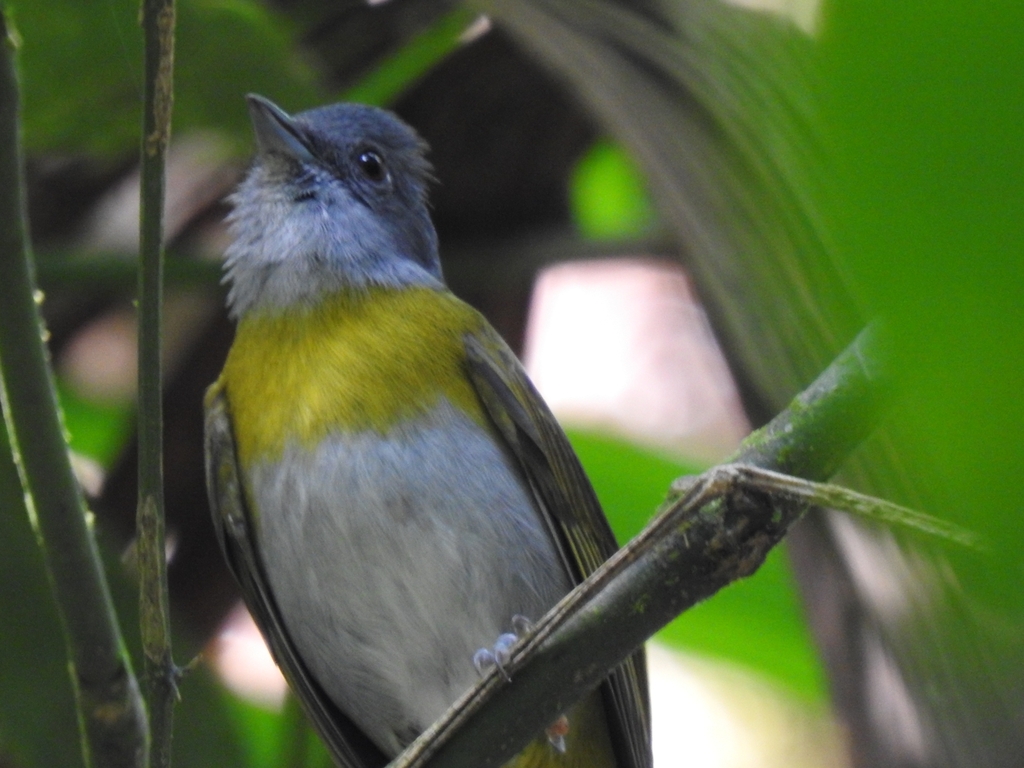
The ashy-throated chlorospingus is 13 to 14 cm (5.1 to 5.5 in) long and weighs 14.5 to 21 g (0.51 to 0.74 oz). The sexes have the same plumage. Adults of the nominate subspecies C. c. canigularis have a mostly gray head with slightly darker ear coverts and a grayish white throat. They have a wide light yellow band across the chest that continues with an olive tinge along the sides and flanks. The centers of their breast and belly are whitish to grayish white and their undertail coverts olive-yellow. The other subspecies of the ashy-throated chlorospingus differ from the nominate and each other thus:
C. c. olivaceiceps: olive rather than gray head C. c. conspicillatus: wider and slightly darker chest band and slightly more olive sides and flanks C. c. paulus: like conspicillatus but with ear coverts the same gray as the rest of the head C. c. signatus: slightly darker gray head with thin white stripe from the eye to the nape All subspecies have a reddish brown iris, a dusky maxilla, usually a pale steel-gray mandible, and dark gray legs and feet.
Range & habitat
The ashy-throated chlorospingus has a highly disjunct distribution. No two subspecies have contiguous ranges and some have gaps within their range. The subspecies are found thus:
C. c. olivaceiceps: Costa Rica on eastern slope of volcanoes in Central Valley and in upper watershed of Reventazón River; western Panama between Bocas del Toro and Veraguas provinces C. c. canigularis: from southern Táchira state in western Venezuela south along the western slope of Colombia's Eastern Andes C. c. conspicillatus: both slopes of Colombia's Central and Western Andes C. c. paulus: western slope of Andes from northern Ecuador's western Pichincha Province south into far northwestern Peru's Tumbes Department; locally in coastal mountains in Ecuador's southern Manabí and northern Santa Elena provinces C. c. signatus: eastern slope of Andes from northern Ecuador's Napo Province south and intermittently through Peru to northern Puno Department The ashy-throated chlorospingus inhabits lowland and tropical evergreen forest and tropical deciduous forest. It favors wet forest heavy with moss and is found mostly in the forest canopy and its edges. …
Wikipedia: “Distribution and habitat”
What it does
The ashy-throated chlorospingus' diet is not well known but does include fruits. It forages in pairs or groups of up to about ten individuals and regularly joins mixed-species feeding flocks.
Wikipedia: “Feeding”
Listen
Looking for field recordings…
Where it lives
Recorded sightings
—
geo-referenced records in GBIF, from museums, herbaria and field observers.
Drag the globe to turn it. Dots are where records exist, not a range map; darker means more records.
In the stacks
Searching the stacks…
Every page naming Chlorospingus canigularis in the Biodiversity Heritage Library →
This page is assembled live from iNaturalist, GBIF, Wikipedia, the Source Library and the Internet Archive. It is not yet part of the hand-edited codex. iNaturalist taxon 10207.