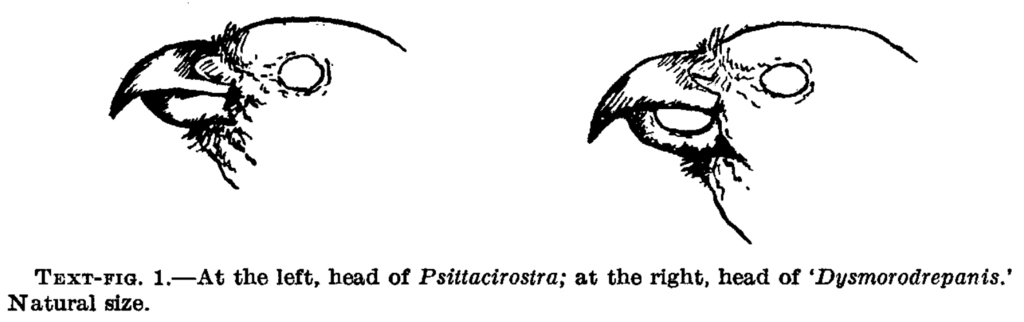
Dysmorodrepanis
The Lānaʻi hookbill (Dysmorodrepanis munroi) is an extinct species of Hawaiian honeycreeper. It was endemic to the island of Lānaʻi in Hawaiʻi, and was last seen in the southwestern part of the island. George C. Munro collected the only known specimen of this species in 1913, which is housed in the Bernice P. Bishop Museum in Honolulu, and saw the species only twice more, once in 1916 and for a final time in 1918. No other sightings have been reported. They inhabited montane dry forests dominated by ʻakoko (Euphorbia species) and ōpuhe (Touchardia sandwicensis). The Lānaʻi hookbill was monotypic within the genus Dysmorodrepanis and had no known subspecies. Its closest relative is believed to be the ʻōʻū, and some early authors suggested that the Lānaʻi hookbill was merely a deformed ʻōʻū. The Lānaʻi hookbill was a plump, medium-sized bird with greenish olive upperparts and pale whitish yellow underparts. It also had a yellow or white superciliary line and a white chin and throat. The wings also had a distinctive and conspicuous white wing patch. The hookbill's distinguishing characteristic was its heavy, parrotlike bill, which had the mandibles hooking sharply towards each other, leaving a gap between them when the beak was closed.
As the bird became extinct before significant field observations could be made, not much is known about its behavior. The Lānaʻi hookbill is only known to have eaten the fruit of the ōpuhe; however, it is unlikely that its unique bill would have developed to eat fruit, and it may have been a snail specialist.
1 branches of this genus, most-observed first
See this branch on the Wheel of Life →
Where it lives
Recorded sightings
—
geo-referenced records in GBIF, from museums, herbaria and field observers.
Drag the globe to turn it. Dots are where records exist, not a range map; darker means more records.
In the stacks
Searching the stacks…
Every page naming Dysmorodrepanis in the Biodiversity Heritage Library →
This page is assembled live from iNaturalist, GBIF, Wikipedia, the Source Library and the Internet Archive. It is not yet part of the hand-edited codex. iNaturalist taxon 10202.