On eBird ↗
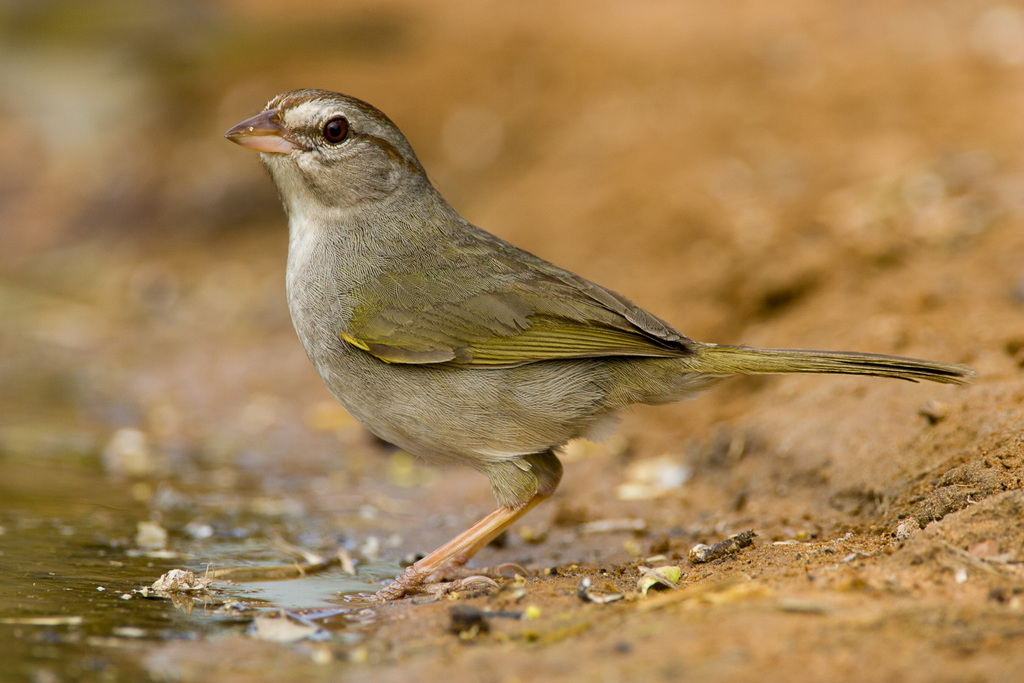
Olive Sparrow
Live sightings near you, the range map, bar charts of when it is seen, and Macaulay Library photos and recordings.
Olive Sparrow
Arremonops rufivirgatus
The olive sparrow (Arremonops rufivirgatus) is a species of American sparrow in the family Emberizidae. (Other names include green finch and Texas sparrow.) Its range includes Belize, Costa Rica, Guatemala, Honduras, Mexico, Nicaragua and southern Texas (including the counties of Val Verde, Atascosa, and Nueces).
From the article Olive sparrow on Wikipedia (CC BY-SA), quoted section by section
Description
The olive sparrow is about 12 to 14 cm (4.7 to 5.5 in) long and weighs 15 to 30 g (0.53 to 1.1 oz). The sexes have the same plumage. Adults of the nominate subspecies have a brown crown with a wide olive gray stripe through its middle and down the nape. They have drab to olive brown lores, a wide buffy gray supercilium, and a thin brown line through the eye on an otherwise gray face. Their upperparts are uniformly olive. Their tail is brownish olive to olive with light yellowish outer edges on the feathers. Their wings' lesser coverts are mostly yellow with a few that are light fuscous with yellowish olive edges. Their primaries and secondaries are fuscous with buff inner edges and light yellowish olive outer edges. Their chin and throat are buffy white, their breast and belly white to buffy white, their sides and flanks buff, and undertail coverts cinnamon or creamy buff. The other subspecies of the olive sparrow differ from the nominate and each other thus:
A. r. crassirostris: darker and browner than nominate with dark olive-green upperparts and dark buffy olive flanks A. r. rhyptothorax: black-striped chestnut crown with gray center, light brownish olive back, whitish breast and belly, and ashy brown flanks A. r. verticalis: chestnut crown with gray center, brownish olive back, and olive-gray flanks A. r. …
Range & habitat
The olive sparrow has a highly disjunct distribution; several subspecies' ranges do not abut another's. The subspecies are found thus:
A. r. rufivirgatus: southern Texas from a line between Val Verde and Calhoun counties south through eastern Mexico to northern Veracruz A. r. crassirostris: southeastern Mexico in Veracruz, eastern Puebla, and eastern Oaxaca A. r. rhyptothorax: northern edge of Mexico's Yucatán Peninsula A. r. verticalis: Yucatán Peninsula and south into northern Belize and extreme northeastern Guatemala A. r. sinaloae: northwestern Mexico from central Sinaloa south through Nayarit A. r. sumichrasti: southwestern Mexico from Jalisco to western Oaxaca A. r. chiapensis: central valley of southern Mexico's Chiapas and into western Guatemala A. r. superciliosus: Pacific slope from southwestern Nicaragua into northwestern Costa Rica to the Valle Central in San José Province The olive sparrow inhabits a variety of landscapes across its wide range. In Texas it is found mostly in brushy open woodlands and open brushlands. In Mexico it occurs in chaparral, thorn forest, shrubby abandoned fields, the edges and clearings of subtropical forest, and the understory of tropical deciduous forest. On the Yucatán Peninsula it inhabits both humid forest and dry coastal scrublands. …
Wikipedia: “Distribution and habitat”
What it does
The olive sparrow's diet has not been studied but is known to include insects, spiders, seeds, and small amounts of fruit. It forages mostly singly and in loose pairs, hopping on the ground or low in dense vegetation. It will feed higher in trees but only rarely.
Wikipedia: “Feeding”
Listen
Looking for field recordings…
Where it lives
Recorded sightings
—
geo-referenced records in GBIF, from museums, herbaria and field observers.
Drag the globe to turn it. Dots are where records exist, not a range map; darker means more records.
In the stacks
Searching the stacks…
Every page naming Arremonops rufivirgatus in the Biodiversity Heritage Library →
This page is assembled live from iNaturalist, GBIF, Wikipedia, the Source Library and the Internet Archive. It is not yet part of the hand-edited codex. iNaturalist taxon 10173.