On eBird ↗
Yellow-browed Sparrow
Live sightings near you, the range map, bar charts of when it is seen, and Macaulay Library photos and recordings.
Yellow-browed Sparrow
Ammodramus aurifrons
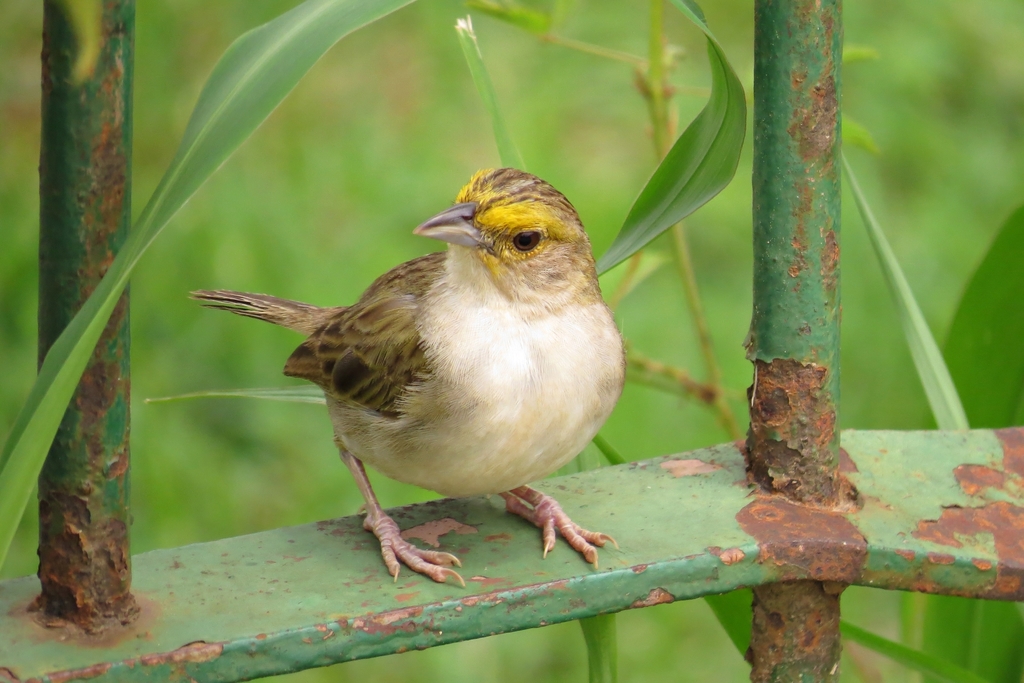
The yellow-browed sparrow (Ammodramus aurifrons) is a species of bird in the family Passerellidae. First described by Johann Baptist von Spix in 1825, this American sparrow is found across much of the Amazon basin in South America. Its natural habitats are subtropical or tropical moist shrubland, pastureland, and heavily degraded former forest.
From the article Yellow-browed sparrow on Wikipedia (CC BY-SA), quoted section by section
Description
The yellow-browed sparrow is a small American sparrow, measuring 13 cm (5 in) in length, with a mass between 14.5 and 19 g (0.5 and 0.7 oz). Sexes are similarly plumaged, though males average very slightly larger than females. The adult is brownish gray on the upperparts, with dusky streaks on the back. Its underparts are whitish, shading to grayish on the chest and buff on the flanks. Its legs are pinkish-brown, while the beak is horn-colored, with a darker culmen. Its iris is reddish brown. The juvenile, which has no yellow on its face or wings, is buffier than adults are, with thin brownish streaks on its breast and flanks.
Similar species. Although quite similar to the grassland sparrow, the yellow-browed sparrow typically shows more yellow on its face. It is overall paler and less streaked than the grassland sparrow, and lacks chestnut edges to its flight feathers. It is best told by its buzzy song, its less secretive behavior and less restrictive habitat preferences.
Range & habitat
Although its former habitat was largely along rivers and on islands, the yellow-browed sparrow is now widespread in grassy areas of the Amazon biome, including agricultural fields, roadsides and around towns. It is generally found in the lowlands, though it has been recorded to 1,000 m (3,281 ft) on the east side of the Andes, and regularly as high as 1,500 m (4,921 ft) — and sometimes to 2,000 m (6,562 ft) — in Ecuador.
Wikipedia: “Habitat and range”
What it does
The yellow-browed sparrow is generally easier to see than its sister species is. It is less secretive, and is found in a wider range of grasslands.
Food and feeding. Like most American sparrows, the yellow-browed sparrow is largely granivorous, feeding on the seeds of native grasses and various introduced plants. It also eats insects, including larvae. It typically feeds on the ground.
Breeding. Breeding has been recorded between February and September. The yellow-browed sparrow builds a cup nest of dried grass lined with fine plant material. The nest is generally on the ground in a grass clump, though sometimes it is placed low in a shrub. The female lays 2–3 white eggs.
Voice. The yellow-browed sparrow's high-pitched song is described as "insect-like". Monotonous and buzzy, it is transcribed as tic, tzzz-tzzzzz, with the first note weak and short. The male sings throughout the day from a low, exposed perch.
Wikipedia: “Behavior”
Listen
Looking for field recordings…
Where it lives
Recorded sightings
—
geo-referenced records in GBIF, from museums, herbaria and field observers.
Drag the globe to turn it. Dots are where records exist, not a range map; darker means more records.
In the stacks
Searching the stacks…
Every page naming Ammodramus aurifrons in the Biodiversity Heritage Library →
This page is assembled live from iNaturalist, GBIF, Wikipedia, the Source Library and the Internet Archive. It is not yet part of the hand-edited codex. iNaturalist taxon 10146.