- Animals
- ›Chordates
- ›Vertebrates
- ›Ray-finned Fishes
- ›Spiny-rayed fishes
- ›Rivulines, Killifishes, and Livebearers
- ›Cyprinodontoidei
- ›Splitfins
- ›Mexican Splitfins
- ›Girardinichthys
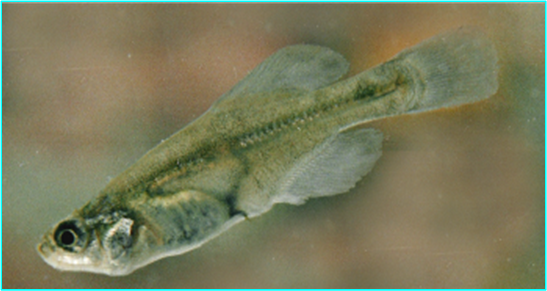
Chapultepec Splitfin
Girardinichthys viviparus
The Chapultepec splitfin (Girardinichthys viviparus), known locally as mexcalpique, is a critically endangered species of fish in the family Goodeidae. It is endemic to Mexico and was originally restricted to lakes and wetlands in the Valley of Mexico, including Lake Texcoco. Through man-made channels it was able to spread to the upper Pánuco River basin (notably Tula River and associated reservoirs). Most native populations disappeared as they were at or near Mexico City, with the waters either being reclaimed, drained, heavily polluted or infested with introduced species. Today the Chapultepec splitfin is only known to survive in three lakes (Viejo, Menor and Mayor) in the Chapultepec park of Mexico City, Lake Xochimilco, Lake Zumpango, Laguna de Tecocomulco northeast of the City where perhaps introduced, and parts of the Pánuco River basin. Most of these remaining populations are small. This species was originally described as Cyprinus viviparus in 1837 by Miguel Bustamante y Septién with the type locality given as "Mexico". In 1860 Pieter Bleeker raised the genus Girardinichthys with a new species Girardinichthys viviparus as its type species, this subsequently proved to be a taxonomy of Cyprinus viviparus.
From the article Chapultepec splitfin on Wikipedia (CC BY-SA), quoted section by section
What it does
The Chapultepec Splitfin is a carnivorous species, possessing small, sharp teeth and an uncoiled intestine that is about body length. It is likely that the species feeds on mosquito larvae and other small insects that make contact with the water's surface.
Wikipedia: “Diet”
Where it lives
Recorded sightings
—
geo-referenced records in GBIF, from museums, herbaria and field observers.
Drag the globe to turn it. Dots are where records exist, not a range map; darker means more records.
In the stacks
Searching the stacks…
Every page naming Girardinichthys viviparus in the Biodiversity Heritage Library →
This page is assembled live from iNaturalist, GBIF, Wikipedia, the Source Library and the Internet Archive. It is not yet part of the hand-edited codex. iNaturalist taxon 101459.