On eBird ↗
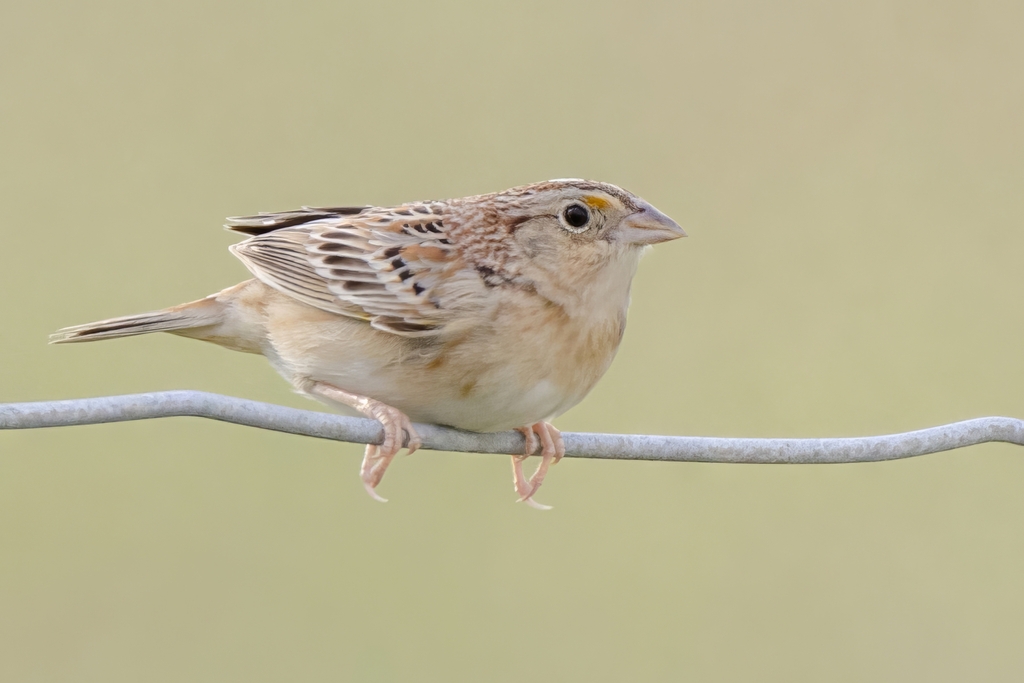
Grasshopper Sparrow
Live sightings near you, the range map, bar charts of when it is seen, and Macaulay Library photos and recordings.
Grasshopper Sparrow
Ammodramus savannarum
The grasshopper sparrow (Ammodramus savannarum) is a small New World sparrow. It belongs to the genus Ammodramus, which contains three species that inhabit grasslands and prairies. Grasshopper sparrows are sometimes found in crop fields and they will readily colonize reclaimed grassland. In the core of their range, grasshopper sparrows are dependent upon large areas of grassland where they avoid trees and shrubs. They seek out heterogenous patches of prairie that contain clumps of dead grass or other vegetation where they conceal their nest, and also contain barer ground where they forage for insects (especially grasshoppers), spiders, and seeds. Grasshopper sparrows are unusual among New World sparrows in that they sing two distinct song types, the prevalence of which varies with the nesting cycle. The primary male song, a high trill preceded by a stereotyped series of short chips, is reminiscent of the sounds of grasshoppers and is the origin of this species' name. Like some other birds of the central North American grasslands, this species also moves around a lot, not only via annual migrations, but individuals frequently disperse between breeding attempts or breeding seasons. Grasshopper sparrows are in steep decline across their range, even in the core of the breeding distribution in the tallgrass prairies of the central Great Plains. The Florida grasshopper sparrow (Ammodramus savannarum floridanus) is highly endangered.
From the article Grasshopper sparrow on Wikipedia (CC BY-SA), quoted section by section
Description
These small sparrows measure 10–14 cm (3.9–5.5 in) in length, span about 17.5 cm (6.9 in) across the wings and weigh from 13.8 to 28.4 g (0.49 to 1.00 oz), with an average of 17 g (0.60 oz). Adults have upper parts streaked with brown, grey, black and white; they have a light brown breast, a white belly and a short brown tail. Their face is light brown with a white eye ring and a dark brown crown with a central narrow light stripe. Adults sport bright yellow feathers at the crook of their underwing, and have a yellow-to-amber patch above their lores. Males and females cannot be distinguished by their plumage, and young birds molt into adult plumage within a few months of fledging.
Range & habitat
Their breeding habitat is open fields and prairie grasslands across southern Canada, the United States, Mexico and Central America, the Caribbean. There is a small endangered population in the Andes of Colombia and (perhaps only formerly) Ecuador. In the central USA, birds are quick to locate newly available habitat, and can be attracted to sites by playing conspecific song. The spatial distribution of territories on the landscape can be clumped with several individuals defending territories near to one another interspersed by large areas of unused and apparently suitable habitat. The reasons for this clumping are elusive; aggregation is not related to group defense against predators or brood parasite, cooperative care, extra-pair matings, or kin selection. Appropriate habitat is strongly influenced by plant structure and precipitation amounts during previous seasons. Grasshopper sparrows avoid woody vegetation, and in the wetter parts of their range, prefer fields that are burned every 2–3 years (which reduces encroachment of trees and shrubs) and seek out areas that are moderately grazed by cattle or bison.
Wikipedia: “Distribution and habitat”
Listen
Looking for field recordings…
Where it lives
Recorded sightings
—
geo-referenced records in GBIF, from museums, herbaria and field observers.
Drag the globe to turn it. Dots are where records exist, not a range map; darker means more records.
In the stacks
Searching the stacks…
Every page naming Ammodramus savannarum in the Biodiversity Heritage Library →
This page is assembled live from iNaturalist, GBIF, Wikipedia, the Source Library and the Internet Archive. It is not yet part of the hand-edited codex. iNaturalist taxon 10139.