- Animals
- ›Chordates
- ›Vertebrates
- ›Ray-finned Fishes
- ›Spiny-rayed fishes
- ›Butterflyfishes, Angelfishes, and Allies
- ›Angelfishes
- ›Genicanthus
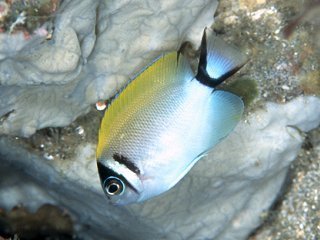
Masked Swallowtail Angelfish
Genicanthus semifasciatus
Genicanthus semifasciatus, the Japanese swallow, is a species of marine ray-finned fish, a marine angelfish, belonging to the family Pomacanthidae. It is found in the Western Pacific.
From the article Genicanthus semifasciatus on Wikipedia (CC BY-SA), quoted section by section
Description
Genicanthus semifasciatus is sexually dichromatic; the males and females show different colouration and patterning. The male has a yellow head and anterior flanks with a darker yellow dorsal area which is marked with dusky vertical bars. The dorsal area of females is greyish brown and white ventrally, with a yellow margin to the dorsal fin with a black head and caudal fin, and black on the head and tail. In both sexes the forked tail narrows at its base to create a "swallow tail". The dorsal fin contains 15 spines and 15–16 soft rays while the anal fin has 3 spines and 17 soft rays. This species attains a maximum total length of 21 centimetres (8.3 in).
Range & habitat
Genicanthus semifasciatus is found in the Western Pacific Ocean. Here it is found from southern Japan, including the Ogasawara Islands, the Izu Islands and the Ryukyu Islands, to the northern Philippines.
Wikipedia: “Distribution”
Where it lives
Recorded sightings
—
geo-referenced records in GBIF, from museums, herbaria and field observers.
Drag the globe to turn it. Dots are where records exist, not a range map; darker means more records.
In the stacks
Searching the stacks…
Every page naming Genicanthus semifasciatus in the Biodiversity Heritage Library →
This page is assembled live from iNaturalist, GBIF, Wikipedia, the Source Library and the Internet Archive. It is not yet part of the hand-edited codex. iNaturalist taxon 101337.