On eBird ↗
Crested Oropendola
Live sightings near you, the range map, bar charts of when it is seen, and Macaulay Library photos and recordings.
Crested Oropendola
Psarocolius decumanus
The crested oropendola also known as the Suriname crested oropendola or the cornbird (Psarocolius decumanus) is a New World tropical icterid bird. It is a resident breeder in lowland South America east of the Andes, from Panama and Colombia south to northern Argentina, as well as on Trinidad and Tobago. If the genus Gymnostinax for the Montezuma oropendola and its closest relatives were considered valid, this species would probably belong in that genus (Price & Lanyon...
From the article Crested oropendola on Wikipedia (CC BY-SA), quoted section by section
Description
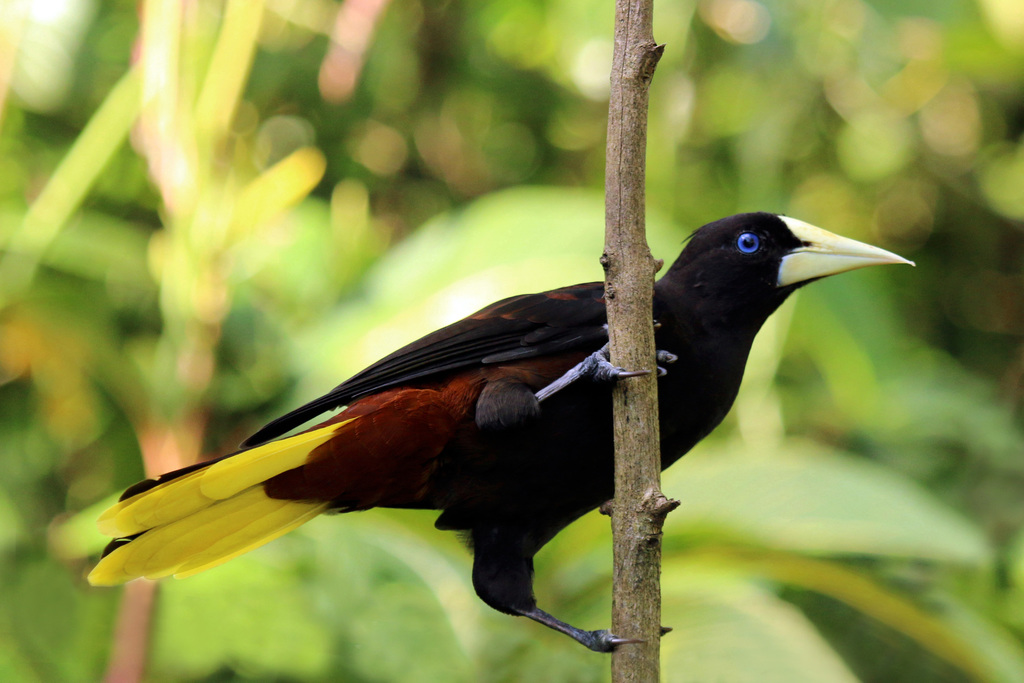
Male crested oropendolas of the nominate subspecies P. d. decumanus average 47 cm (19 in) long and females 37 cm (15 in). Males weigh about 285 g (10 oz) and females about 160 g (5.6 oz). Adult males have long feathers on their nape that form a crest. They are mostly a slightly glossy black with a chesnut rump, uppertail coverts, and undertail coverts. Their central pair of tail feathers are black and the rest yellow. Adult females are overall duller than males; they are brownish tinged rather than pure black and have a minimal crest. Both sexes have a large ivory to pale yellow bill with a swollen casque, a blue iris, and black legs and feet. Juveniles are similar to adult females but even duller; their eyes are dark brownish and their bill has a brown tinge. Subspecies P. d. melanterus is a glossier black and has less chestnut than the nominate. P. d. insularis is smaller than the nominate and has chestnut flanks and belly. P. d. maculosus is very like the nominate but often has pale yellow feathers scattered throughout its body. Some individuals of the nominate also show this trait.
Range & habitat
The subspecies of the crested oropendola are found thus:
P. d. melanterus: from extreme southern Costa Rica south through Panama into northern and central Colombia west of the country's Eastern Andes P. d. insularis: Trinidad and Tobago P. d. decumanus: from Colombia east of the Andes across Venezuela (but see below) and the Guianas; south through eastern Ecuador into Peru to the Amazon River, and most of Brazil except the far east P. d. maculosus: Peru south of the Amazon, northern and eastern Bolivia, most of Paraguay, northwestern Argentina's Jujuy and Salta provinces, and northeastern Argentina's Formosa and Corrientes provinces The range of P. d. decumanus in Venezuela is uncertain. There it is well known north of the Orinoco River and near the Guianas, is a straggler to the llanos, and is probably present but not known in the central part of the country. The exact division of ranges between P. d. decumanus and P. d. maculosus is vague except in Peru. The crested oropendola inhabits a variety of landscapes but is not regularly found in extensive primary forest. It favors the edges and clearings of primary forest in the tropical, subtropical, and lower montane zones, gallery forest especially in the Pantanal, savanna, and coffee and cacao plantations with large trees. In its tiny Costa Rican range it occurs between 100 and 1,500 m (300 and 4,900 ft). …
Wikipedia: “Distribution and habitat”
What it does
The crested oropendola feeds primarily on wild and cultivated fruits, insects, and spiders. Small vertebrates such as tree-frogs and the nectar of flowers are smaller components of its diet. It feeds mostly in flocks of its own species in the upper levels of the forest but sometimes joins mixed-species feeding flocks that include other icterids and jays (Corvidae). It is persecuted as an agricultural pest in Trinidad, Venezuela, and some other areas.
Wikipedia: “Feeding”
Listen
Looking for field recordings…
Where it lives
Recorded sightings
—
geo-referenced records in GBIF, from museums, herbaria and field observers.
Drag the globe to turn it. Dots are where records exist, not a range map; darker means more records.
In the stacks
Searching the stacks…
Every page naming Psarocolius decumanus in the Biodiversity Heritage Library →
This page is assembled live from iNaturalist, GBIF, Wikipedia, the Source Library and the Internet Archive. It is not yet part of the hand-edited codex. iNaturalist taxon 10126.