- Animals
- ›Chordates
- ›Vertebrates
- ›Ray-finned Fishes
- ›Spiny-rayed fishes
- ›Rivulines, Killifishes, and Livebearers
- ›Cyprinodontoidei
- ›Topminnows
- ›Fundulus
- ›Fundulus
- ›Fundulus heteroclitus
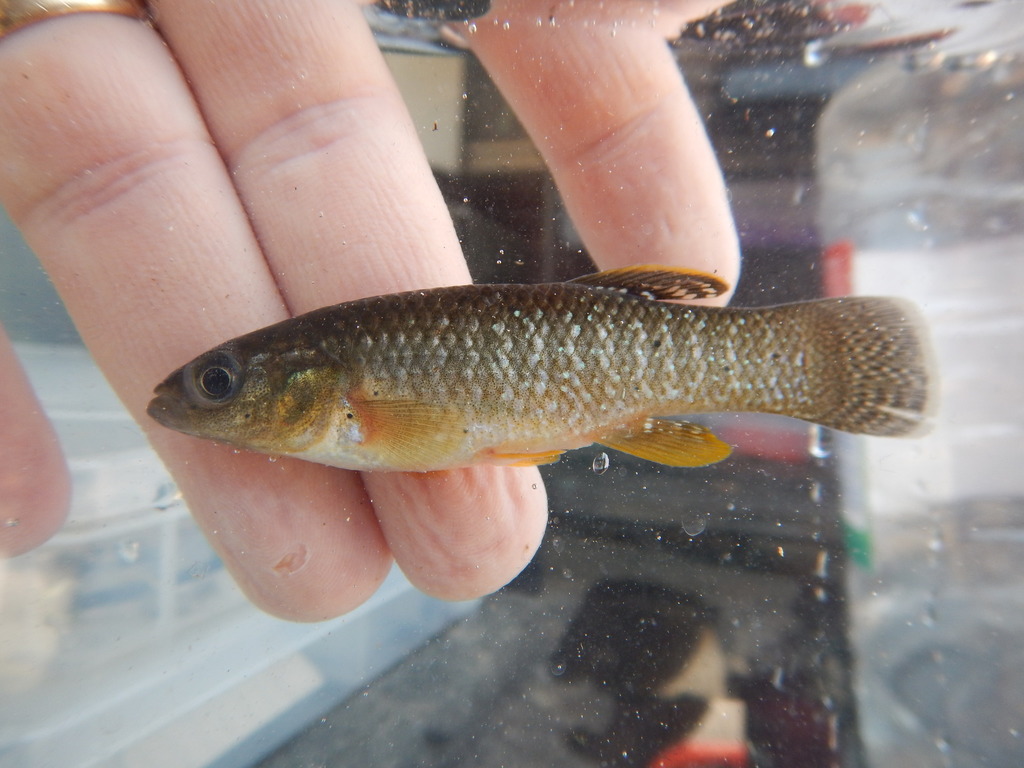
Gulf Killifish
Fundulus grandis
The Gulf killifish (Fundulus grandis) is one of the largest members of the genus Fundulus; it is capable of growing up to 7 inches (18 cm) in length, whereas the majority of other Fundulus reach a maximum length of 4 inches (10 cm). Therefore, F. grandis is among the largest minnows preyed upon by many sport fish, such as flounder, speckled trout (Cynoscion nebulosus), and red drum (Sciaenops ocellatus). Fundulus derives from the Latin meaning "bottom," and grandis means "large". The Gulf killifish is native to the Gulf of Mexico from Texas to Florida and the eastern coast of Florida and the Caribbean Sea in the Atlantic Ocean. Threats to the survival of the Gulf killifish include extreme changes in salinity, changes in temperatures, and toxic events such as the hypoxic dead zone in Louisiana and the Deepwater Horizon oil spill. The Gulf killifish is currently being used to test the effects of oil and oil dispersants on the physiology of marine species affected by these substances. This is significant to conservation biology, because with the continued extraction of oil and other natural resources from North American waters, it has become increasingly important to understand the risks and consequences in worst-case scenarios, such as the Deepwater Horizon oil spill, and the lasting effects on the marine ecosystem.
From the article Gulf killifish on Wikipedia (CC BY-SA), quoted section by section
Range & habitat
The Gulf killifish is found in the Atlantic Ocean, the Gulf of Mexico, and the Caribbean Sea, and over the Southeast United States Continental Shelf. The normal range of Gulf killifish is from Texas to the western coast of Florida and from the east coast of Florida and throughout the Caribbean. These waters undergo several changes in water characteristics such as temperature, dissolved oxygen, and salinity, among many other variables that can have profound effects on the survival and abundance of the Gulf killifish.
Wikipedia: “Distribution”
Toxicity
F. grandis populations in the highly polluted waters of the Houston Ship Channel were recently found to have adapted to resist the effects of the pollution. This resistance confers protection to embryos of these populations from cardiac teratogenesis (developmental deformities in the heart) compared to embryos from reference and un-contaminated populations. Further, the adapted populations of Gulf killifish seem to also be more resistant to pesticides, oxidative stress, and have a higher metabolism, which could be stemming from the strong selection that these organisms have been under to develop resistance to strong contamination. This strong resistance and cross-resistance suggests the role of adaptation to anthropogenic contaminants in this environment. Such events are widespread in many fish species and populations.
Wikipedia: “Gulf killifish evolution to toxic environments”
Where it lives
Recorded sightings
—
geo-referenced records in GBIF, from museums, herbaria and field observers.
Drag the globe to turn it. Dots are where records exist, not a range map; darker means more records.
In the stacks
Searching the stacks…
Every page naming Fundulus grandis in the Biodiversity Heritage Library →
This page is assembled live from iNaturalist, GBIF, Wikipedia, the Source Library and the Internet Archive. It is not yet part of the hand-edited codex. iNaturalist taxon 101057.