 NL·0597
Herbarium of the Nature Library
- Name
- Junco hyemalis
- Family
- Passerellidae
- Native to
- Breeds across Canada, Alaska and the mountains of the western and north-eastern US; winters throughout most of the US and northern Mexico
- Habitat
- Boreal forest, Montane coniferous forest, Woodland edge, Gardens
On eBird ↗
Dark-eyed Junco
Live sightings near you, the range map, bar charts of when it is seen, and Macaulay Library photos and recordings.
Dark-eyed junco
Junco hyemalis
Also calledJunco ojo oscuro (Spanish) · Junco ardoisé (French) · Snowbird (American English)
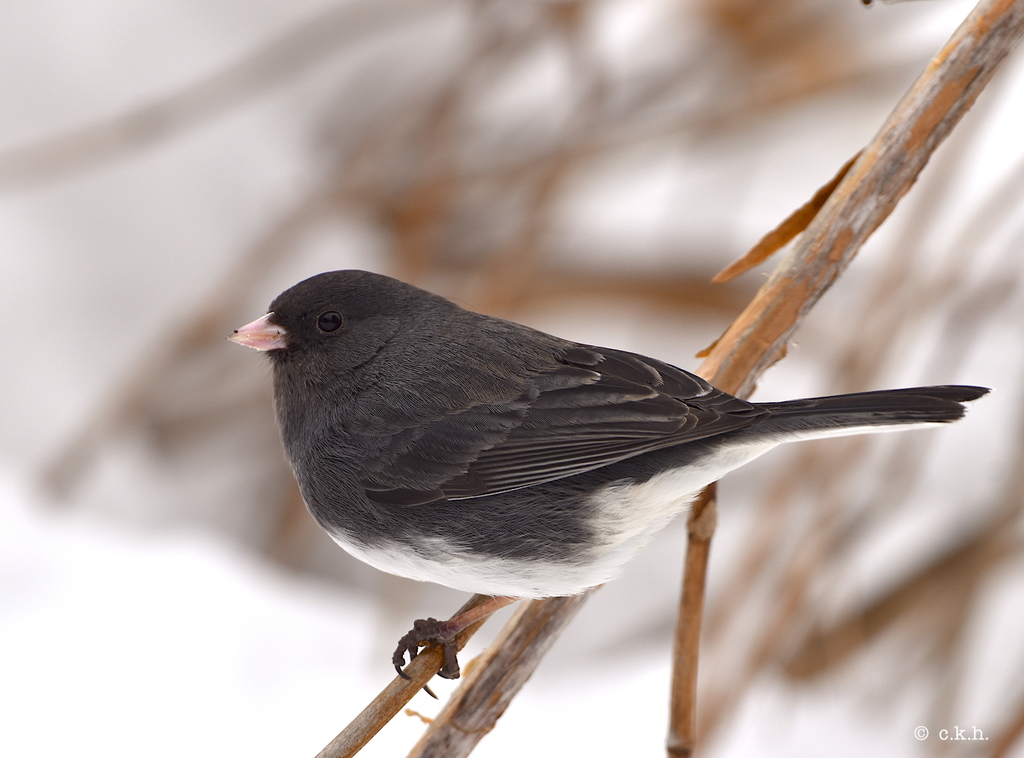
A neat, grey-hooded sparrow whose arrival at feeders signals winter across much of the US — hence the nickname 'snowbird'. Its many regional forms evolved strikingly different colours in only the last several thousand years.
The dark-eyed junco is a species of junco, a group of small, grayish New World sparrows. The species is common across much of temperate North America and in summer it ranges far into the Arctic. It is a variable species, much like the related fox sparrow, and its systematics are still not completely resolved. Wikipedia
What it can do
- iFlashes white outer tail feathers in flight, a signal used in both courtship and alarm
- iiHas diversified into distinct forms — Slate-colored, Oregon, Pink-sided, White-winged, Gray-headed — since the last glaciation
- iiiHas colonised urban habitats; a population in San Diego evolved less white in the tail within a few decades
In the field
Field marks
- aSlate-grey or black hood with a pale pink bill
- bWhite belly sharply cut off from the dark breast
- cBright white outer tail feathers flashed in flight
- dWestern 'Oregon' form has a black hood and brown back
- Voice
- A musical trill on one pitch, like a Chipping Sparrow but more ringing; calls a sharp 'tack' and twittering in flight.
- Not to be confused with
- Yellow-eyed Junco (south-eastern Arizona and Mexico) has yellow eyes and a rufous back. Eastern Towhee is larger with rufous sides. Chipping Sparrow's trill is drier and faster.
- Where to see it
- Winter feeders and woodland edges across the US; breeding in the Appalachians, Rockies, Sierra Nevada and boreal Canada.
- When
- Winter visitor (Oct–Apr) in most of the US; resident in western and Appalachian mountains
Listen
Looking for field recordings…
Life & habits
- Diet
- Seeds of grasses and weeds; insects in summer
- Habitat
- Coniferous and mixed forest when breeding; open woods, fields and gardens in winter
- Size
- 13–17 cm; 18–30 g
- Lifespan
- Banding record about 11 years
Wintering flocks keep a pecking order, and birds of different forms often mix at the same feeder.
Where it lives
Recorded sightings
—
geo-referenced records in GBIF, from museums, herbaria and field observers.
Native range
Breeds across Canada, Alaska and the mountains of the western and north-eastern US; winters throughout most of the US and northern Mexico
Drag the globe to turn it. Dots are where records exist, not a range map; darker means more records.
In the old herbals & bestiaries
Woodcuts and engravings matched from the Source Library’s scanned books by name. Plates marked “relative” show a close kin rather than this exact species. Click a plate to read the page it came from, with translation.

In the stacks
Searching the stacks…
Every page naming Junco hyemalis in the Biodiversity Heritage Library →
Marginalia
Curiosity
Its species name hyemalis means 'of winter'.
Kinship
- kingdomAnimalia
- ›phylumChordata
- ›subphylumVertebrata
- ›classAves
- ›orderPasseriformes
- ›familyPasserellidae
- ›genusJunco
Neighbours on the shelf
Photographs: iNaturalist contributors under the licences shown. Records: GBIF.org. Historical plates: Source Library (CC BY-SA 4.0; originals public domain). Summary text: Nature Library editors and Wikipedia (CC BY-SA). Medicinal and edibility notes are historical and educational, not advice. iNaturalist taxon 10094.