- Animals
- ›Chordates
- ›Vertebrates
- ›Reptiles
- ›Snakes and Lizards
- ›Lizards
- ›Skinks and allies
- ›Skinks
- ›Mabuyas
- ›Eutropis
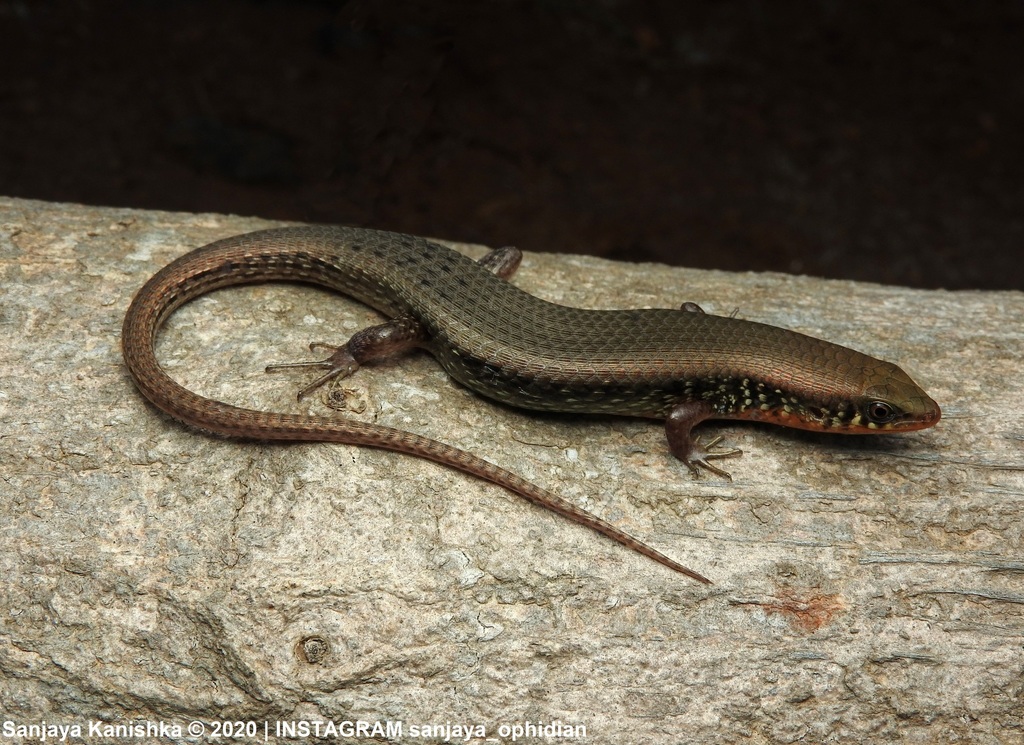
Tammanna Skink
Eutropis tammanna
Eutropis tammanna (Tammanna skink) is a species of skink endemic to the island of Sri Lanka.
From the article Eutropis tammanna on Wikipedia (CC BY-SA), quoted section by section
Description
The snout is short. It lacks transparent disks on the lower eyelids. Post-nasalia are absent. There are 15 lamellae under the fourth toe. Dorsal scales have 4–5 keels. The dorsum is medium brown, and the lips are bright orange in males and yellow in females, the color extending to the middle of the flanks. A black stripe extends from below the eye to beyond the base of tail, with large, creamy-yellow spots; in females, this stripe is paler. The venter is yellowish cream.
Range & habitat
It is a terrestrial skink found in open grasslands, coconut and cashew plantations, house gardens, and agricultural fields. It is widespread at elevations less than 200 m (660 ft).
Wikipedia: “Habitat and distribution”
What it does
It is a typically diurnal lizard, found under heaps of forest debris, leaves, logs, in shrubs and bushes, as well as near plantation and farm refuse, such as coconut husk piles. It lives generally at sea level, and close to beaches. The diet typically consists of invertebrates that will fit into its mouth and that it can effectively swallow, including a variety of small cockroaches, beetles, beetle larvae (grubs), moths and their larvae, crickets, small grasshoppers, and earthworms, among other bugs and invertebrates. Larger specimens may potentially cannibalise juveniles, out of dominance, and may also be a threat to juvenile lizards belonging to other species. They may very seldomly prey upon tiny froglets and small or recently-born snakes, although insects and arthropods still make up the bulk of their diet.
Wikipedia: “Ecology and diet”
Where it lives
Recorded sightings
—
geo-referenced records in GBIF, from museums, herbaria and field observers.
Drag the globe to turn it. Dots are where records exist, not a range map; darker means more records.
In the stacks
Searching the stacks…
Every page naming Eutropis tammanna in the Biodiversity Heritage Library →
This page is assembled live from iNaturalist, GBIF, Wikipedia, the Source Library and the Internet Archive. It is not yet part of the hand-edited codex. iNaturalist taxon 100814.