On eBird ↗
Pectoral Sparrow
Live sightings near you, the range map, bar charts of when it is seen, and Macaulay Library photos and recordings.
Pectoral Sparrow
Arremon taciturnus
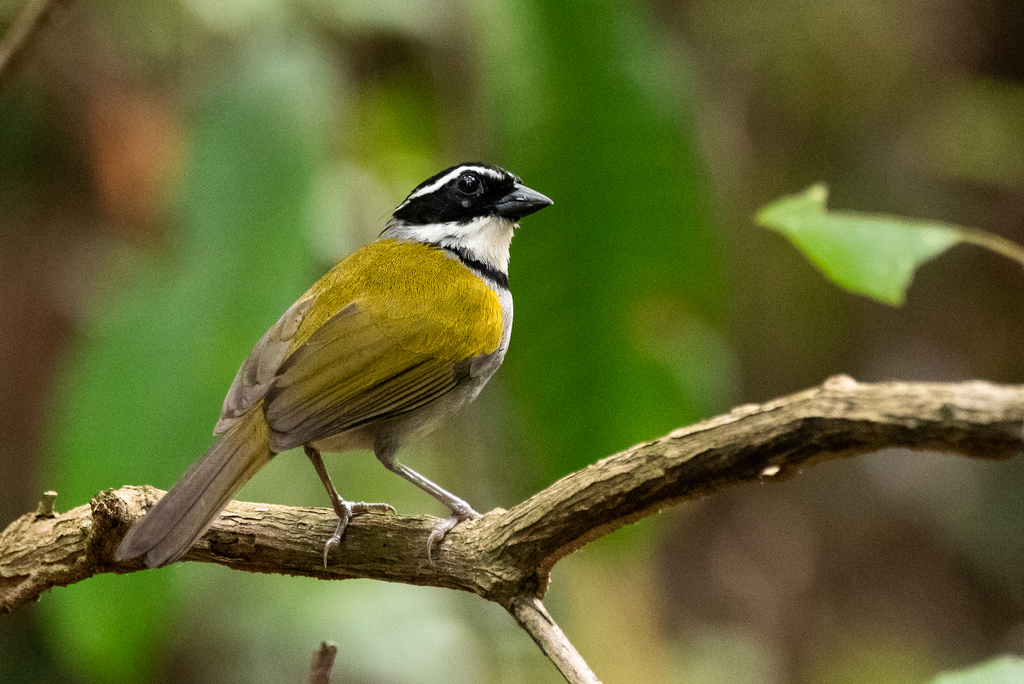
The pectoral sparrow (Arremon taciturnus) is a small species of New World sparrow first described in 1779 by Georges-Louis Leclerc. It has two subspecies. Like other sparrows in its family Arremon, it has pale green-to-olive wings, a distinctive black band going across its breast (in subspecies nigrirostris the band is not continuous and instead breaks in the center). It is found throughout southeastern South America, in subtropical or tropical moist lowland forests. The phenology of its breeding is unknown, however it has been observed nest building as early as August and as late as December. Incubation takes 15–17 days, however the duration of the nestling and fledgling stages are unknown due to a lack of research. It is omnivorous, mainly eating insects and seeds, and is considered a least-concern species by BirdLife International due to its large population and range.
From the article Pectoral sparrow on Wikipedia (CC BY-SA), quoted section by section
Description
The pectoral sparrow is sexually dimorphic, and, as the name implies, sparrow-sized, at 15 cm (5.9 in) in length and 24 g (0.85 oz) in weight. Its upperparts are pale green, becoming yellow near the bend of the wing. The head is black, with white on its throat and as stripes on its crown. Its underparts are white in males and creamy in females, with males also having a broad black band going across its breast (a pectoral band). The beak is also black, roughly 14–15 mm (0.55–0.59 in) long for both males and females. Tails are 58–60 and 64–67 mm (2.3–2.4 and 2.5–2.6 in) and wings are 74–75 and 76–80 mm (2.9–3.0 and 3.0–3.1 in) for males and females respectively. Its iris is brown, and its tarsi and toes are pinkish gray. Male and female plumage are different, with females having dull olive upperparts instead of bright yellow, are a grayish pectoral band. The pectoral sparrow is fairly unique in its habitat, usually being the only small forest sparrow with a striped head in its range. It can be differentiated from the orange-billed sparrow, which it borders distribution with in eastern Columbia, by the namesake orange bill, as well its inverted throat colors (black throat with a white stripe).
Range & habitat
The pectoral sparrow is non-migratory and can be found everywhere in the Amazon Basin east of the Andes except for the western parts between the Negro and Purus rivers. Besides the Amazon jungle, it is found in eastern and north-eastern Brazil. It occupies altitudes up to 1,500 m (4,900 ft) in southern Venezuela, 1,000 m (3,300 ft) in southeastern Peru, and 1,300 m (4,300 ft) in Bolivia. It occupies the lowland undergrowths of humid evergreen forests or secondary forests, and infrequently in lighter woodlands or coffee plantations, often when near humid wooded ravines. Pair density in Peru was reported to be about 1 pair per 200 hectares (490 acres).
Wikipedia: “Distribution and habitat”
What it does
Feeding behavior is not well studied. The pectoral sparrow has been observed foraging on the ground, mainly eating insects and seeds, and to a lesser extent various fruits. Studies on stomach contents in Brazil and Suriname showed various beetles, true bugs and ants, along with other insects and a small amount of grass and seeds. Adults have been observed bringing insect limbs to the nest for feeding.
Wikipedia: “Feeding”
Listen
Looking for field recordings…
Where it lives
Recorded sightings
—
geo-referenced records in GBIF, from museums, herbaria and field observers.
Drag the globe to turn it. Dots are where records exist, not a range map; darker means more records.
In the stacks
Searching the stacks…
Every page naming Arremon taciturnus in the Biodiversity Heritage Library →
This page is assembled live from iNaturalist, GBIF, Wikipedia, the Source Library and the Internet Archive. It is not yet part of the hand-edited codex. iNaturalist taxon 10065.