On eBird ↗
Golden-winged Sparrow
Live sightings near you, the range map, bar charts of when it is seen, and Macaulay Library photos and recordings.
Golden-winged Sparrow
Arremon schlegeli
The Golden-winged sparrow (Arremon schlegeli) is a species of bird in the family Passerellidae that can found in Colombia and Venezuela. Its natural habitats are subtropical or tropical dry forests and subtropical or tropical dry shrubland.
From the article Golden-winged sparrow on Wikipedia (CC BY-SA), quoted section by section
Description
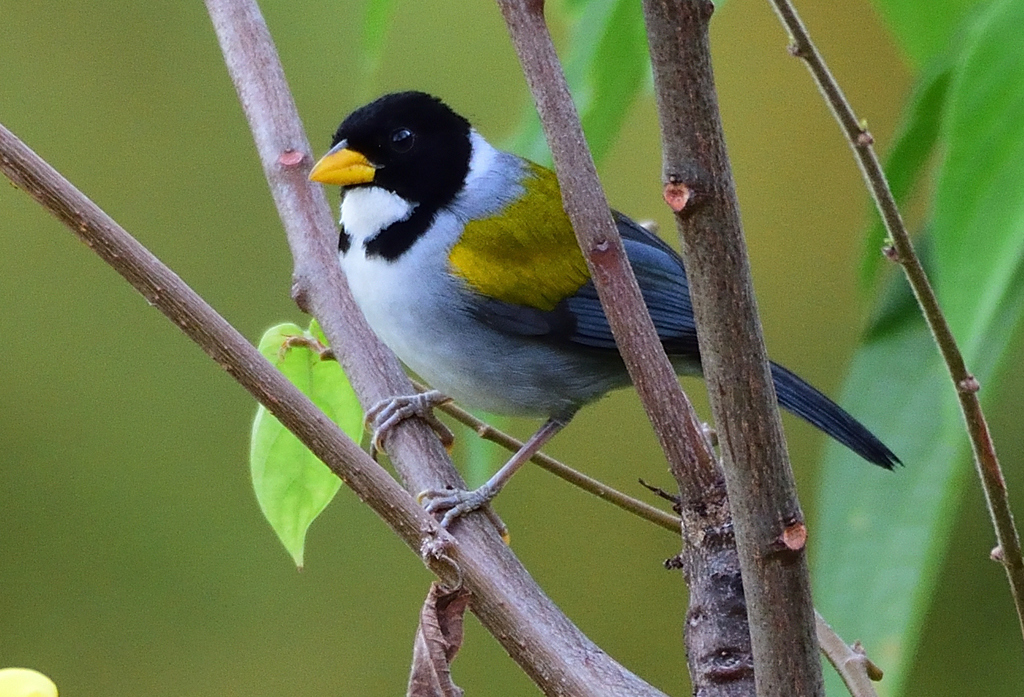
The Golden-winged sparrow can be identified by its black head, long yellow bill, gray upperparts, and a patch of green on its back. The Golden-winged sparrow is the only sparrow in its range with a completely black head. Their eyes are either brown or black. The bills of adults are yellow and the bills of juveniles are black. A male Golden-winged sparrow's face, malar, and chin are black. It has a white throat, gray nape, and green on its back. A female Golden-winged sparrow has buffier underparts. The average length of a Golden-winged sparrow is 150 mm. Females weigh approximately 23g, and males weigh approximately 32g.
Wikipedia: “Characteristics”
Range & habitat
The Golden-winged sparrow lives in a terrestrial ecosystem. Its habitats include subtropical or tropical dry forests and shrubland, and subtropical or tropical heavily degraded former forest, either artificial or terrestrial. The Golden winged sparrow also lives in woodlands or dry areas from the lowlands up to 1400 meters. Within these habitats, they reside in forests, second-growth, thickets, ravines, and hillsides.
Wikipedia: “Habitat”
What it does
Golden-winged sparrows feed on or above the ground on seeds, fruit, and insects. They forage both alone and in pairs, in forests with second growth and dry to humid weather. The species breeds during the wet season due to an increase in singing activity. The song of Golden-winged sparrows is commonly heard early in the morning during April and May. Their song is a high-pitched series of repeated notes, which have been described as the repetition of "Zeut-zeut-zeut-zee" or "Soot-soot-soot-see".
Wikipedia: “Behavior”
Listen
Looking for field recordings…
Where it lives
Recorded sightings
—
geo-referenced records in GBIF, from museums, herbaria and field observers.
Drag the globe to turn it. Dots are where records exist, not a range map; darker means more records.
In the stacks
Searching the stacks…
Every page naming Arremon schlegeli in the Biodiversity Heritage Library →
This page is assembled live from iNaturalist, GBIF, Wikipedia, the Source Library and the Internet Archive. It is not yet part of the hand-edited codex. iNaturalist taxon 10063.