- Animals
- ›Chordates
- ›Vertebrates
- ›Ray-finned Fishes
- ›Spiny-rayed fishes
- ›Perches, Scorpionfishes, Sticklebacks, and Allies
- ›Perches, groupers and allies
- ›Perches, Darters, and allies
- ›Darters
- ›Etheostoma
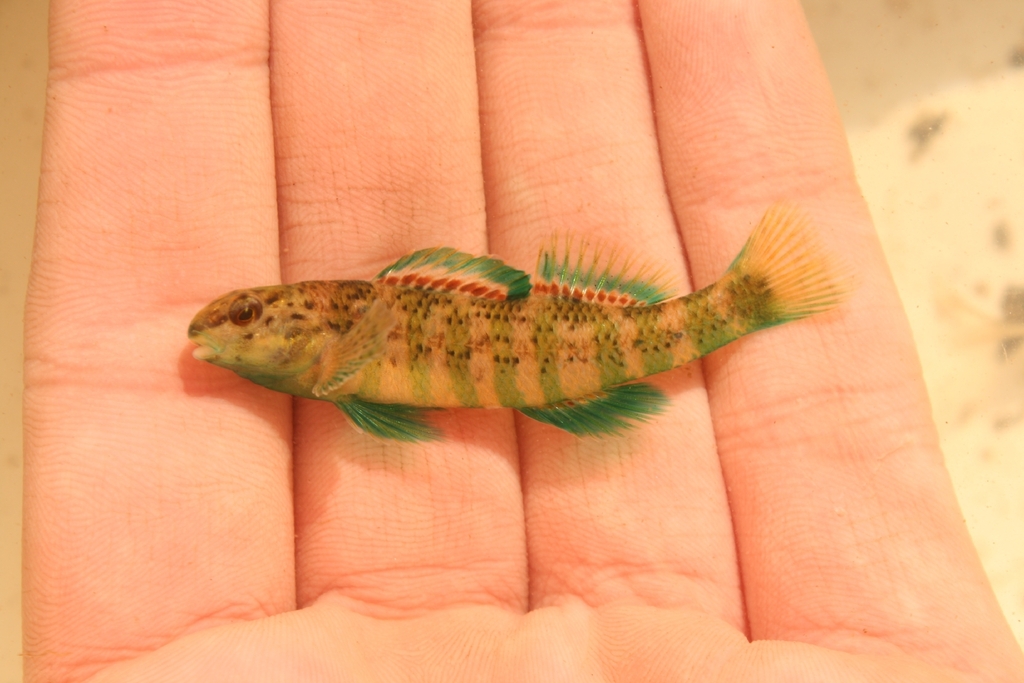
Brighteye Darter
Etheostoma lynceum
The brighteye darter (Etheostoma lynceum) is a species of freshwater ray-finned fish, a darter from the subfamily Etheostomatinae, part of the family Percidae, which also contains the perches, ruffes and pikeperches. It is endemic to the eastern United States. The brighteye darter was first described by Oliver Perry Hay in 1885. He noted it is closely related to the banded darter (E. zonale). Until the 1970s, the brighteye darter was generally believed to be a genetic variation of the banded darter.
From the article Brighteye darter on Wikipedia (CC BY-SA), quoted section by section
Range & habitat
The brighteye darter inhabits the lower, benthopelagic areas of freshwater streams and rivers. The brighteye darter is distributed in eastern tributaries of the Mississippi River from Louisiana north to western Tennessee and eastward along the Gulf Coast to the Escatawpa River system in Mobile County. It can also be found in the former Mississippi embayment in the western part of Kentucky, and in coastal drainages from the Escatawpa River in Alabama to the Mississippi River in Louisiana. Rechannelization may have extirpated them from some of their natural ranges into Alabama, but brighteye darters have been able to find more suitable streams as they travel up the Mississippi River system.
Wikipedia: “Distribution”
What it does
The brighteye darter feeds primarily on invertebrates, mainly flies in the family Chironomidae. The larval stages of these flies are an important component of the bottom of the aquatic ecosystem in which the brighteye darter resides. The darter will watch for the larval stage to erupt from its egg casing and eat it before it has time to swim off. These flies hatch year-round and make up 75–80% of the darters' diets. In comparison to other darters to which the brighteye is related, it does not change food source from season to season. Other darters, such as the blackbanded darter (Percina nigrofasciata), can change their diets with every season, thus having much more diverse diets. The brighteye darter prefers clear, fast-flowing water, with gravel riffles. This type of habitat can be found in several places around the Mississippi River Basin.
Wikipedia: “Ecology”
In human culture
The brighteye darter was first formally described in 1885 by the American ichthyologist Oliver Perry Hay (1846–1939) with the type locality given as a shallow rocky branch of the Chickasawha River at Enterprise, Clarke County, Mississippi. The specific name lynceum refers to Lynceus of Messenia, one of the Argonauts who took part in a mythical voyage on board the Argo with Jason. Lynceus was known for his acute vision.
Wikipedia: “Taxonomy and etymology”
Where it lives
Recorded sightings
—
geo-referenced records in GBIF, from museums, herbaria and field observers.
Drag the globe to turn it. Dots are where records exist, not a range map; darker means more records.
In the stacks
Searching the stacks…
Every page naming Etheostoma lynceum in the Biodiversity Heritage Library →
This page is assembled live from iNaturalist, GBIF, Wikipedia, the Source Library and the Internet Archive. It is not yet part of the hand-edited codex. iNaturalist taxon 100501.