- Animals
- ›Chordates
- ›Vertebrates
- ›Ray-finned Fishes
- ›Spiny-rayed fishes
- ›Perches, Scorpionfishes, Sticklebacks, and Allies
- ›Perches, groupers and allies
- ›Perches, Darters, and allies
- ›Darters
- ›Etheostoma
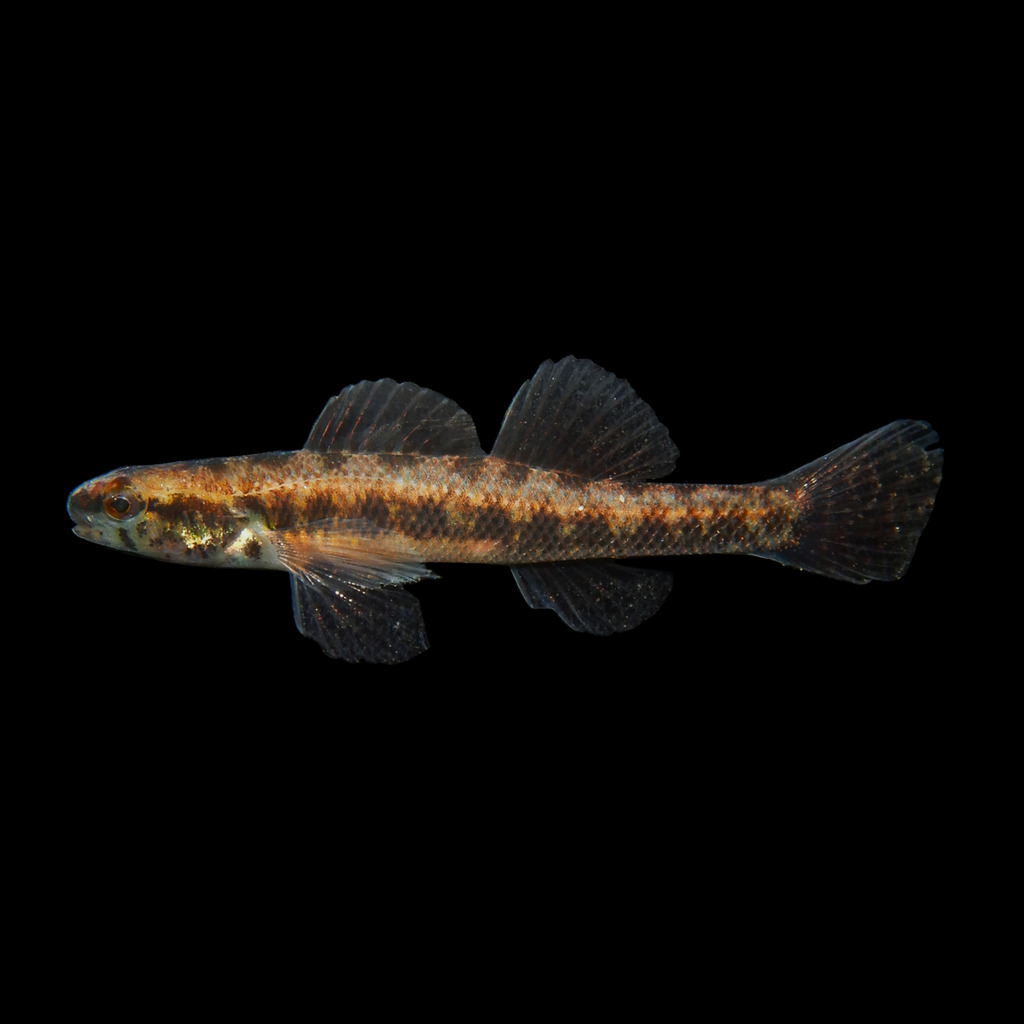
Swamp Darter
Etheostoma fusiforme
The swamp darter (Etheostoma fusiforme) is a species of freshwater ray-finned fish, a darter from the subfamily Etheostomatinae, part of the family Percidae, which also contains the perches, ruffes and pikeperches. It is endemic to the Eastern United States.
From the article Swamp darter on Wikipedia (CC BY-SA), quoted section by section
Description
This species can reach a length of 5.9 cm (2.3 in), though most are only about 4 cm (1.6 in). It has a narrow, laterally compressed body with a rounded head and a blunt, conical snout which does not extend past the upper lips. The lateral line curves slightly upwards towards the tail. In color they are green to tan dorsally with small dark saddles and dark green and brown mottling. There are 10–12 square-shaped markings on the flanks. The underparts are white to yellow with numerous black and brown speckles. There is a narrow suborbital bar and 3 dusky black spots on the caudal fin. The rays in the fins are marked with small spots and the spiny part of the male's dorsal fin normally has a dark band at its base and another dark submarginal band. When breeding, the males become darker and tubercles develop on the soft rays of the pelvic and anal fins, the spine in the pelvic fin and frequently grow on the second spine of the anal fin.
Range & habitat
The swamp darter has a wide distribution in the lowlands of the eastern United States, it is generally found below the fall line on the Atlantic and Gulf coastal plains from southern Maine to the Sabine River, Louisiana and the Red River of the South in southeastern Oklahoma. It is also found in the tributaries of the Mississippi River as far north as Kentucky and southeastern Missouri. An introduced swamp darter population is established in the French Broad River system in North Carolina. In New York State the swamp darter only occurs in the Peconic River and in a small number of ponds in the vicinity of that river in eastern Long Island, the swamp darter also extends up the Red River of the South drainage as far as North Texas and Southeastern Oklahoma, where it is rare. No other darter is found as far south as E. fusiforme.
Wikipedia: “Distribution”
In human culture
The swamp darter was first formally described in 1854 as Boleosoma fusiforme by the French biologist Charles Frédéric Girard (1822–1895) with the type locality given as a tributary of Charles River at Framingham, Massachusetts. It has been placed in the subgenus Hololepsis or in the larger Boleichthys. There are two recognised subspecies, although many have been proposed in the past:
E.f. barretti: from the Pee Dee River in South Carolina and including the southern and western parts of its range E.f. fusiforme: the northern Atlantic coastal range from the Waccamaw River, North Carolina as far as Maine The specific name means "spindle shaped" or tapering at each end.
Wikipedia: “Taxonomy and etymology”
Where it lives
Recorded sightings
—
geo-referenced records in GBIF, from museums, herbaria and field observers.
Drag the globe to turn it. Dots are where records exist, not a range map; darker means more records.
In the stacks
Searching the stacks…
Every page naming Etheostoma fusiforme in the Biodiversity Heritage Library →
This page is assembled live from iNaturalist, GBIF, Wikipedia, the Source Library and the Internet Archive. It is not yet part of the hand-edited codex. iNaturalist taxon 100482.