On eBird ↗
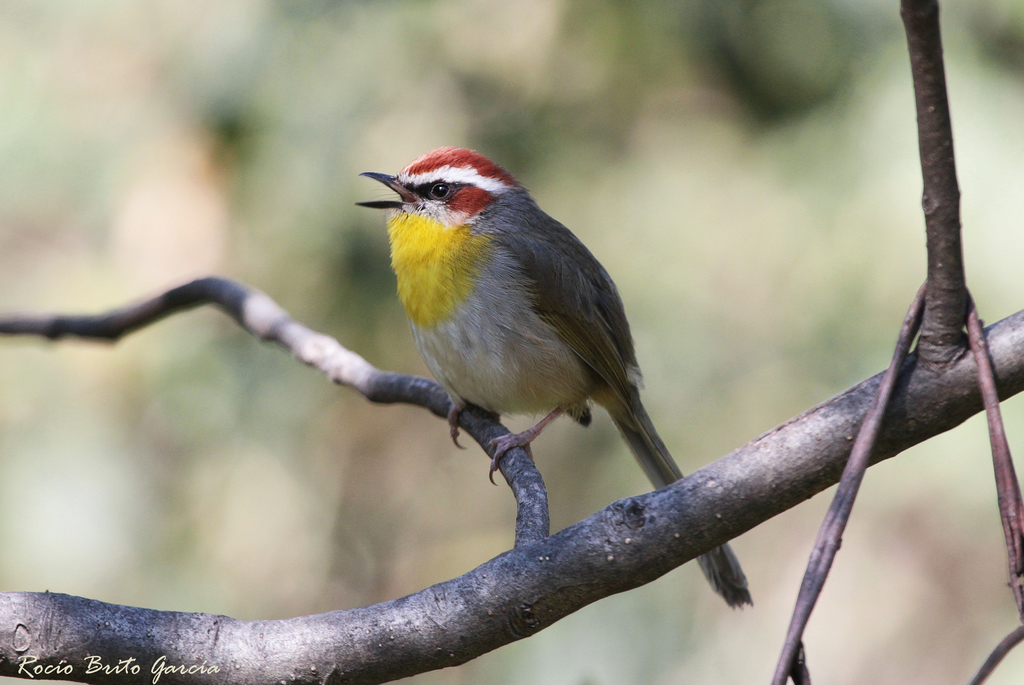
Rufous-capped Warbler
Live sightings near you, the range map, bar charts of when it is seen, and Macaulay Library photos and recordings.
Rufous-capped Warbler
Basileuterus rufifrons
The rufous-capped warbler (Basileuterus rufifrons) is a species of bird in the family Parulidae, the New World warblers. It is found in Belize, Guatemala, and Mexico. It also occurs as a casual visitor to the U. S. states of Arizona and Texas.
From the article Rufous-capped warbler on Wikipedia (CC BY-SA), quoted section by section
Description
The rufous-capped warbler is about 13 cm (5.1 in) long and weighs 7 to 16 g (0.25 to 0.56 oz). The sexes have the same plumage. Adults of the nominate subspecies B. r. rufifrons have a rufous crown and ear coverts with a long white supercilium between them, black lores, and a wide white streak from the lores under the eye and ear coverts. Their nape is grayish and their upperparts olive gray. Their wings and tail are dusky gray with yellow-green edges on the feathers. Their chin is white, their throat and upper breast are lemon yellow, their lower breast and belly are brownish white, and their flanks, vent, and undertail coverts have an olive-buff wash. Juveniles have an olive-brown head with a warmer brown crown. Their upperparts are olive-brown. Their greater and median upperwing coverts have buff tips that show as two wing bars. Their breast is pale olive-buff that becomes yellowish white on the belly and undertail coverts. The other subspecies of the rufous-capped warbler differ from the nominate and each other thus:
B. r. caudatus: second-longest tail; paler rufous on head and duller grayer upperparts than nominate B. r. dugesi: longest tail; like caudatus with slightly more olive upperparts B. r. jouyi: grayer upperparts than nominate B. r. …
Range & habitat
The subspecies of the rufous-capped warbler are found thus:
B. r. caudatus: northwestern Mexico from Sonora and western Chihuahua south to northern Durango (and see below) B. r. dugesi: central Mexico from southern Sinaloa and western Durango south to southern Puebla and western Oaxaca B. r. jouyi: northeastern Mexico from Coahuila, Nuevo León, and western Tamaulipas south to eastern Hidalgo and central Veracruz B. r. rufifrons: southern Mexico and into Guatemala to the Motagua River valley B. r. salvini: Gulf/Caribbean slope from southern Veracruz and northern Oaxaca south to Guatemala and Belize, where it is spottily found Subspecies B. r. caudatus is a regular visitor to southeastern Arizona and to Texas in the Big Bend area, lower Rio Grande Valley, and the Edwards Plateau, and it occasionally has bred in the U. S. The rufous-capped warbler inhabits a variety of somewhat dry and open landscapes including scrublands, open woodlands, hedgerows, young secondary forest, shade coffee plantations, and the edges of mature forest. It shuns the interior of forest. Overall it ranges from sea level to 3,000 m (9,800 ft) but is found between 450 and 2,150 m (1,500 and 7,100 ft) south of Mexico.
Wikipedia: “Distribution and habitat”
What it does
The rufous-capped warbler feeds primarily on insects and other invertebrates but includes small numbers of berries in its diet. It is a deliberate forager, taking most food by gleaning from vegetation in the habitat's lower to mid-level. It sometimes joins mixed-species feeding flocks.
Wikipedia: “Feeding”
Listen
Looking for field recordings…
Where it lives
Recorded sightings
—
geo-referenced records in GBIF, from museums, herbaria and field observers.
Drag the globe to turn it. Dots are where records exist, not a range map; darker means more records.
In the stacks
Searching the stacks…
Every page naming Basileuterus rufifrons in the Biodiversity Heritage Library →
This page is assembled live from iNaturalist, GBIF, Wikipedia, the Source Library and the Internet Archive. It is not yet part of the hand-edited codex. iNaturalist taxon 10045.