- Animals
- ›Chordates
- ›Vertebrates
- ›Ray-finned Fishes
- ›Spiny-rayed fishes
- ›Perches, Scorpionfishes, Sticklebacks, and Allies
- ›Perches, groupers and allies
- ›Perches, Darters, and allies
- ›Darters
- ›Etheostoma
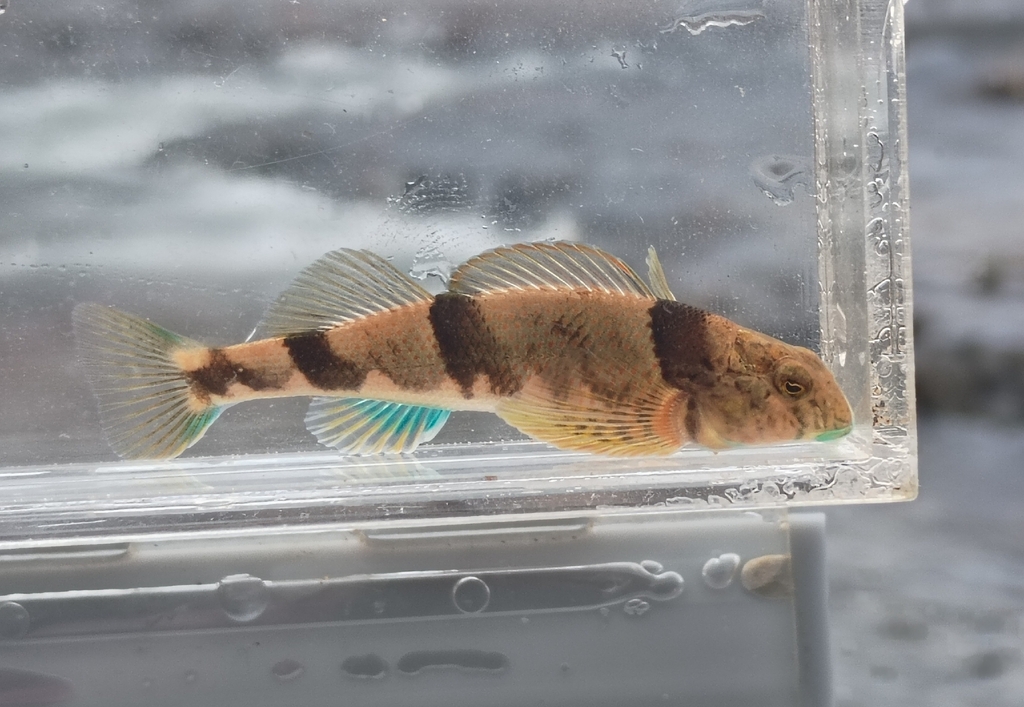
Blenny Darter
Etheostoma blennius
The blenny darter (Etheostoma blennius) is a species of freshwater ray-finned fish, a darter from the subfamily Etheostomatinae, part of the family Percidae, which also contains the perches, ruffes and pikeperches. It is a poorly known species which occurs in Alabama and Tennessee where it inhabits swift riffles.
From the article Blenny darter on Wikipedia (CC BY-SA), quoted section by section
Description
The blenny darter is a moderately-sized but rather robust darter. It has 4 dark saddle like blotches across its back, the anterior blotch being the most distinct and these blotches becoming progressively more indistinct towards the caudal fin. The upper flanks are frequently marked with spots which are occasionally arranged in vertical bars. There is also a series of small partially-fused blotches along the lateral line between the second and fourth saddle blotches. The lower flank is irregularly spotted and the belly is pale. The upper gill cover is dark and contrasts with the pale lower part and cheek. Males have some markings on the breast but females are plain. Males also have a dark margin to the spiny part of the dorsal fin which is not always present in females. The spines in the dorsal fins of female are alternately dark and uncolored whereas all the spines in the males dorsal fin are colorless, the membrane in the dorsal fin being clear in females and spotted in males. The cheek, gill cover and breast are scaleless while the belly and nape are scaled. When spawning the males darken to almost black on the head and the fins become more intensely colored. The maximum published total length is 8.3 centimetres (3.3 in), although around 5.7 centimetres (2.2 in) is more common.
Range & habitat
The blenny darter is native to the southeastern United States and is found in Alabama and Tennessee, in small to large tributaries of the Tennessee River drainage, more specifically the Buffalo, Duck, and Sequatchie Rivers, and White Oak Creek, Tennessee. The species has a more-limited distribution in Alabama and is restricted to Tennessee River tributaries within the Tennessee Valley of the Highland Rim.
Wikipedia: “Distribution”
In human culture
The blenny darter was first formally described in 1887 by the American zoologists Charles Henry Gilbert (1859–1928) and Joseph Swain (1857–1927) with the type locality given as Cox's Creek and tributary of the Tennessee River near Florence, Alabama. There are 51 morphological characteristics which were used to indicate that the Swannanoa darter (E. swannanoa) is the blenny darter's closest relative and E. swannanoa is in a clade called the seagreen darter group after the seagreen darter (E. thalassinum) There are two recognized subspecies:
E. b. blennius occurs in the Buffalo and Duck Rivers, and White Oak Creek. E. b. sequatchiense is limited to Sequatchie River in Tennessee; intergrades between the two subspecies occur throughout their distribution in Alabama and in the Elk River of Tennessee. The generic name Etheostoma is a compound of the Greek etheo meaning "filter or strain" and stoma meaning "mouth" while the specific name blennius refers to the resemblance of this species to a marine blenny. The subspecific name sequatchiense means "of the Sequatchie River".
Wikipedia: “Taxonomy and etymology”
Where it lives
Recorded sightings
—
geo-referenced records in GBIF, from museums, herbaria and field observers.
Drag the globe to turn it. Dots are where records exist, not a range map; darker means more records.
In the stacks
Searching the stacks…
Every page naming Etheostoma blennius in the Biodiversity Heritage Library →
This page is assembled live from iNaturalist, GBIF, Wikipedia, the Source Library and the Internet Archive. It is not yet part of the hand-edited codex. iNaturalist taxon 100448.