- Animals
- ›Arthropods
- ›Hexapods
- ›Insects
- ›Winged and Once-winged Insects
- ›Dragonflies and Damselflies
- ›Damselflies
- ›Coenagrionoid Damselflies
- ›White-legged damselflies
- ›Esme
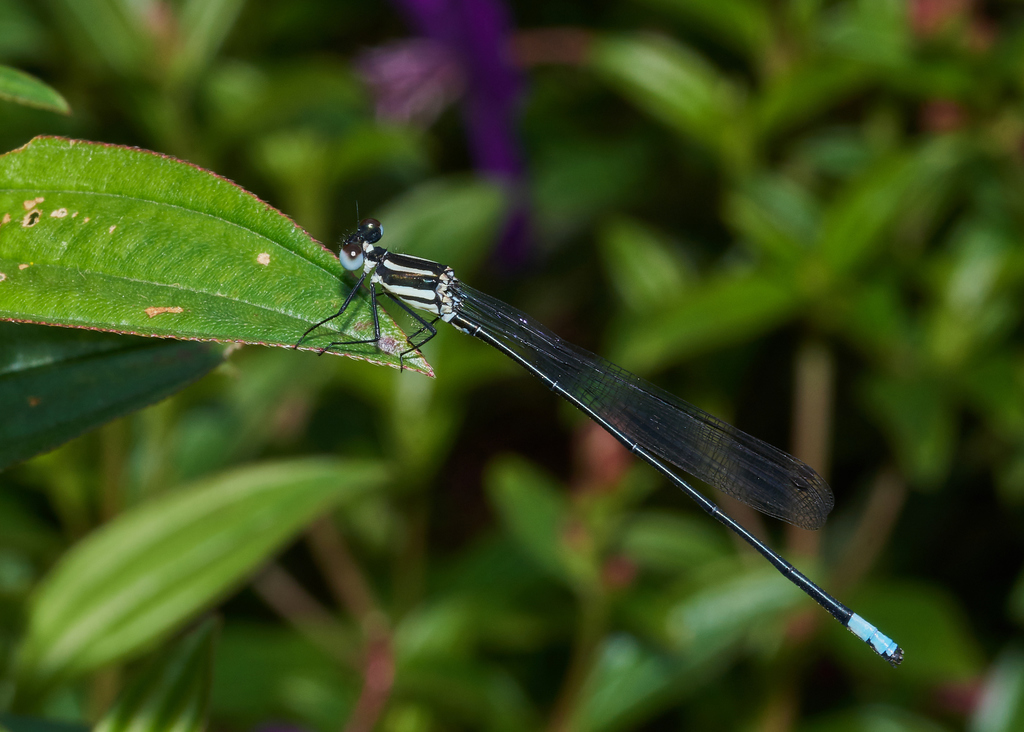
Travancore bambootail
Esme mudiensis
Esme mudiensis is a damselfly in the family Platycnemididae. It is commonly known as the Travancore bambootail. It is endemic to the Western Ghats in India, particularly south of Palakkad Gap.
From the article Esme mudiensis on Wikipedia (CC BY-SA), quoted section by section
Description
It is a medium-sized damselfly with black-capped blue eyes. Its thorax is velvet-black on the dorsum and azure blue on the sides. The dorsum is marked with narrow ante-humeral blue stripes, and there is another moderately broad black stripe over the postero-lateral suture. The base of the sides is pale blue. Wings are transparent with black and diamond shaped pterostigma. The abdomen is black, marked with azure blue on segment 1 and 2. Segments 3 to 6 have very narrow baso-dorsal annules. Segments 8 to 10 are blue. There is a narrow black basal annule on segment 8. The ventral borders of all segments are broadly black. Anal appendages are black. The female is similar to the male, but with a more robust build. It can be easily distinguished from other species of Esme by the labrum being entirely unmarked with metallic blue-black. It is usually found along hill streams, and seen perched on riparian vegetation.
Wikipedia: “Description and habitat”
Listen
Looking for field recordings…
Where it lives
Recorded sightings
—
geo-referenced records in GBIF, from museums, herbaria and field observers.
Drag the globe to turn it. Dots are where records exist, not a range map; darker means more records.
In the stacks
Searching the stacks…
Every page naming Esme mudiensis in the Biodiversity Heritage Library →
This page is assembled live from iNaturalist, GBIF, Wikipedia, the Source Library and the Internet Archive. It is not yet part of the hand-edited codex. iNaturalist taxon 100423.