- Animals
- ›Arthropods
- ›Hexapods
- ›Insects
- ›Winged and Once-winged Insects
- ›Butterflies and Moths
- ›Lasiocampoidea
- ›Lappet Moths
- ›Lasiocampinae
- ›Pinarini
- ›Eriogaster
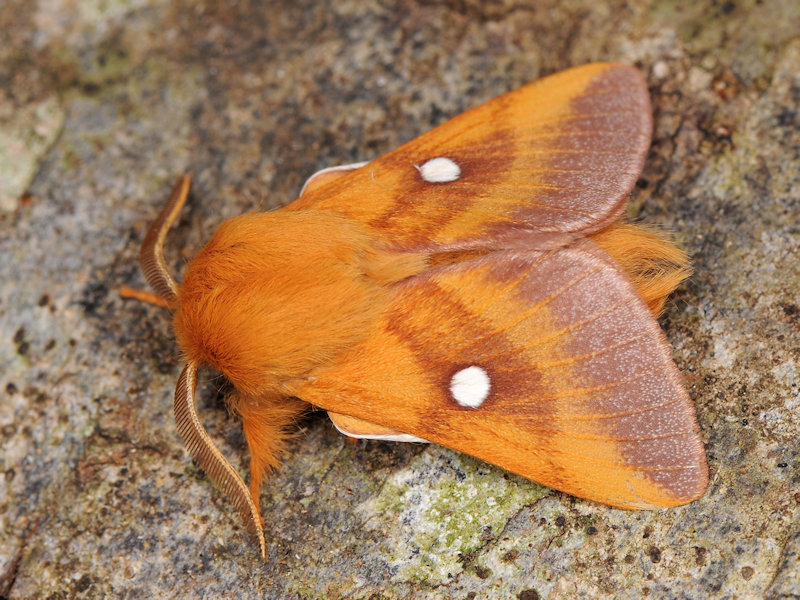
Eastern Eggar
Eriogaster catax
Eriogaster catax, commonly known as the eastern eggar, is a species of moth in the family Lasiocampidae.
From the article Eriogaster catax on Wikipedia (CC BY-SA), quoted section by section
Description
Eriogaster catax has a wingspan of 27–35 millimetres (1.1–1.4 in) in males, of 35–45 millimetres (1.4–1.8 in) in the females. This species shows a pronounced sexual dimorphism. The males are smaller and have feathery antennae. In males the basal part of the front wing is yellow-orange, while the outer part is pinkish-brown. In the females the front wings are browner. In both sexes, the front wings show a transversal line and a white discal spot within a dark border. Hind wings have no markings. Females are larger and at the end of the abdomen they have a tuft of dense gray-black hairs. The eggs hatch in April. The larvae feed on Crataegus, Quercus, Betula, Populus, Prunus and Berberis species. This univoltine species fly at night in September and October.
Range & habitat
It is found in Austria, Belgium, Bulgaria, Czech Republic, Germany, Hungary, Italy, the Netherlands, Poland, Serbia and Montenegro, Slovakia, and Spain.
Wikipedia: “Distribution”
Listen
Looking for field recordings…
Where it lives
Recorded sightings
—
geo-referenced records in GBIF, from museums, herbaria and field observers.
Drag the globe to turn it. Dots are where records exist, not a range map; darker means more records.
In the stacks
Searching the stacks…
Every page naming Eriogaster catax in the Biodiversity Heritage Library →
This page is assembled live from iNaturalist, GBIF, Wikipedia, the Source Library and the Internet Archive. It is not yet part of the hand-edited codex. iNaturalist taxon 100362.