- Animals
- ›Chordates
- ›Vertebrates
- ›Ray-finned Fishes
- ›Spiny-rayed fishes
- ›Perches, Scorpionfishes, Sticklebacks, and Allies
- ›Perches, groupers and allies
- ›Groupers
- ›Epinephelus
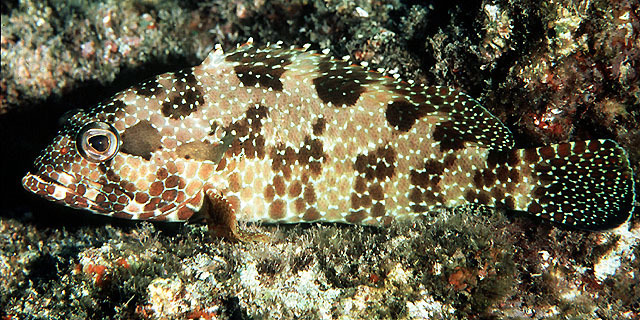
Wirenet Rockcod
Epinephelus hexagonatus
Epinephelus hexagonatus, commonly referred to as the star-spotted groper or the wirenet rockcod, is a species of ray-finned fish, a grouper from the subfamily Epinephelinae which is part of the family Serranidae, which also includes the anthias and sea basses. It is found mostly in the West Indian Ocean. It is named after the polygonal pattern of brown spots on its skin. There is a white triangle between each spot, and five darker spot clusters along...
From the article Epinephelus hexagonatus on Wikipedia (CC BY-SA), quoted section by section
Description
E. hexagonatus is named after a polygonal pattern of brown spots on its skin with a white triangle between each spot and its neighbour. These spots are present across the whole body, but five notably darker spot-clusters lie along the base of the dorsal fin. Its colouring provides camouflage from predators in reefs.
Range & habitat
E. hexagonatus is found in shallow outer-reef areas exposed to surge, usually depths of less than six meters, but can be found ten meters or more. Its diet mainly consists of fishes and crustaceans. This fish grows up to 26 cm long.
== References ==
Wikipedia: “Habitat”
Where it lives
Recorded sightings
—
geo-referenced records in GBIF, from museums, herbaria and field observers.
Drag the globe to turn it. Dots are where records exist, not a range map; darker means more records.
In the stacks
Searching the stacks…
Every page naming Epinephelus hexagonatus in the Biodiversity Heritage Library →
This page is assembled live from iNaturalist, GBIF, Wikipedia, the Source Library and the Internet Archive. It is not yet part of the hand-edited codex. iNaturalist taxon 100106.