 NL·0234
Herbarium of the Nature Library
- Name
- Terathopius ecaudatus
- Family
- Accipitridae
- Native to
- Sub-Saharan Africa and south-western Arabia
- Habitat
- Savanna, Open woodland
On eBird ↗
Bateleur
Live sightings near you, the range map, bar charts of when it is seen, and Macaulay Library photos and recordings.
Bateleur
Terathopius ecaudatus
Also calledBerghaan (Afrikaans) · Ingqungqulu (Zulu) · Bateleur des savanes (French)
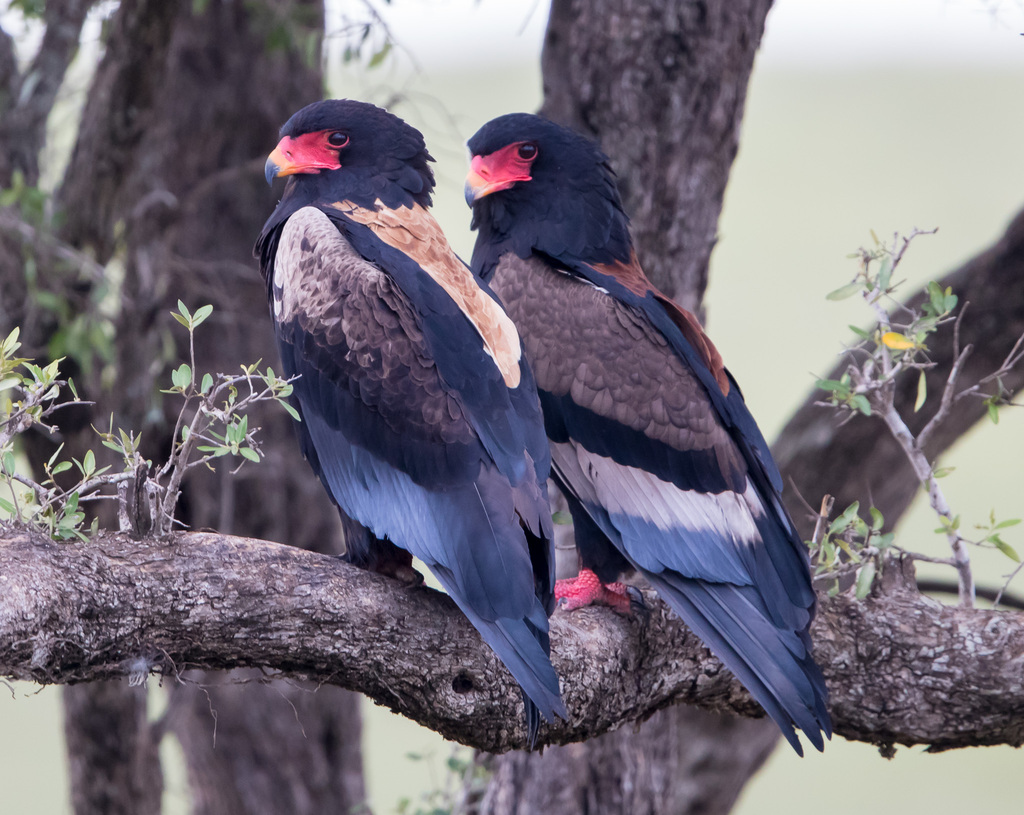
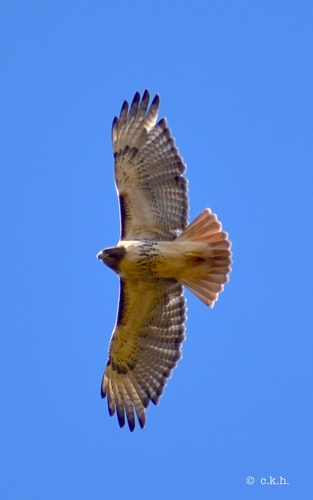
A striking eagle with almost no tail, red face and legs, and a rocking, tightrope-walker flight. It spends much of the day gliding low over the savanna searching for carrion and prey.
The bateleur, also known as the bateleur eagle, is a medium-sized eagle in the family Accipitridae. It is often considered a relative of the snake eagles and, like them, it is classified within the subfamily Circaetinae. It is the only member of the genus Terathopius and may be the origin of the "Zimbabwe Bird", the national emblem of Zimbabwe. Adult bateleurs are generally black in colour with a chestnut colour on the mantle as well as on the rump and tail. Adults also have gray patches about the leading edges of the wings with bright red on their cere and their feet. Adults also show white greater coverts, contrasting with black remiges in males, gray patches on the underwing primaries and black wingtips. The juvenile bateleur is quite different, being largely drab brown with a bit of paler feather scaling. All bateleurs have extremely large heads for their size, rather small bills, large feet, relatively short legs, long, bow-like wings and uniquely short tails, which are much smaller still on adults compared to juvenile birds. Wikipedia
What it can do
- iGlides for hours, tilting from side to side, with little flapping
- iiSpreads its wings in 'heraldic' sunbathing postures
- iiiFinds carcasses and is often first at them
In the field
Field marks
- aVery short tail; feet project past it in flight
- bBlack body with chestnut back (cream in some birds)
- cBright red face and legs
- dGrey shoulder patch
- eFemales have grey secondaries, males black
- Voice
- A loud, barking 'kaw-aw' and a harsh 'schaaaw'.
- Not to be confused with
- Black-chested snake eagle has a long tail and white belly. Juvenile bateleurs are brown and may resemble other brown eagles but share the short-tailed silhouette.
- Where to see it
- Kruger, Kgalagadi, Okavango, Serengeti, Maasai Mara
- When
- Resident
Listen
Looking for field recordings…
Life & habits
- Diet
- Carrion, birds, small mammals, reptiles
- Habitat
- Open savanna and woodland
- Size
- 55–70 cm; wingspan about 1.7–1.8 m
It flies with wings held in a shallow V, rocking side to side, a habit that inspired its French name meaning 'acrobat'.
Where it lives
Recorded sightings
—
geo-referenced records in GBIF, from museums, herbaria and field observers.
Native range
Sub-Saharan Africa and south-western Arabia
Drag the globe to turn it. Dots are where records exist, not a range map; darker means more records.
In the stacks
Searching the stacks…
Every page naming Terathopius ecaudatus in the Biodiversity Heritage Library →
Marginalia
François Le Vaillant named it 'bateleur' (French for a street acrobat) in the 18th century because of its tilting flight.
Curiosity
Bateleurs can spend 8–9 hours a day in the air and cover hundreds of kilometres.
Kinship
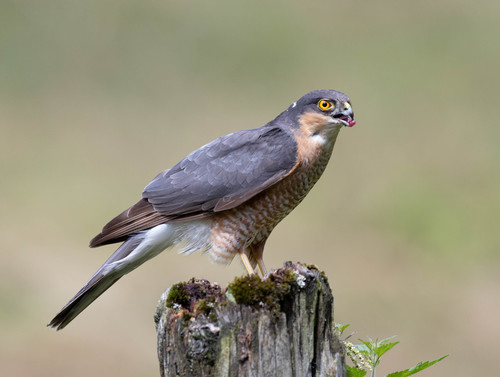

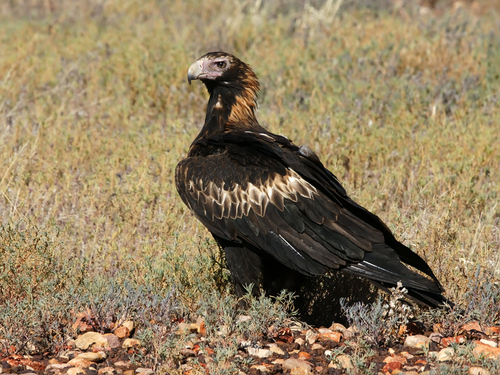
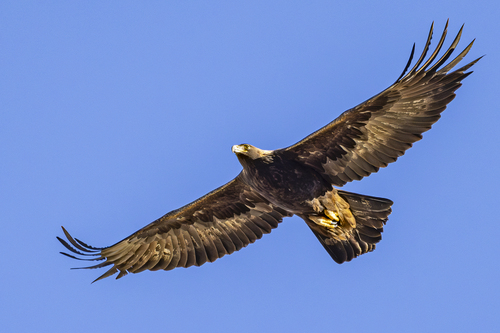

Photographs: iNaturalist contributors under the licences shown. Records: GBIF.org. Historical plates: Source Library (CC BY-SA 4.0; originals public domain). Summary text: Nature Library editors and Wikipedia (CC BY-SA). Medicinal and edibility notes are historical and educational, not advice. iNaturalist taxon 5231.