 NL·0697
Herbarium of the Nature Library
- Name
- Silurus glanis
- Family
- Siluridae
- Native to
- Central and Eastern Europe east to the Black, Caspian and Aral Sea basins; introduced to Spain, Italy, France, Britain and elsewhere
- Habitat
- Large rivers, Lakes, Reservoirs, Brackish Black and Caspian Sea margins
Wels catfish
Silurus glanis
Also calledWels / Waller (German) · Som сом (Russian) · Harcsa (Hungarian) · Sum (Polish) · Yayın balığı (Turkish) · Silure glane (French)
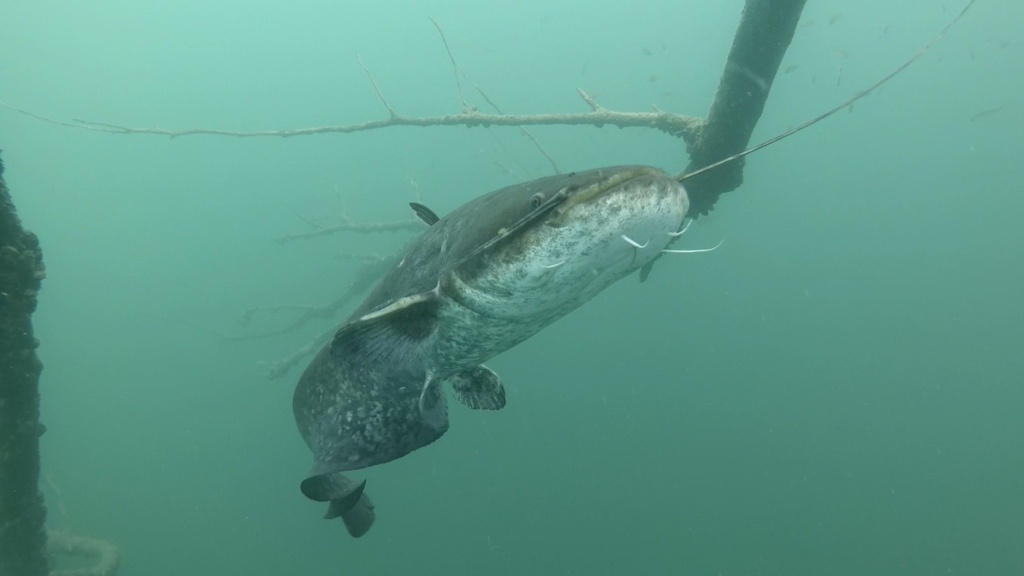
Europe's largest freshwater fish, a scaleless giant catfish with a cavernous mouth and whiskers like a walrus. Introduced wels in France have learned to lunge onto riverbanks to grab pigeons.
The wels catfish, also called sheatfish or just wels, is a large species of catfish native to wide areas of central, southern, and eastern Europe, in the basins of the Baltic, Black and Caspian Seas. It has been introduced to several countries in Western Europe, Mediterranean and Asia as a prized sport fish. Its modern day range spans from the United Kingdom in the west to western China in the east. Wikipedia
What it can do
- iHunts in darkness with two long upper barbels and four shorter chin barbels
- iiBeaches itself on riverbanks to seize pigeons, then wriggles back into the water (documented on the Tarn at Albi, France)
- iiiGrows to about 2.8 m, the largest verified freshwater fish in Europe
- ivMales guard and fan the nest of eggs for days
In the field
Field marks
- aLong, scaleless, slimy body; broad flat head and very wide mouth
- bOne pair of very long barbels on the upper jaw and two pairs of short barbels under the chin
- cTiny dorsal fin and a very long anal fin joined almost to the tail
- dMottled dark olive-black back, paler marbled flanks and a whitish belly
- Not to be confused with
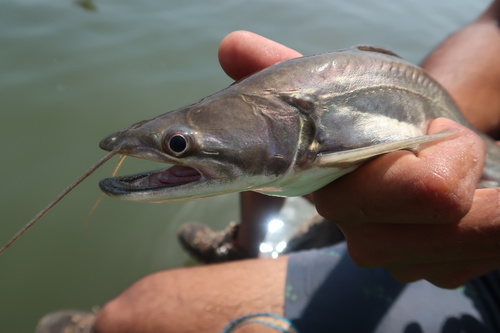
- Aristotle's catfish (Silurus aristotelis) of Greece has only four barbels. Introduced North American channel and blue catfish have scaleless bodies but a forked tail, an adipose fin and eight barbels.
- Where to see it
- The Ebro at Mequinenza and Caspe (Spain); the Po delta (Italy); the Danube delta; the Volga delta
- When
- Resident; spawns May–July; active through the warm months
Life & habits
- Diet
- Carnivore and scavenger: fish, crayfish, frogs, water birds, rodents and carrion
- Habitat
- Deep, slow lowland rivers, lakes, reservoirs and backwaters with soft beds
- Size
- Commonly 1–1.6 m; verified fish to about 2.8 m and over 130 kg
- Lifespan
- Up to 30 years or more; some estimates suggest around 50
Mostly nocturnal; by day it rests in holes under banks or sunken trees. It spawns in late spring in shallow vegetation, and the male guards the nest.
Where it lives
Recorded sightings
—
geo-referenced records in GBIF, from museums, herbaria and field observers.
Native range
Central and Eastern Europe east to the Black, Caspian and Aral Sea basins; introduced to Spain, Italy, France, Britain and elsewhere
Drag the globe to turn it. Dots are where records exist, not a range map; darker means more records.
In the old herbals & bestiaries
Woodcuts and engravings matched from the Source Library’s scanned books by name. Plates marked “relative” show a close kin rather than this exact species. Click a plate to read the page it came from, with translation.

De Piscibus Libri V et De Cetis Liber Unus
Ulisse Aldrovandi · 1661 · p.618

De Piscibus Libri V et De Cetis Liber Unus
Ulisse Aldrovandi · 1661 · p.619

History of Animals, Book II: On Oviparous Quadrupeds
Conrad Gessner · 1586 · p.698

Books on Marine Fishes
Guillaume Rondelet · 1554 · p.821

Commentaries on the Six Books of Dioscorides on Medical Matter
Pietro Andrea Mattioli · 1563 · p.305

History of Animals, Book II: On Oviparous Quadrupeds
Conrad Gessner · 1586 · p.686

Commentaries on the Six Books of Pedanius Dioscorides on Medical Matter
Pietro Andrea Mattioli · 1565 · p.510
In the stacks
Searching the stacks…
Every page naming Silurus glanis in the Biodiversity Heritage Library →
Marginalia
Aristotle described the male catfish guarding its nest in 'History of Animals' (4th century BC). The observation was dismissed until Louis Agassiz confirmed it in 1857 in the related Greek catfish he named Glanis aristotelis (now Silurus aristotelis) in Aristotle's honour.
Curiosity
About 28% of the wels catfish's beaching attacks on pigeons at Albi succeeded, which the researchers compared with orcas surging onto beaches to catch seals.
Kinship



Fact-checked: 2 corrections made to this sheet. Photographs: iNaturalist contributors under the licences shown. Records: GBIF.org. Historical plates: Source Library (CC BY-SA 4.0; originals public domain). Summary text: Nature Library editors and Wikipedia (CC BY-SA). Medicinal and edibility notes are historical and educational, not advice. iNaturalist taxon 112581.