 NL·0647
Herbarium of the Nature Library
- Name
- Protopterus annectens
- Family
- Protopteridae
- Native to
- West and Central Africa: from Senegal and Gambia through the Niger, Volta and Lake Chad basins, with populations also in parts of the Congo basin
- Habitat
- Floodplain swamps, Seasonal wetlands, Slow rivers
West African lungfish
Protopterus annectens
Also calledProtoptère (French) · African lungfish
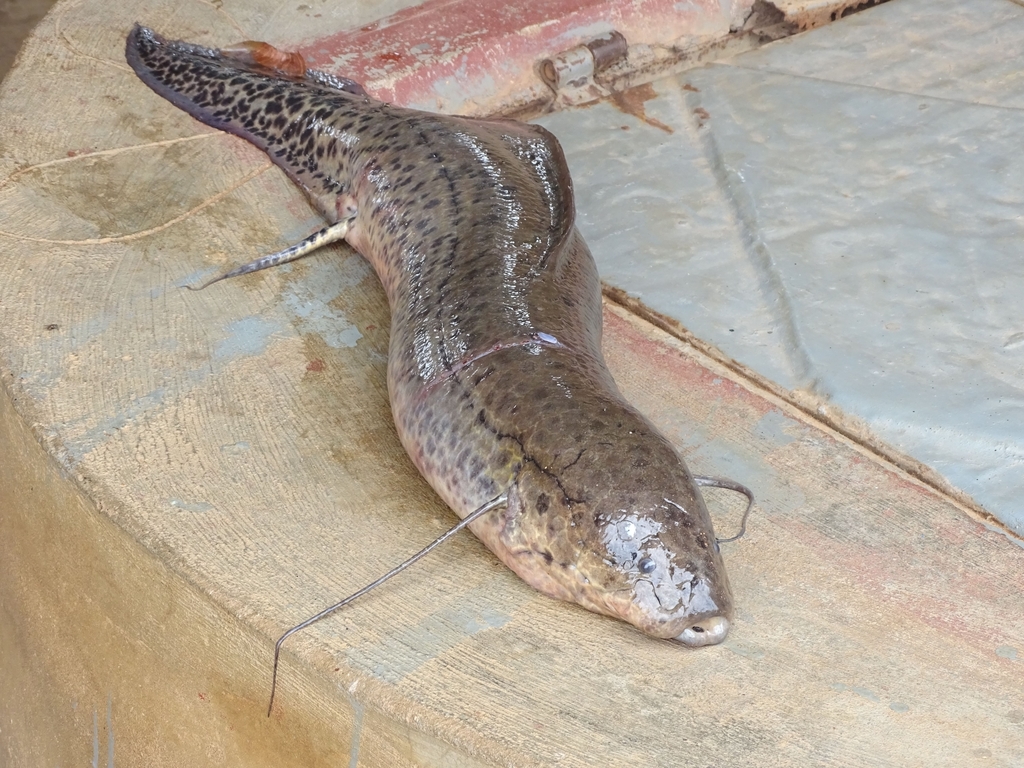
An eel-like air-breather of West African floodplains that survives the dry season sealed in a mucus cocoon in baked mud for months, sometimes years. It walks along the bottom on thin, thread-like fins, a hint of how the first vertebrates moved onto land.
The West African lungfish, also known as the Tana lungfish or simply African lungfish, is a species of African lungfish. It is found in a wide range of freshwater habitats in West and Central Africa, as well as the northern half of Southern Africa. Wikipedia
What it can do
- iAestivates: it burrows into mud, secretes a mucus cocoon that hardens, and breathes air through a tube to the surface while its metabolism slows
- iiObligate air-breather that drowns if kept from the surface
- iiiWalks and bounds along the bottom with its slender pelvic fins, a gait studied as a model for the origin of tetrapod walking
- ivMales guard the nest and aerate the eggs
In the field
Field marks
- aEel-like body with a continuous fin around the rear
- bLong, thin, thread-like pectoral and pelvic fins with a fringe on the pectorals
- cOlive-brown to grey with dark spots, pale belly
- dSmall eyes and a short, rounded snout
- Not to be confused with
- Marbled lungfish (Protopterus aethiopicus) of East Africa is larger, with marbled patterning. True eels and spiny eels have no thread-like paired fins.
- Where to see it
- Gambia River floodplains; the Inner Niger Delta (Mali); rice-growing wetlands of Senegal and Guinea-Bissau
- When
- Active in the rainy season (roughly June–October); aestivates in the dry season
Life & habits
- Diet
- Omnivore: snails, crustaceans, insect larvae, fish, frogs and plant matter
- Habitat
- Seasonal swamps, floodplains, marshes and river margins that may dry out
- Size
- Usually 50–70 cm; up to about 1 m
- Lifespan
- Over 20 years in captivity
As waters recede it wriggles into the mud and curls up in a cocoon, and it emerges when the rains return. Males dig nests and guard eggs and larvae.
Where it lives
Recorded sightings
—
geo-referenced records in GBIF, from museums, herbaria and field observers.
Native range
West and Central Africa: from Senegal and Gambia through the Niger, Volta and Lake Chad basins, with populations also in parts of the Congo basin
Drag the globe to turn it. Dots are where records exist, not a range map; darker means more records.
In the stacks
Searching the stacks…
Every page naming Protopterus annectens in the Biodiversity Heritage Library →
Marginalia
Richard Owen described it in 1839 as Lepidosiren annectens, 'the connecting one', because it seemed to link fish and amphibians. Lungfish cocoons dug from Gambian mud were shipped alive to Europe, where they 'woke' in aquaria.
Curiosity
In 2011 researchers filmed this species lifting its body and walking on its pelvic fins along the bottom, a gait once thought to have arisen only in tetrapods.
Kinship



Photographs: iNaturalist contributors under the licences shown. Records: GBIF.org. Historical plates: Source Library (CC BY-SA 4.0; originals public domain). Summary text: Nature Library editors and Wikipedia (CC BY-SA). Medicinal and edibility notes are historical and educational, not advice. iNaturalist taxon 110712.