 NL·0643
Herbarium of the Nature Library
- Name
- Pristis pristis
- Family
- Pristidae
- Native to
- Tropical coasts, estuaries and rivers of the Atlantic, eastern Pacific and Indo-West Pacific; now largely confined to northern Australia, parts of West Africa and Central/South America
- Habitat
- Estuaries, Rivers, Coastal waters, Mangrove
Largetooth sawfish
Pristis pristis
Also calledFreshwater sawfish · Pez sierra (Spanish) · Poisson-scie (French) · Peixe-serra (Portuguese)
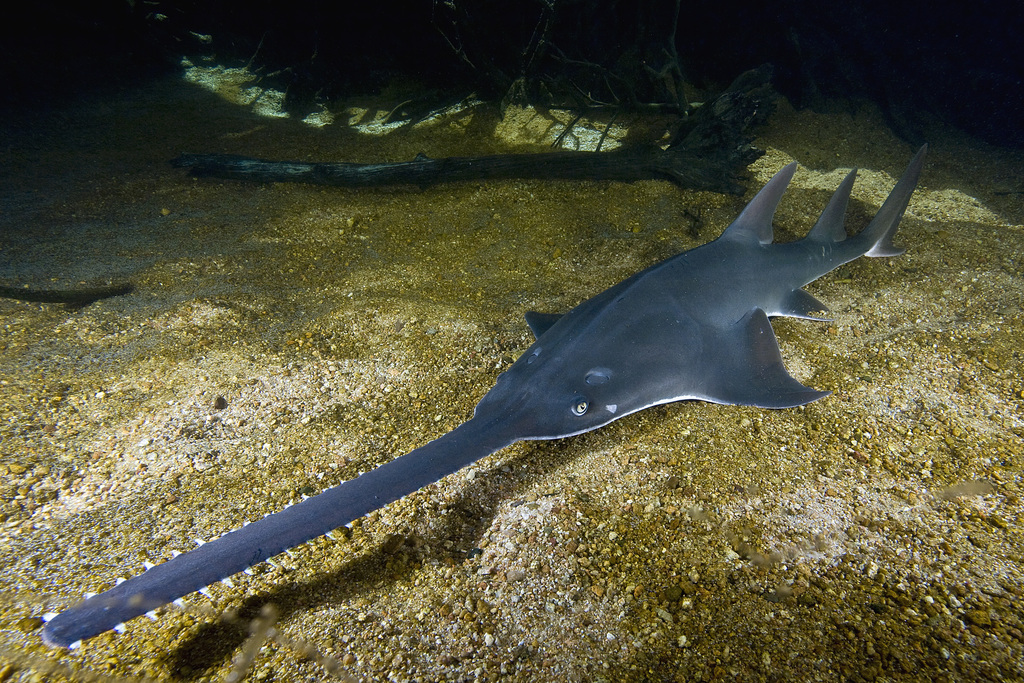
A ray with a shark-like body and a long, toothed 'saw' that it uses to sense and slash prey. Born in rivers and estuaries, it can travel hundreds of kilometres upstream, but it has vanished from much of its former range.
The largetooth sawfish is a species of sawfish in the family Pristidae. It is found worldwide in tropical and subtropical coastal regions, but also enters freshwater. It has declined drastically and is now critically endangered. Wikipedia
What it can do
- iThe rostrum (saw) is covered in electroreceptors that detect prey in murky water
- iiSwipes the saw side to side to stun and impale fish
- iiiPups are born with their saw teeth sheathed to protect the mother
- ivMoves between seawater and freshwater, travelling hundreds of kilometres up rivers such as the Amazon
In the field
Field marks
- aLong, flat, blade-like rostrum with large widely spaced teeth (14–24 pairs)
- bFirst dorsal fin starts in front of the pelvic fins
- cDistinct lower lobe on the tail fin
- dGrey to yellowish-brown, shark-like body with flattened head
- Not to be confused with
- Smalltooth sawfish (P. pectinata) has more, closer-set teeth (20–34 pairs) and no tail lower lobe; sawsharks are true sharks with barbels on the saw and gill slits on the side of the head.
- Where to see it
- Rarely; Fitzroy and Daly rivers in northern Australia; a few public aquariums in North America, Europe, Australia and Asia
- When
- Year-round; juveniles move with wet-season floods
Life & habits
- Diet
- Fish, crustaceans, molluscs
- Habitat
- Turbid estuaries, river mouths and freshwater rivers; adults in coastal seas
- Size
- Up to about 6.5–7 m
- Lifespan
- Up to about 35–45 years
Juveniles spend their early years in rivers, sometimes far inland in isolated pools such as the Fitzroy River of Western Australia, before moving to sea as adults.
Where it lives
Recorded sightings
—
geo-referenced records in GBIF, from museums, herbaria and field observers.
Native range
Tropical coasts, estuaries and rivers of the Atlantic, eastern Pacific and Indo-West Pacific; now largely confined to northern Australia, parts of West Africa and Central/South America
Drag the globe to turn it. Dots are where records exist, not a range map; darker means more records.
In the old herbals & bestiaries
No plate in the Source Library names this exact species, so these show its closest relatives as the old naturalists drew them: same genus, or the same kind of animal. Click a plate to read the page it came from, with translation.

Garden of Health (Hortus Sanitatis)
Relative · Jacob Meydenbach · 1491 · p.637

Recherche curieuse d'antiquités, venuës d'Italie, de la Grece, d'Egypte, & trouvées à Nimegue, a Sant...
Relative · Chevalier, Nicolas · 1714 · p.56

Books on Marine Fishes
Relative · Guillaume Rondelet · 1554 · p.508

History of the Northern Peoples
Relative · Olaus Magnus · 1555 · p.818

De Piscibus Libri V et De Cetis Liber Unus
Relative · Ulisse Aldrovandi · 1661 · p.755

De Piscibus Libri V et De Cetis Liber Unus
Relative · Ulisse Aldrovandi · 1661 · p.753

Louis Renard — Poissons, ecrevisses et crabes (1754)
Relative · Louis Renard · 1754 · p.173

Georg Wolfgang Knorr — Deliciae naturae selectae (1771)
Relative · Georg Wolfgang Knorr · 1771 · p.275
In the stacks
Searching the stacks…
Every page naming Pristis pristis in the Biodiversity Heritage Library →
Marginalia
Sawfish rostra were sold as curios worldwide; in West African Bijagós culture and among Aboriginal Australians the sawfish is an important spirit figure.
Curiosity
Three formerly separate species (P. microdon, P. perotteti and P. pristis) were merged into one in 2013 after genetic study.
Kinship




Fact-checked: 1 correction made to this sheet. Photographs: iNaturalist contributors under the licences shown. Records: GBIF.org. Historical plates: Source Library (CC BY-SA 4.0; originals public domain). Summary text: Nature Library editors and Wikipedia (CC BY-SA). Medicinal and edibility notes are historical and educational, not advice. iNaturalist taxon 110381.