 NL·0641
Herbarium of the Nature Library
- Name
- Polyodon spathula
- Family
- Polyodontidae
- Native to
- Mississippi River basin and nearby Gulf Coast drainages of the United States; extirpated from Canada and the Great Lakes
- Habitat
- Large rivers, Reservoirs, Backwaters
American paddlefish
Polyodon spathula
Also calledSpoonbill (US) · Spoonbill cat · Spatule (French) · Duck-billed cat
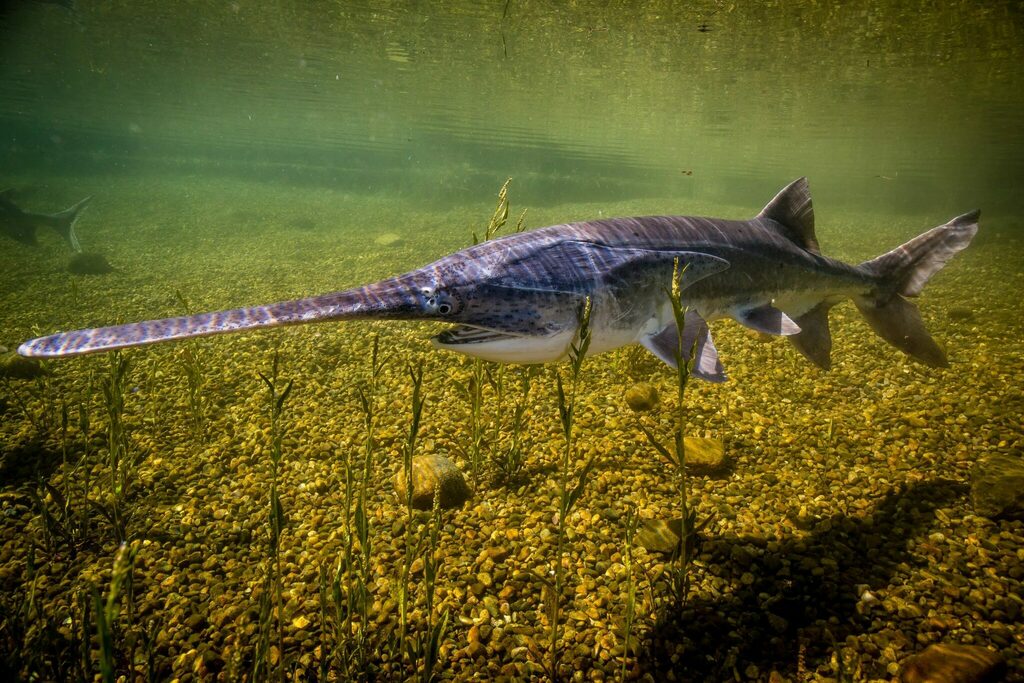
A big, shark-like filter feeder of the Mississippi basin with a long, flat paddle for a snout. The paddle is covered in electroreceptors that detect swarms of plankton. Its only recent relative, the Chinese paddlefish, was declared extinct in 2022.
The American paddlefish, also known as a Mississippi paddlefish, spoon-billed cat, or spoonbill, is a species of ray-finned fish. It is the last living species of paddlefish (Polyodontidae). This family is most closely related to the sturgeons; together they make up the order Acipenseriformes, which are one of the most basal living groups of ray-finned fish. Fossil records of other paddlefish species date back 125 million years to the Early Cretaceous, with records of Polyodon extending back 65 million years to the early Paleocene. The American paddlefish is a smooth-skinned freshwater fish with an almost entirely cartilaginous skeleton and a paddle-shaped rostrum (snout), which extends nearly one-third its body length. It has been referred to as a freshwater shark because of its heterocercal tail or caudal fin resembling that of sharks, though it is not closely related. The American paddlefish is a highly derived fish because it has evolved specialised adaptations, such as filter feeding. Its rostrum and cranium are covered with tens of thousands of sensory receptors for locating swarms of zooplankton, its primary food source. The only other species of paddlefish that survived to modern times was the Chinese paddlefish, last sighted in 2003 in the Yangtze River in China and considered to have gone extinct no later than 2010. Wikipedia
What it can do
- iIts paddle-shaped rostrum carries tens of thousands of electroreceptors that sense the weak electric fields of zooplankton
- iiSwims with its mouth agape, sieving plankton through comb-like gill rakers
- iiiMakes long upstream spawning migrations, sometimes hundreds of kilometres
- ivBelongs to a lineage that goes back over 100 million years; very similar fossils occur in Montana
In the field
Field marks
- aLong, flat, paddle-shaped snout (about a third of body length in adults)
- bSmooth, scaleless grey to bluish skin
- cHuge mouth and a long, pointed, flap-like gill cover
- dShark-like tail with a longer upper lobe
- Not to be confused with
- Shovelnose sturgeon (Scaphirhynchus platorynchus) has bony scutes, a shovel-shaped snout and barbels in front of a small mouth on the underside. No other fish in its range has a long paddle snout.
- Where to see it
- Osage River and Lake of the Ozarks (Missouri); Grand Lake o' the Cherokees (Oklahoma); Gavins Point Dam on the Missouri (South Dakota/Nebraska) during spring snagging season
- When
- Spawning migrations March–May when rivers rise; snagging seasons in spring
Life & habits
- Diet
- Filter-feeder: zooplankton (water fleas, copepods) and insect larvae
- Habitat
- Slow, deep, open water of large rivers, oxbows and reservoirs
- Size
- Commonly 1–1.5 m; up to about 2.2 m and 90 kg
- Lifespan
- Usually 20–30 years; over 50 recorded
In spring, adults migrate upriver during floods to spawn over gravel bars. The sticky eggs hatch within days and the larvae drift downstream.
Where it lives
Recorded sightings
—
geo-referenced records in GBIF, from museums, herbaria and field observers.
Native range
Mississippi River basin and nearby Gulf Coast drainages of the United States; extirpated from Canada and the Great Lakes
Drag the globe to turn it. Dots are where records exist, not a range map; darker means more records.
In the old herbals & bestiaries
No plate in the Source Library names this exact species, so these show its closest relatives as the old naturalists drew them: same genus, or the same kind of animal. Click a plate to read the page it came from, with translation.


In the stacks
Searching the stacks…
Every page naming Polyodon spathula in the Biodiversity Heritage Library →
Marginalia
Native peoples of the Mississippi basin fished paddlefish long before European contact. Johann Walbaum described it in 1792 as a kind of shark, Squalus spathula.
Curiosity
Paddlefish with their paddle removed can still feed normally, because electroreceptors on the head and gill covers take over, but the paddle greatly extends their detection range.
Kinship




Fact-checked: 1 correction made to this sheet. Photographs: iNaturalist contributors under the licences shown. Records: GBIF.org. Historical plates: Source Library (CC BY-SA 4.0; originals public domain). Summary text: Nature Library editors and Wikipedia (CC BY-SA). Medicinal and edibility notes are historical and educational, not advice. iNaturalist taxon 54721.