 NL·0507
Herbarium of the Nature Library
- Name
- Photinus pyralis
- Family
- Lampyridae
- Native to
- Eastern and central North America, south to northern South America
- Habitat
- Meadow, Lawns, Woodland edge, Wetland edge
Common eastern firefly
Photinus pyralis
Also calledBig dipper firefly (English) · Luciérnaga (Spanish) · Yínghuǒchóng (Chinese, firefly) · Lightning bug (American English)
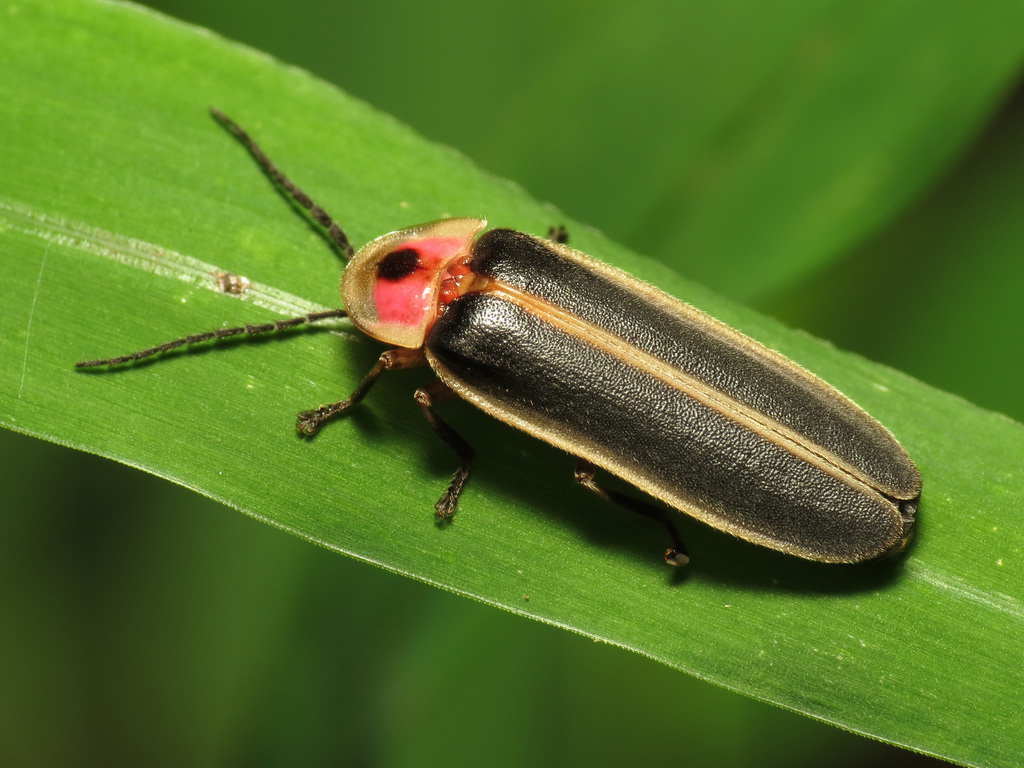
North America's most familiar firefly, a beetle that courts with flashes of cold yellow-green light. Males trace a J-shaped 'swoop' as they flash, and females answer from the grass.
Photinus pyralis, also known by the common names the common eastern firefly or big dipper firefly, and sometimes called a "lightning bug", is a species of flying beetle. An organ on its abdomen is responsible for its light production. It is the most common species of firefly in North America and is typically found east of the Rocky Mountains. Photinus fireflies are often confused with fireflies of the similar-sounding genus, Photuris, which are also found in North America. Wikipedia
What it can do
- iProduces light through the luciferin–luciferase reaction with very little heat
- iiMales flash a species-specific timed pattern; females reply after a set delay
- iiiLarvae glow too and hunt snails, slugs and worms
- ivContains defensive lucibufagins that make it distasteful to predators
In the field
Field marks
- aFlat, soft-bodied beetle 1–1.4 cm long, dark wing covers edged yellow
- bHead shield (pronotum) yellow with a black central spot ringed pink or red
- cMales have lanterns on the last three abdominal segments; females a small lantern on one segment
- dMales fly low in a J-shaped swoop, flashing on the upswing
- Voice
- Silent; signals with light. The male's yellow flash comes every 5–7 seconds and the female answers from the grass 1–2 seconds later
- Not to be confused with
- Photuris fireflies are longer and leggier, flash later into the night with different patterns, and females mimic Photinus replies to eat the males. Many other Photinus species differ chiefly in flash rhythm.
- Where to see it
- Lawns, meadows and woodland edges across the eastern and central United States, including suburban yards
- When
- Late spring and summer (mainly Jun–Jul), flashing from dusk for about an hour
Listen
Looking for field recordings…
Life & habits
- Diet
- Larvae eat soft-bodied invertebrates; adults eat little or nothing
- Habitat
- Open fields, lawns, forest edges and moist ground
- Size
- 11–14 mm
- Lifespan
- About 1–2 years, mostly as a larva; adults a few weeks
At dusk a male rises while flashing, drawing a J in the air; a receptive female answers with a single flash after about two seconds.
Where it lives
Recorded sightings
—
geo-referenced records in GBIF, from museums, herbaria and field observers.
Native range
Eastern and central North America, south to northern South America
Drag the globe to turn it. Dots are where records exist, not a range map; darker means more records.
In the stacks
Searching the stacks…
Every page naming Photinus pyralis in the Biodiversity Heritage Library →
Marginalia
The firefly luciferase gene, cloned from this species in 1985, became a standard tool in molecular biology for reporting gene activity and detecting ATP. Predatory Photuris 'femme fatale' fireflies mimic its female's reply to lure and eat males.
Curiosity
Its light reaction gives off almost no heat, and about 40% of reactions produce a photon (Ando et al. 2008) — far lower than the once-quoted ~90%, but still among the most efficient light-producing reactions in nature.
Kinship





Fact-checked: 1 correction made to this sheet. Photographs: iNaturalist contributors under the licences shown. Records: GBIF.org. Historical plates: Source Library (CC BY-SA 4.0; originals public domain). Summary text: Nature Library editors and Wikipedia (CC BY-SA). Medicinal and edibility notes are historical and educational, not advice. iNaturalist taxon 129350.