 NL·0722
Herbarium of the Nature Library
- Name
- Nestor notabilis
- Family
- Strigopidae
- Native to
- South Island, New Zealand
- Habitat
- Alpine, Subalpine forest
On eBird ↗
Kea
Live sightings near you, the range map, bar charts of when it is seen, and Macaulay Library photos and recordings.
Kea
Nestor notabilis
Also calledKea (Māori) · Mountain parrot (English)
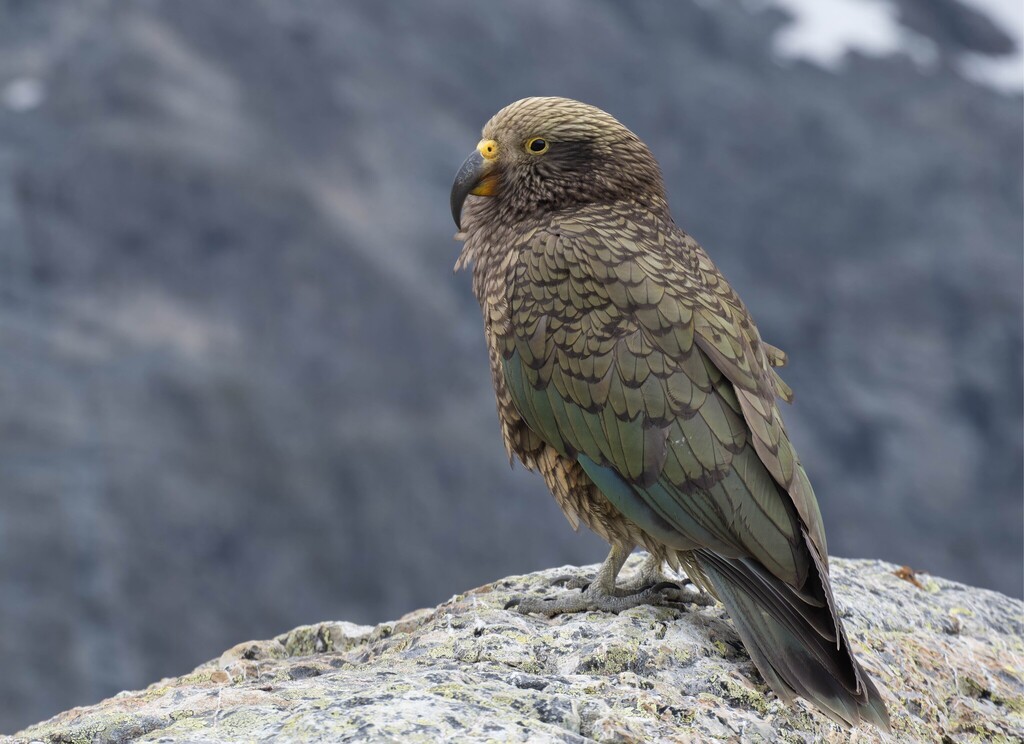
The world's only alpine parrot, an olive-green clown of New Zealand's Southern Alps. Famously curious and clever, kea solve puzzles, use tools and even have a 'play' call that sets other kea romping.
The kea is a species of large parrot in the family Strigopidae that is endemic to the forested and alpine regions of the South Island of New Zealand. About 48 cm (19 in) long, it is mostly olive-green, with brilliant orange under its wings, and has a large, narrow, curved, grey-brown upper beak. Its omnivorous diet consists mainly of roots, leaves, berries, nectar, and insects, but also includes carrion. It was once killed for bounty due to concern by sheep farmers that it attacked livestock, especially sheep. The kea is now uncommon, and received absolute protection under the Wildlife Act in 1986. Wikipedia
What it can do
- iSolves multi-step puzzles and uses tools in experiments
- iiIts 'warble' call triggers play in other kea, an emotional contagion
- iiiUnderstands statistical probabilities in choice tasks
- ivSurvives in cold, snowy mountain habitats
In the field
Field marks
- aOlive-green plumage with black edging
- bBright orange underwings in flight
- cLong, narrow, hooked grey bill
- dBlue-green flight feathers
- Voice
- A loud, descending 'kee-aaa' call, from which its name derives.
- Not to be confused with
- Kākā is reddish-brown, lives in lowland forest, and has a heavier bill.
- Where to see it
- Arthur's Pass, Homer Tunnel (Milford Road), Aoraki/Mount Cook
- When
- Resident
Listen
Looking for field recordings…
Life & habits
- Diet
- Roots, leaves, fruit, insects, carrion
- Habitat
- Alpine and subalpine forest, scrub, grassland
- Size
- About 48 cm; 800–1000 g
Young kea gather in groups to explore and play, tearing car parts and backpacks.
Where it lives
Recorded sightings
—
geo-referenced records in GBIF, from museums, herbaria and field observers.
Native range
South Island, New Zealand
Drag the globe to turn it. Dots are where records exist, not a range map; darker means more records.
In the old herbals & bestiaries
Woodcuts and engravings matched from the Source Library’s scanned books by name. Plates marked “relative” show a close kin rather than this exact species. Click a plate to read the page it came from, with translation.

In the stacks
Searching the stacks…
Every page naming Nestor notabilis in the Biodiversity Heritage Library →
Marginalia
Farmers accused kea of killing sheep, and a bounty killed some 150,000 birds between 1860 and 1970.
Curiosity
Kea are one of the few non-primate animals shown to make statistical inferences.
Kinship




Photographs: iNaturalist contributors under the licences shown. Records: GBIF.org. Historical plates: Source Library (CC BY-SA 4.0; originals public domain). Summary text: Nature Library editors and Wikipedia (CC BY-SA). Medicinal and edibility notes are historical and educational, not advice. iNaturalist taxon 18941.