 NL·0245
Herbarium of the Nature Library
- Name
- Moloch horridus
- Family
- Agamidae
- Native to
- Arid and semi-arid central and western Australia
- Habitat
- Desert, Spinifex grassland, Mallee scrub
Thorny devil
Moloch horridus
Also calledThorny dragon · Mountain devil · Ngiyari (Western Desert languages)
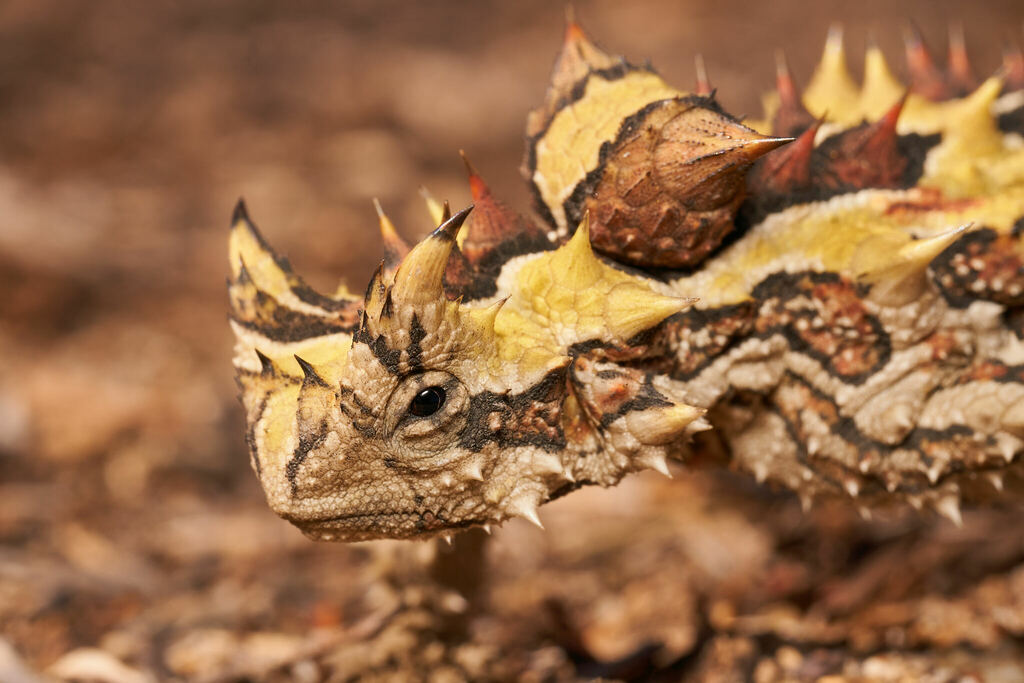
An Australian desert lizard covered in conical spines. Grooves between its scales pull water from damp sand or dew across its skin to its mouth, and it eats only ants, thousands at a sitting.
The thorny devil, also known commonly as the mountain devil, thorny lizard, thorny dragon, and moloch, is a species of lizard in the family Agamidae. The species is endemic to Australia. It is the sole species in the genus Moloch. It grows up to 21 cm (8.3 in) in total length, with females generally larger than males. Wikipedia
What it can do
- iWicks water to its mouth: fine channels between its scales draw dew and damp from sand up to the corners of its jaws, where it swallows it
- iiEats only small ants, licking them up one at a time
- iiiHas a knob on the back of its neck that acts as a 'false head' when it dips its real head
- ivChanges colour between yellow, red and brown with temperature and mood
In the field
Field marks
- aBody covered in large conical spines, including two horns over the eyes
- bYellow, red and brown camouflage pattern
- cSpiny knob on the back of the neck
- dSlow, swaying walk
- Not to be confused with
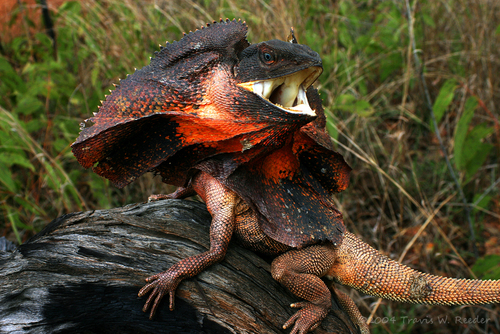
- Unlike any other Australian lizard. North American horned lizards (Phrynosoma) look similar through convergent evolution but live on another continent.
- Where to see it
- Red-sand deserts near Uluru and Alice Springs, the Great Victoria Desert, and Western Australia's Wheatbelt and Shark Bay; often seen on sandy roads in the morning
- When
- Active in spring and autumn; breeds in late winter–spring (August–December)
Life & habits
- Diet
- Small black ants, especially Iridomyrmex and Ochetellus
- Habitat
- Sandy desert, spinifex grassland and mallee scrub
- Size
- Up to ~20 cm
- Lifespan
- ~15–20 years
It walks with a jerky, rocking gait and freezes when watched. When threatened it tucks its head down so the knob on its neck looks like a head.
Where it lives
Recorded sightings
—
geo-referenced records in GBIF, from museums, herbaria and field observers.
Native range
Arid and semi-arid central and western Australia
Drag the globe to turn it. Dots are where records exist, not a range map; darker means more records.
In the old herbals & bestiaries
No plate in the Source Library names this exact species, so these show its closest relatives as the old naturalists drew them: same genus, or the same kind of animal. Click a plate to read the page it came from, with translation.

In the stacks
Searching the stacks…
Every page naming Moloch horridus in the Biodiversity Heritage Library →
Marginalia
John Edward Gray named it in 1841 after Moloch, the Canaanite god associated with child sacrifice, a reference to its fearsome look.
Curiosity
A thorny devil can eat thousands of ants in a single day, licking them up one at a time.
Kinship



Photographs: iNaturalist contributors under the licences shown. Records: GBIF.org. Historical plates: Source Library (CC BY-SA 4.0; originals public domain). Summary text: Nature Library editors and Wikipedia (CC BY-SA). Medicinal and edibility notes are historical and educational, not advice. iNaturalist taxon 31519.