 NL·0550
Herbarium of the Nature Library
- Name
- Mellivora capensis
- Family
- Mustelidae
- Native to
- Sub-Saharan Africa, North Africa's edges, Arabia, Iran, Central Asia and the Indian subcontinent
- Habitat
- Savanna, Desert, Dry forest, Grassland
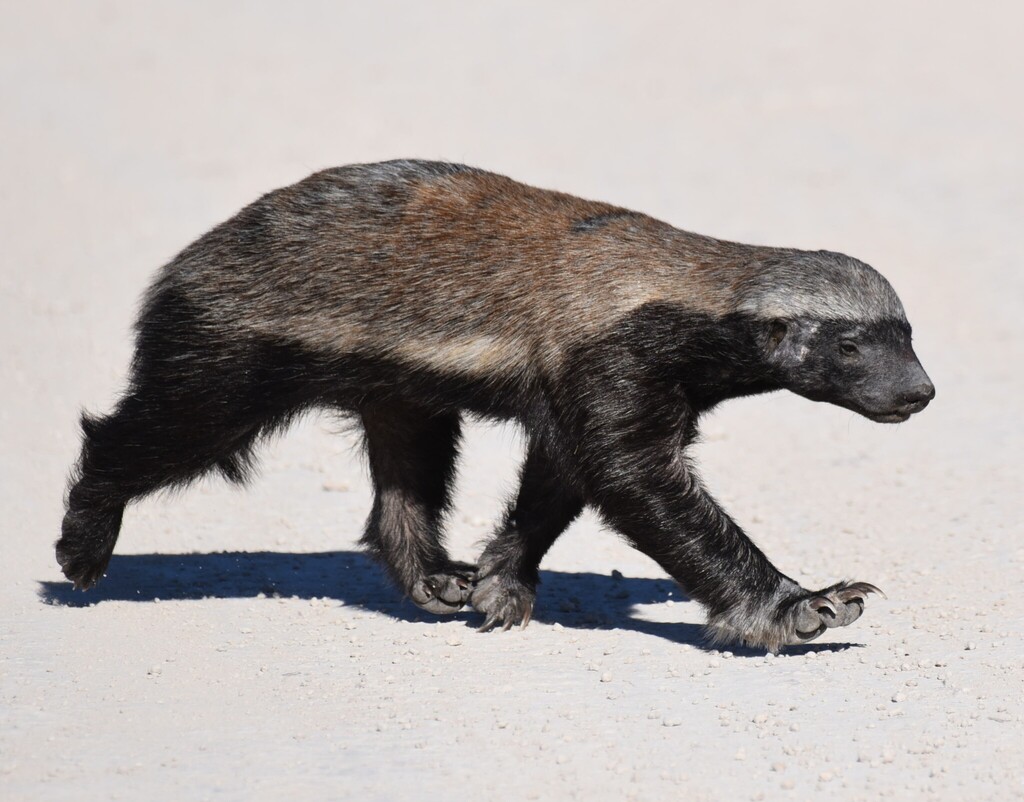
Honey badger (ratel)
Mellivora capensis
Also calledRatel (Afrikaans) · Nyegere (Swahili) · Al-ghurayr (Arabic) · Bijjū (Hindi) · Fēngmì huān 蜜獾 (Chinese)
A stocky, fearless mustelid of Africa and southern Asia, famed for raiding beehives and fighting off lions. Thick, loose skin lets it twist round and bite an attacker that has hold of it.
The honey badger, also known as the ratel, is a mammal widely distributed across Africa, Southwest Asia, and the Indian subcontinent. It is the sole living representative of the Mellivorinae subfamily of the Mustelidae. Wikipedia
What it can do
- iResists cobra and other snake venom because of a mutation in its nerve receptors, shared with mongooses
- iiRips open beehives, termite mounds and burrows with long, strong foreclaws
- iiiEscapes and solves problems: captive honey badgers have stacked objects to climb out of enclosures
- ivReleases a foul smell from anal glands when threatened
In the field
Field marks
- aStocky, low-slung badger
- bBlack below with a silver-grey back
- cShort legs with long front claws
- dSmall eyes and ears
- Voice
- Growls and rattles
- Not to be confused with
- Zorilla (striped polecat) is smaller with black-and-white stripes. Never approach on foot; watch from a vehicle, boat or hide, or with a licensed guide.
- Where to see it
- Kgalagadi Transfrontier Park (South Africa/Botswana)
- When
- Resident
Listen
Looking for field recordings…
Life & habits
- Diet
- Omnivore: rodents, snakes, lizards, insects, bee larvae and honey, carrion, fruit
- Habitat
- Almost every habitat from desert to forest edge
- Size
- Males 9–16 kg, females 5–10 kg; body 55–77 cm
- Lifespan
- 7–8 years in the wild; to ~24 in captivity
Mainly a solitary forager, it may travel 10–30 km in a day of digging for prey. Its partnership with honeyguide birds is widely told but poorly documented.
Where it lives
Recorded sightings
—
geo-referenced records in GBIF, from museums, herbaria and field observers.
Native range
Sub-Saharan Africa, North Africa's edges, Arabia, Iran, Central Asia and the Indian subcontinent
Drag the globe to turn it. Dots are where records exist, not a range map; darker means more records.
In the stacks
Searching the stacks…
Every page naming Mellivora capensis in the Biodiversity Heritage Library →
Marginalia
Afrikaans-speaking farmers called it the ratel, a name that entered zoology. The 2011 viral video 'The Crazy Nastyass Honey Badger' made its fearlessness an internet legend.
Curiosity
Bitten by a cobra, a honey badger may collapse, sleep for a couple of hours, then wake up and finish eating the snake.
Kinship




Photographs: iNaturalist contributors under the licences shown. Records: GBIF.org. Historical plates: Source Library (CC BY-SA 4.0; originals public domain). Summary text: Nature Library editors and Wikipedia (CC BY-SA). Medicinal and edibility notes are historical and educational, not advice. iNaturalist taxon 41834.