 NL·0526
Herbarium of the Nature Library
- Name
- Manis crassicaudata
- Family
- Manidae
- Native to
- India, Pakistan, Sri Lanka, Nepal and possibly Bangladesh
- Habitat
- Dry deciduous forest, Scrub, Grassland, Farmland
Indian pangolin
Manis crassicaudata
Also calledThick-tailed pangolin · Alungu (Tamil) · Scaly anteater
An armour-plated ant- and termite-eater of the Indian subcontinent, covered in overlapping keratin scales and able to roll into a near-impregnable ball. It is one of the most trafficked mammals in the world, poached for its scales and meat, and is protected under Schedule I of India's Wildlife Protection Act.
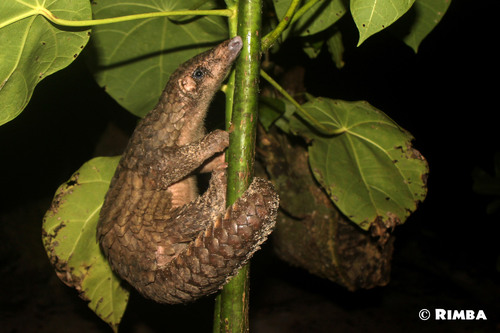
The Indian pangolin, also called thick-tailed pangolin and scaly anteater, is a pangolin native to the Indian subcontinent. Like other pangolins, it has large, overlapping scales on its body which act as armour. The colour of its scales varies depending on the colour of the earth in its surroundings. It can also curl itself into a ball as self-defence against predators such as the tiger. It is an insectivore feeding on ants and termites, digging them out of mounds and logs using its long claws, which are as long as its fore limbs. It is nocturnal and rests in deep burrows during the day. Wikipedia
What it can do
- iToothless; a sticky tongue about 40 cm long, extending some 25 cm from the mouth, reaches deep into termite galleries
- iiRolls into a tight ball, protected by sharp-edged scales, when threatened
- iiiDigs burrows several metres long with powerful foreclaws
- ivCan close its nostrils and ears against biting ants
In the field
Field marks
- aSilhouette: low, tapering body like a walking pine cone, with a broad, thick tail
- b11–13 rows of large, overlapping yellowish-brown scales on the body
- cTiny conical head with small eyes and no visible teeth
- dSigns: burrows with fresh soil at the entrance, dug-open termite mounds and ant nests, a tail-drag line between footprints
- Not to be confused with
- Chinese pangolin (in the northeast Himalayan foothills) has smaller scales, prominent external ears and a shorter tail. Sunda pangolin occurs only in Southeast Asia. No other South Asian mammal has scales.
- Where to see it
- Rarely seen; nocturnal surveys in Kanha and Satpura (central India), Pothohar Plateau (Pakistan), dry zone of Sri Lanka, and Similipal (Odisha)
- When
- Resident; active at night year-round
Listen
Looking for field recordings…
Life & habits
- Diet
- Ants and termites, including their eggs and larvae
- Habitat
- Grassland, dry and moist forest, scrub and farmland, including hilly and semi-desert terrain
- Size
- Head and body 45–75 cm, tail 33–47 cm; about 9–16 kg
- Lifespan
- Poorly known; up to about 19 years in captivity
Nocturnal and solitary, sleeping by day in burrows or rock crevices. Walks on its knuckles and hind feet, sometimes rearing up on its back legs.
Where it lives
Recorded sightings
—
geo-referenced records in GBIF, from museums, herbaria and field observers.
Native range
India, Pakistan, Sri Lanka, Nepal and possibly Bangladesh
Drag the globe to turn it. Dots are where records exist, not a range map; darker means more records.
In the old herbals & bestiaries
No plate in the Source Library names this exact species, so these show its closest relatives as the old naturalists drew them: same genus, or the same kind of animal. Click a plate to read the page it came from, with translation.

In the stacks
Searching the stacks…
Every page naming Manis crassicaudata in the Biodiversity Heritage Library →
Marginalia
A suit of armour made from Indian pangolin scales was presented to King George III in 1820 by the Marquess of Hastings and is now displayed at the Royal Armouries in Leeds. Demand for its scales in traditional Chinese medicine, which have no proven medicinal effect, drives most poaching.
Curiosity
Pangolin scales are made of keratin, the same protein as human fingernails.
Kinship





Fact-checked: 2 corrections made to this sheet. Photographs: iNaturalist contributors under the licences shown. Records: GBIF.org. Historical plates: Source Library (CC BY-SA 4.0; originals public domain). Summary text: Nature Library editors and Wikipedia (CC BY-SA). Medicinal and edibility notes are historical and educational, not advice. iNaturalist taxon 43362.