 NL·0521
Herbarium of the Nature Library
- Name
- Lucanus cervus
- Family
- Lucanidae
- Native to
- Europe from southern Sweden to Iberia, east to Turkey, the Caucasus and Syria
- Habitat
- Temperate deciduous forest, Parkland, Gardens
European stag beetle
Lucanus cervus
Also calledHirschkäfer (German) · Lucane cerf-volant (French) · Ciervo volante (Spanish) · Jelonek rogacz (Polish)
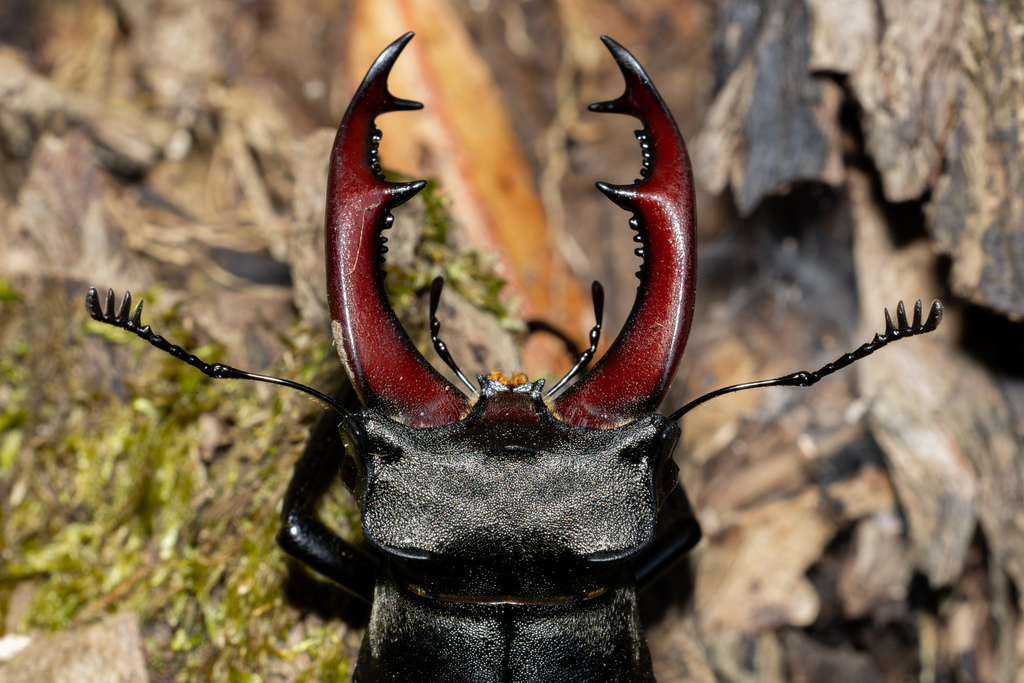
Europe's largest beetle, whose males carry huge antler-like jaws used only for wrestling rivals. It spends most of its life as a grub in rotting wood underground and emerges for just a few summer weeks.
Lucanus cervus, known as the European stag beetle, or the greater stag beetle, is one of the best-known species of stag beetle in Western Europe, and is the eponymous example of the genus. L. cervus is listed as Near Threatened by the IUCN Red List. Wikipedia
What it can do
- iLarvae live 3–6 years feeding on decaying wood
- iiMales' enlarged mandibles function like antlers in contests over females
- iiiAdults fly on warm summer evenings with a loud, whirring, upright flight
In the field
Field marks
- aMale with huge, branched, reddish-brown 'antler' mandibles
- bChestnut-brown wing cases and black head and thorax
- cFemale smaller with short, strong jaws
- dSlow, upright, buzzing flight at dusk
- Not to be confused with
- Lesser stag beetle (Dorcus parallelipipedus) is smaller (2–3 cm), all dull black, and has small jaws; female stag beetles have reddish-brown wing cases. Rhinoceros beetle (Sinodendron cylindricum) is small, black and cylindrical.
- Where to see it
- South-east England (south London, Thames valley, Essex, Kent), and oak woodland across central and southern Europe.
- When
- Adults late May–July, flying on warm evenings
Listen
Looking for field recordings…
Life & habits
- Diet
- Larvae eat decaying wood of oak and other broadleaves (stumps, roots); adults sip sap and fruit juice
- Habitat
- Old oak woods, parks, hedgerows and suburban gardens with dead wood
- Size
- Males about 3.5–9 cm including mandibles; females 3–5 cm
- Lifespan
- Up to about 6 years, almost all as a larva; adults a few weeks
Males grapple on branches and tree trunks, trying to grip and throw opponents off.
Where it lives
Recorded sightings
—
geo-referenced records in GBIF, from museums, herbaria and field observers.
Native range
Europe from southern Sweden to Iberia, east to Turkey, the Caucasus and Syria
Drag the globe to turn it. Dots are where records exist, not a range map; darker means more records.
In the old herbals & bestiaries
Woodcuts and engravings matched from the Source Library’s scanned books by name. Plates marked “relative” show a close kin rather than this exact species. Click a plate to read the page it came from, with translation.

In the stacks
Searching the stacks…
Every page naming Lucanus cervus in the Biodiversity Heritage Library →
Marginalia
Pliny the Elder reported that children wore stag-beetle jaws as amulets against illness, and Albrecht Dürer painted a lifelike stag beetle in 1505. Old English folklore blamed it for carrying hot coals and setting thatch alight.
Curiosity
Despite their size, the male's jaws are too weak to give a painful nip; the smaller-jawed female bites much harder.
Kinship




Photographs: iNaturalist contributors under the licences shown. Records: GBIF.org. Historical plates: Source Library (CC BY-SA 4.0; originals public domain). Summary text: Nature Library editors and Wikipedia (CC BY-SA). Medicinal and edibility notes are historical and educational, not advice. iNaturalist taxon 61749.