 NL·0495
Herbarium of the Nature Library
- Name
- Ibidorhyncha struthersii
- Family
- Ibidorhynchidae
- Native to
- Mountains of Central and High Asia: Kazakhstan, Kyrgyzstan and Tajikistan through northern Pakistan, Ladakh, Nepal, Bhutan and Tibet to northern and central China
- Habitat
- River, Alpine
On eBird ↗
Ibisbill
Live sightings near you, the range map, bar charts of when it is seen, and Macaulay Library photos and recordings.
Ibisbill
Ibidorhyncha struthersii
Also calledHuán zuǐ yù 鹮嘴鹬 (Chinese)
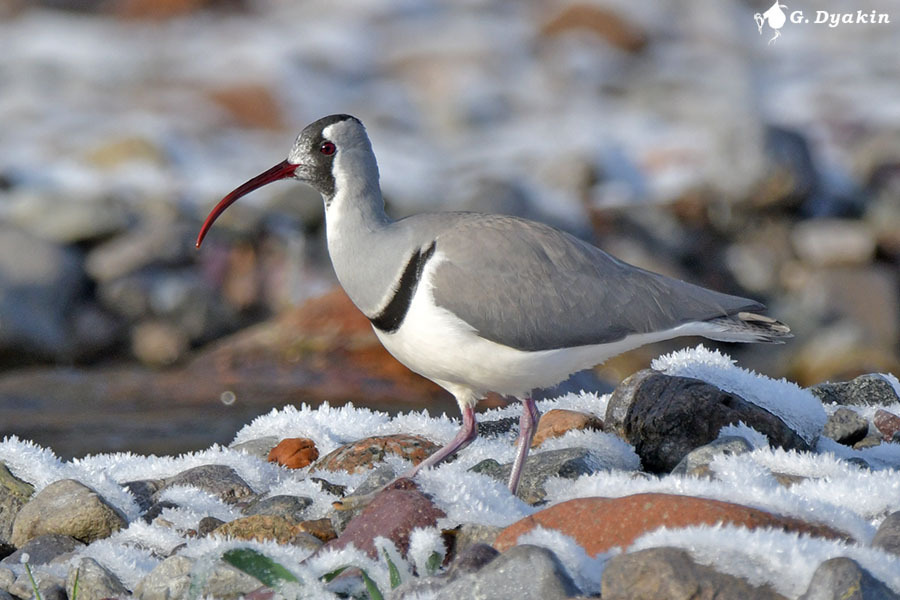
A grey shorebird with a crimson, down-curved bill and a black face and breast band, living on the shingle beds of fast mountain rivers across High Asia. It is so distinct that it sits in a family of its own.
The ibisbill is a bird related to the waders, but sufficiently distinctive to merit its own family Ibidorhynchidae. It is grey with a white belly, red legs and long down-curved bill, and a black face and black breast band. It occurs on the shingle riverbanks of the high plateaux of central Asia and the Himalayas. Wikipedia
What it can do
- iProbes under stones in fast-flowing glacial rivers for larvae
- iiCamouflaged grey plumage matches river shingle
- iiiBreeds at altitudes up to about 4,400 m
In the field
Field marks
- aGrey-brown upperparts and grey neck and breast
- bLong, down-curved crimson bill
- cBlack face and black breast band bordered with white
- dRed legs (duller outside breeding season)
- Voice
- A ringing, whistled 'klee-klee' and a 'tee-tee-tee' trill, carrying over the noise of rivers
- Not to be confused with
- No real lookalike: curlews and whimbrels are brown, streaked and lack the black breast band and red bill.
- Where to see it
- Hunza and Chitral rivers in northern Pakistan; Indus valley near Leh in Ladakh; Langtang and Mustang in Nepal; mountain rivers near Beijing in winter
- When
- Resident, moving to lower river valleys in winter
Listen
Looking for field recordings…
Life & habits
- Diet
- Aquatic insects and larvae, small fish and crustaceans
- Habitat
- Shingle and stony braided river beds in mountain valleys, roughly 1,700–4,400 m
- Size
- About 38–41 cm long
Wades in rushing water, reaching under stones with its curved bill; very hard to spot until it moves.
Where it lives
Recorded sightings
—
geo-referenced records in GBIF, from museums, herbaria and field observers.
Native range
Mountains of Central and High Asia: Kazakhstan, Kyrgyzstan and Tajikistan through northern Pakistan, Ladakh, Nepal, Bhutan and Tibet to northern and central China
Drag the globe to turn it. Dots are where records exist, not a range map; darker means more records.
In the stacks
Searching the stacks…
Every page naming Ibidorhyncha struthersii in the Biodiversity Heritage Library →
Marginalia
It is a prize sighting for birders visiting the Karakoram and Ladakh, where its grey plumage vanishes against river stones.
Curiosity
It is the only member of the family Ibidorhynchidae.
Kinship



Photographs: iNaturalist contributors under the licences shown. Records: GBIF.org. Historical plates: Source Library (CC BY-SA 4.0; originals public domain). Summary text: Nature Library editors and Wikipedia (CC BY-SA). Medicinal and edibility notes are historical and educational, not advice. iNaturalist taxon 4908.