 NL·0076
Herbarium of the Nature Library
- Name
- Hypericum perforatum
- Family
- Hypericaceae
- Native to
- Europe, North Africa and Western & Central Asia; invasive in North America, Australia and elsewhere
- Habitat
- Temperate grassland, Disturbed ground, Open woodland
St John's wort
Hypericum perforatum
Also calledJohanniskraut (German) · Hierba de San Juan (Spanish) · Hufārīqūn (Unani/Arabic, from Greek hyperikon) · Guàn yè lián qiáo 贯叶连翘 (Chinese) · Klamath weed (US)
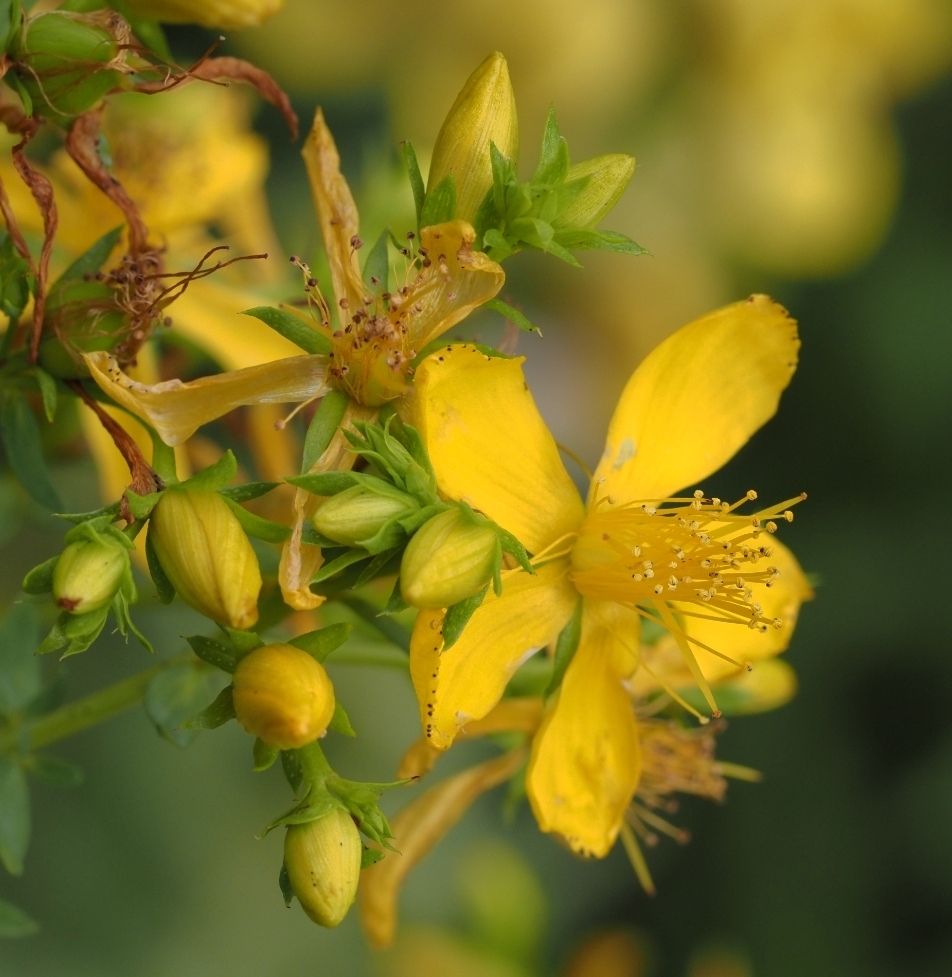
A golden-flowered meadow perennial that blooms around midsummer, St John's Day. Its leaves are pricked with translucent oil glands and its flowers bleed red. It works as an antidepressant, but also speeds up the liver's clearance of many prescription drugs.
Hypericum perforatum, commonly known as St. John's wort, is a flowering plant in the family Hypericaceae. It is a hairless, perennial herb with woody roots, yellow flowers marked by black glands, and leaves that appear perforated due to translucent glands, producing thousands of seeds per plant. Wikipedia
What it can do
- iExtracts containing hyperforin and hypericin outperform placebo for mild to moderate depression in clinical trials
- iiTranslucent leaf glands make the leaves look perforated when held to the light
- iiiFlowers stain the fingers and oils red with hypericin
- ivHypericin is photodynamic: grazing animals that eat it can suffer severe sunburn (hypericism)
- vSpreads aggressively by seed and runners; a major rangeland weed outside its native range
At the table
Not a food. Toxic to livestock, which become photosensitised. In people it is taken only as standardised medicine.
In the medicine cabinet
| Tradition | Use |
|---|---|
| European folk medicine | Red flower oil for wounds, burns and nerve pain; tea for melancholy and bedwetting |
| Unani | Hufariqun used as a diuretic, wound-healer and for sciatica |
| Modern phytotherapy | Standardised extracts prescribed in Germany for mild to moderate depression |
Weight of evidence
Strong. An approved drug, or consistent results in well-run clinical trials.
Active compounds
hyperforin, hypericin, pseudohypericin, hyperoside, rutin, quercetin
Fruit & seed


Fruit
Capsule
Ripens: Late summer–autumn
Three-chambered dry capsule with many seeds.


Seed
~1 mm
Tiny, cylindrical, dark brown, finely pitted
- Dispersal
- Wind, water, animals and machinery; long-lived seed bank
- Germination
- Needs light; 1–3 weeks at 20 °C
Photographs from Wikimedia Commons under open licences; hover for the photographer, click for the file.
How to grow it
Hardiness (USDA zones)
USDA 3–8. Survives winters down to about -40 °C.
- Light
- Full sun
- Water
- Low
- Soil
- Well-drained, poor to average
- Propagation
- Seed or division
- To harvest
- Flowering tops in year 2
- Climates
- Temperate, Mediterranean
- 1Check local rules first: it is a declared noxious weed in many US states, Australia and elsewhere
- 2Surface-sow in spring
- 3Harvest the top third of flowering stems at peak bloom
- 4Macerate fresh flowers in olive oil in sun for 'red oil', or dry quickly for tea
Can it grow where you are?
Where it lives
Recorded sightings
—
geo-referenced records in GBIF, from museums, herbaria and field observers.
Native range
Europe, North Africa and Western & Central Asia; invasive in North America, Australia and elsewhere
Drag the globe to turn it. Dots are where records exist, not a range map; darker means more records.
In Gerard's Herball, 1597

Second Booke · Chap. 150 · p. 432 · read the page →
Of Saint Iohns woort.
John Gerard, The Herball, or Generall Historie of Plantes, London, 1597. What England's best-known herbal said of st john's wort, in its own spelling.
- The vertues
- S. Iohns woort, with his flowers and seede boiled and drunken, prouoketh vrine, and is right good against the stone in the bladder, and stoppeth the laske. The leaues stamped are good to be laide vpon burnings, scaldings, and all wounds; and also for rotten and filthie vlcers. The leaues, flowers, and seedes stamped, and put into a glasse with oile oliue, and set in the hot sunne for certaine weekes together, and then strained from those herbes, and the like quantitie of new put in, and sunned in like maner, doth make an oile of the colour of blood, which is a most pretious remedy for deep wounds, & those that are thorow the bodie, for sinewes that are prickt, or any wound made with a venomed weapon. I am accustomed to make a compound oile hereof, the making of which yee shall receiue at my hands, bicause that I knowe in the world there is not a better, no not naturall Balsam it selfe; for I dare vndertake to cure any such wound, as absolutely in each respect, if not sooner and better, as any man whatsoeuer shall or may with naturall Balsam.
- The place
- They grow very plentifully in the pastures in euery countrie.
- The time
- They flower and flourish for the most part in Iuly and August.
- The temperature
- S. Iohns woort, as Galen teacheth, is hot and drie, being of substance thinne.
- The names
- S. Iohns woort is called in Greeke ὑπερικόν: in Latine Hypericum: in shops Perforata: of diuers Fuga Demonum: in Dutch San Iohans kraut: in Italian Hyperico: in Spanish Caraconzillo: in French Mille pertuys: in English S. Iohns woort, or S. Iohns grasse.
Gerard wrote within Galenic humoral medicine, and his opinions, including about the peoples of the Americas and their crops, are those of 1590s London. His “vertues” are history, not advice. Transcription: Source Library (CC BY-SA 4.0). The whole chapter in the Herball Room.
In the old herbals & bestiaries
Woodcuts and engravings matched from the Source Library’s scanned books by name. Plates marked “relative” show a close kin rather than this exact species. Click a plate to read the page it came from, with translation.

The Great Herbary with all the figures of the herbs
1532 · p.164

On the Names of Plants
Hieronymus Bock (Tragus) · 1552 · p.144

The Dutch Herbarium or Herbal
Petrus Nylandt · 1670 · p.169

Hortus Eystettensis
Basilius Besler · 1640 · p.265

Commentaries on the Six Books of Pedanius Dioscorides on Medical Matter
Pietro Andrea Mattioli · 1565 · p.1110

Commentaries on the Six Books of Dioscorides
Pietro Andrea Mattioli · 1560 · p.637

Six Groups of the History of Plants
Rembert Dodoens · 1583 · p.96

Six Groups of the History of Plants
Rembert Dodoens · 1583 · p.99

Herbarium Portatile, Oder Behendes Kräuter- und Gewächs-Buch: Darinn nicht allein 1363. so wol Einheimische als Außländndische Kräuter mit Lateinisch und Deutscher Benennung abgebildet, sondern auch die meisten, so in der Medicin gebräuchlich, kürtzlich erkläret werden
Panckow, Thomas · 1656 · p.116
In the stacks
Searching the stacks…
Every page naming Hypericum perforatum in the Biodiversity Heritage Library →
Marginalia
Medieval Europeans hung it over doors on St John's Eve (23 June) to repel evil spirits, and it was known as fuga daemonum, 'devil's flight'. Dioscorides and Pliny recommended hyperikon for sciatica and burns.
Curiosity
In the 1940s California released Chrysolina leaf beetles against Klamath weed, as St John's wort was called there. It became one of the first great successes of biological weed control.
Kinship



Fact-checked: 1 correction made to this sheet. Photographs: iNaturalist contributors under the licences shown. Records: GBIF.org. Historical plates: Source Library (CC BY-SA 4.0; originals public domain). Summary text: Nature Library editors and Wikipedia (CC BY-SA). Medicinal and edibility notes are historical and educational, not advice. iNaturalist taxon 56077.