 NL·0336
Herbarium of the Nature Library
- Name
- Horornis diphone
- Family
- Cettiidae
- Native to
- Japan and nearby islands including Sakhalin and the Ryukyus; related forms in Korea, eastern China and Taiwan treated as part of this species by some authorities; introduced to Hawaii
- Habitat
- Temperate forest, Bamboo thicket, Scrub
On eBird ↗
Japanese Bush Warbler
Live sightings near you, the range map, bar charts of when it is seen, and Macaulay Library photos and recordings.
Japanese bush warbler
Horornis diphone
Also calledUguisu 鶯 (Japanese) · Rìběn shù yīng 日本树莺 (Chinese) · Japanese nightingale
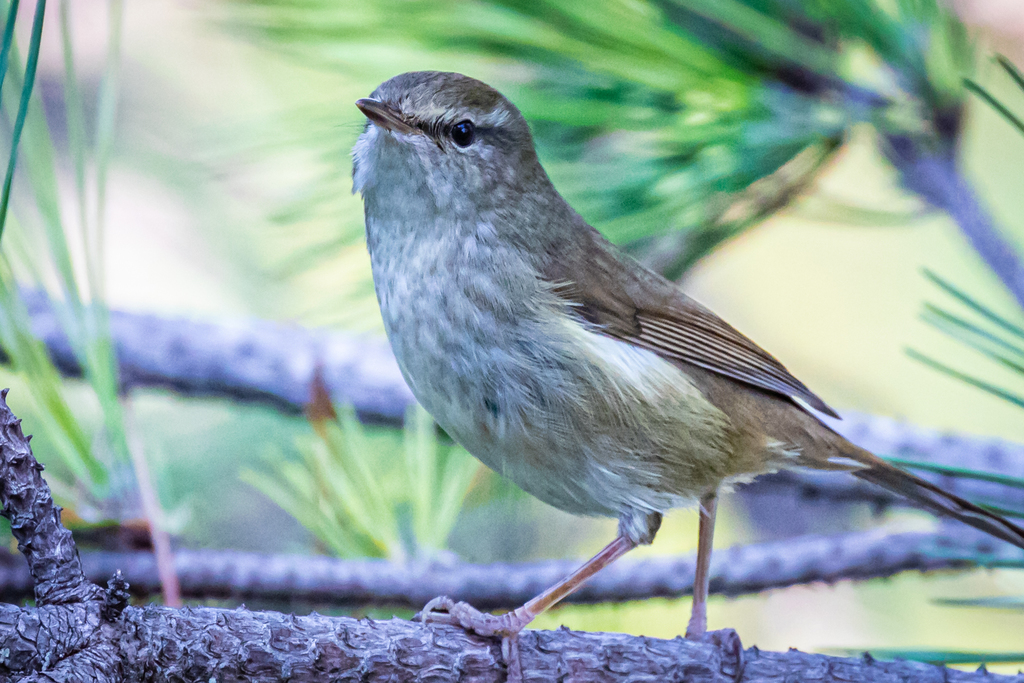
A drab olive-brown warbler that hides in bamboo thickets but announces spring across Japan with its clear, rising whistle 'hoo-hokekyo'. It is so central to Japanese culture that its name became a byword for a beautiful voice.
The Japanese bush warbler, known in Japanese as uguisu (鶯), is an Asian passerine bird more often heard than seen. Its distinctive breeding song can be heard throughout much of Japan from the start of spring. Wikipedia
What it can do
- iSong carries far from deep cover despite the bird's small size
- iiMales sing almost continuously through spring and summer
- iiiIntroduced population thrives in Hawaiian forests
In the field
Field marks
- aPlain olive-brown upperparts and buffy-grey underparts
- bPale eyebrow stripe
- cRounded tail and short wings
- dLacks the bright eye-ring and yellow-green tones of the Japanese white-eye
- Voice
- A long, rising whistle followed by an explosive flourish, written 'hoo-hokekyo'; also a rapid 'kekyo-kekyo-kekyo' sequence
- Not to be confused with
- Japanese white-eye (mejiro) is brighter green with a white eye-ring and is often mistaken for the uguisu; Manchurian bush warbler is larger and browner.
- Where to see it
- City parks and temple gardens throughout Japan in spring, e.g. Kyoto's Higashiyama and Tokyo's Meiji Jingu forest; also Oahu, Hawaii
- When
- Resident; sings from late February to summer, in winter heard only as a call
Listen
Looking for field recordings…
Life & habits
- Diet
- Insects and spiders; some nectar and fruit
- Habitat
- Dense undergrowth, bamboo thickets, scrub and forest edge from lowland to mountains
- Size
- About 14–16 cm long (males larger than females)
Skulks low in dense vegetation and is rarely seen in the open; in winter it moves to lower ground and gives only short 'chat' calls.
Where it lives
Recorded sightings
—
geo-referenced records in GBIF, from museums, herbaria and field observers.
Native range
Japan and nearby islands including Sakhalin and the Ryukyus; related forms in Korea, eastern China and Taiwan treated as part of this species by some authorities; introduced to Hawaii
Drag the globe to turn it. Dots are where records exist, not a range map; darker means more records.
In the old herbals & bestiaries
No plate in the Source Library names this exact species, so these show its closest relatives as the old naturalists drew them: same genus, or the same kind of animal. Click a plate to read the page it came from, with translation.


In the stacks
Searching the stacks…
Every page naming Horornis diphone in the Biodiversity Heritage Library →
Marginalia
The Kokinshū (905) preface lists the uguisu singing among the blossoms as a voice of poetry, and its song is heard as 'Hokekyō', the Japanese name of the Lotus Sutra. Its droppings (uguisu no fun) were traditionally used in Japanese facial cosmetics.
Curiosity
The squeaking 'nightingale floors' (uguisubari) of Kyoto's Nijō Castle and Chion-in temple are named after the bird's chirping.
Kinship



Photographs: iNaturalist contributors under the licences shown. Records: GBIF.org. Historical plates: Source Library (CC BY-SA 4.0; originals public domain). Summary text: Nature Library editors and Wikipedia (CC BY-SA). Medicinal and edibility notes are historical and educational, not advice. iNaturalist taxon 980065.