 NL·0477
Herbarium of the Nature Library
- Name
- Electrophorus electricus
- Family
- Gymnotidae
- Native to
- Guiana Shield rivers of the Guianas, northern Brazil and southern Venezuela (since 2019 two other electric eel species are recognised elsewhere in the Amazon)
- Habitat
- Clearwater and blackwater rivers, Swamps, Flooded forest
Electric eel
Electrophorus electricus
Also calledPoraquê (Portuguese, from Tupi) · Anguila eléctrica (Spanish) · Temblador (Venezuelan Spanish)
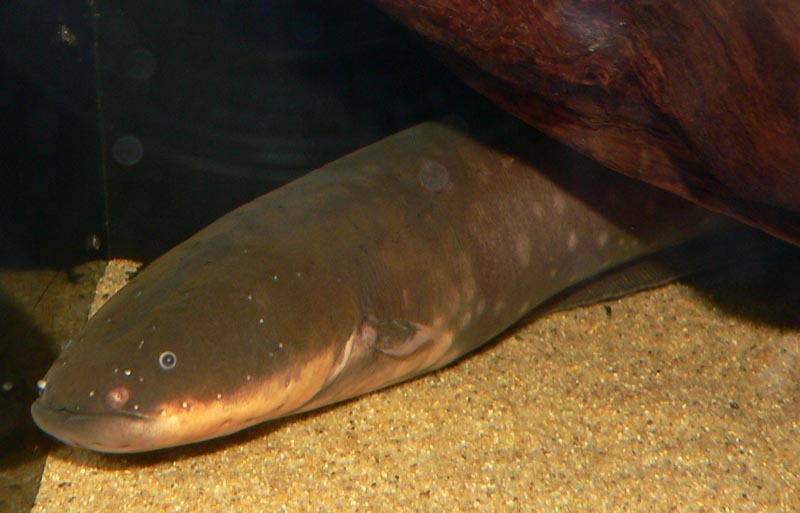
Not an eel at all but a knifefish, with organs of modified muscle that fill most of its body and can deliver shocks of several hundred volts. It breathes air through its mouth and leaps out of the water to shock threats directly.
Electrophorus electricus is the best-known species of electric eel. It is a South American electric fish. Until the discovery of two additional species in 2019, the genus was classified as the monotypic, with this species the only one in the genus. Despite the name, it is not an eel, but rather a knifefish. It is considered as a freshwater teleost which contains an electrogenic tissue that produces electric discharges. Wikipedia
What it can do
- iGenerates high-voltage discharges from three electric organs to stun prey and deter predators; the closely related Volta's electric eel reaches about 860 V
- iiUses weak electric pulses to sense its surroundings and to communicate (electrolocation)
- iiiFires rapid pulse trains that make hidden prey twitch and reveal itself
- ivGets most of its oxygen by gulping air, through a heavily vascularised mouth lining
- vLeaps out of the water and presses its chin against a threat to send current straight into it
In the field
Field marks
- aLong, cylindrical, scaleless body; dark grey-brown to olive above, often with an orange or reddish throat
- bNo dorsal, pelvic or tail fins; a long anal fin runs along most of the underside and drives swimming
- cFlattened head with small eyes; vent far forward, just behind the head
- dRegularly surfaces to gulp air
- Not to be confused with
- Volta's electric eel (E. voltai) of the Brazilian Shield and Vari's electric eel (E. varii) of the Amazon lowlands look nearly identical and are separated mainly by skull shape, DNA and range. True eels (Anguilla) have dorsal and tail fins, and swamp eels (Synbranchidae) lack the long anal fin.
- Where to see it
- Rivers of the Guiana Shield in Suriname, French Guiana and Guyana; public aquaria worldwide
- When
- Resident; breeds in the dry season
Life & habits
- Diet
- Carnivore: fish, crustaceans and amphibians; juveniles eat invertebrates
- Habitat
- Slow, muddy or rocky streams, pools and swamps, often in oxygen-poor water
- Size
- Up to about 2 m and 20 kg
- Lifespan
- Poorly known in the wild; 15–20+ years in captivity
Rises to gulp air every few minutes. Males build foam nests from saliva in the dry season and guard the young, and in Volta's electric eel groups have been seen herding and shocking fish together.
Where it lives
Recorded sightings
—
geo-referenced records in GBIF, from museums, herbaria and field observers.
Native range
Guiana Shield rivers of the Guianas, northern Brazil and southern Venezuela (since 2019 two other electric eel species are recognised elsewhere in the Amazon)
Drag the globe to turn it. Dots are where records exist, not a range map; darker means more records.
In the stacks
Searching the stacks…
Every page naming Electrophorus electricus in the Biodiversity Heritage Library →
Marginalia
In 1800 Alexander von Humboldt watched fishermen in the Venezuelan Llanos drive horses into a pool so electric eels would exhaust their charge on them before being caught. Michael Faraday used an electric eel in London in 1838 to show that animal electricity is the same as ordinary electricity.
Curiosity
The electric eel's organs contain thousands of stacked cells called electrocytes. Each makes only about 0.15 V, but connected in series they add up to hundreds of volts.
Kinship



Fact-checked: 1 correction made to this sheet. Photographs: iNaturalist contributors under the licences shown. Records: GBIF.org. Historical plates: Source Library (CC BY-SA 4.0; originals public domain). Summary text: Nature Library editors and Wikipedia (CC BY-SA). Medicinal and edibility notes are historical and educational, not advice. iNaturalist taxon 99786.