 NL·0421
Herbarium of the Nature Library
- Name
- Dytiscus marginalis
- Family
- Dytiscidae
- Native to
- Europe and northern Asia
- Habitat
- Ponds, Lakes, Wetlands
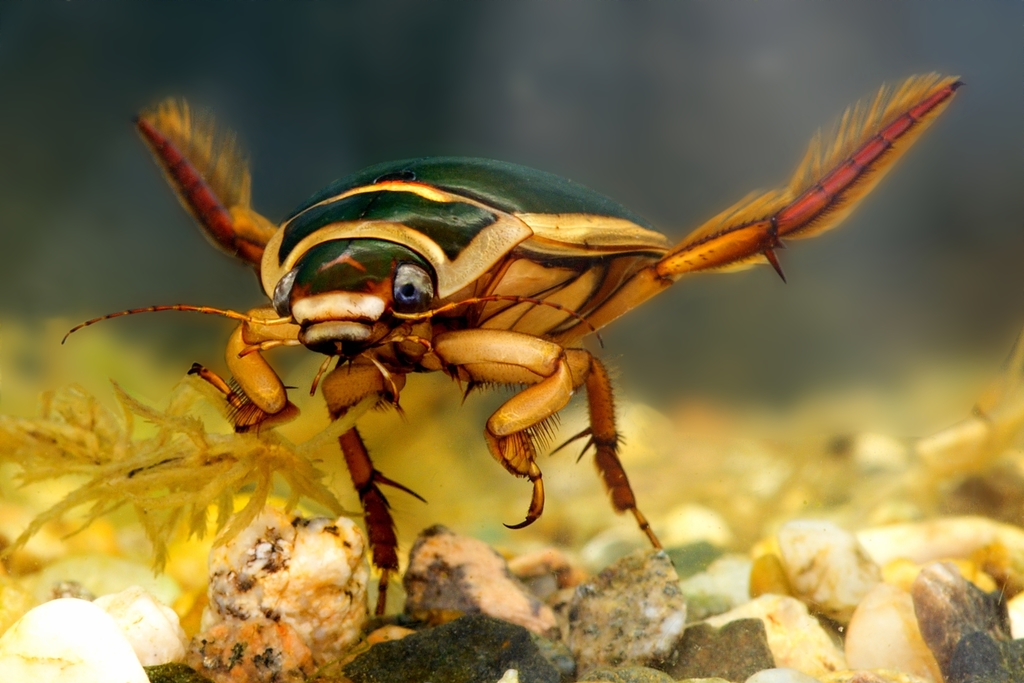
Great diving beetle
Dytiscus marginalis
Also calledGelbrandkäfer (German) · Dytique bordé (French) · Ditisco (Spanish) · Pływak żółtobrzeżek (Polish)
A large predatory water beetle that carries its air supply in a bubble beneath its wing cases. Adults and their fearsome larvae, 'water tigers', hunt tadpoles, newts and even small fish.
The great diving beetle is an aquatic diving beetle native to Europe and northern Asia, and in the UK is common in Wales, much of England and southern Scotland but less common on chalk and in the far north. The great diving beetle, true to its name, is a rather large insect. The larvae can grow up to 60 millimetres (2.4 in) in length, while the adults are generally 27–35 millimetres (1.1–1.4 in). Wikipedia
What it can do
- iStores air under the wing cases and refills by poking its abdomen tip through the surface
- iiLarvae inject digestive enzymes through hollow, sickle-shaped jaws and suck out the liquefied prey
- iiiAdults fly at night between ponds and can mistake shiny car roofs and glasshouses for water
- ivRemains active under winter ice
In the field
Field marks
- aSmooth, oval, dark olive-black body
- bYellow border around the thorax and wing cases
- cMales have glossy wing cases and suction pads on the front feet; females usually have grooved wing cases
- dFringed, flattened hind legs used as oars
- Not to be confused with
- Great silver water beetle (Hydrophilus piceus) is larger, all black, has short clubbed antennae and moves its legs alternately. Other Dytiscus species are separated by the shape of the yellow border and underside colour.
- Where to see it
- Garden ponds and vegetated lakes across Europe; often netted in pond-dipping sessions.
- When
- Active year-round; most often seen spring to late summer
Listen
Looking for field recordings…
Life & habits
- Diet
- Tadpoles, insect larvae, snails, newts, small fish and carrion
- Habitat
- Well-vegetated ponds, lakes, ditches and slow rivers
- Size
- About 2.7–3.5 cm
- Lifespan
- Adults can live several years
It swims with both hind legs stroking together like oars, unlike scavenger water beetles which move them alternately.
Where it lives
Recorded sightings
—
geo-referenced records in GBIF, from museums, herbaria and field observers.
Native range
Europe and northern Asia
Drag the globe to turn it. Dots are where records exist, not a range map; darker means more records.
In the stacks
Searching the stacks…
Every page naming Dytiscus marginalis in the Biodiversity Heritage Library →
Marginalia
Curiosity
The male's front feet bear sucker discs that help him grip the female during mating; the ridges on many females' wing cases are thought to make that grip harder.
Kinship

Fact-checked: 1 correction made to this sheet. Photographs: iNaturalist contributors under the licences shown. Records: GBIF.org. Historical plates: Source Library (CC BY-SA 4.0; originals public domain). Summary text: Nature Library editors and Wikipedia (CC BY-SA). Medicinal and edibility notes are historical and educational, not advice. iNaturalist taxon 127299.