 NL·0022
Herbarium of the Nature Library
- Name
- Dracaena cinnabari
- Family
- Asparagaceae
- Native to
- Endemic to the Socotra archipelago, Yemen
- Habitat
- Arid montane woodland, Limestone plateaus
Socotra dragon tree
Dracaena cinnabari
Also calledDam al-akhawayn ('blood of the two brothers', Arabic) · Arhiyeb (Soqotri) · Dragon's blood tree (English) · Árbol de sangre de dragón (Spanish)
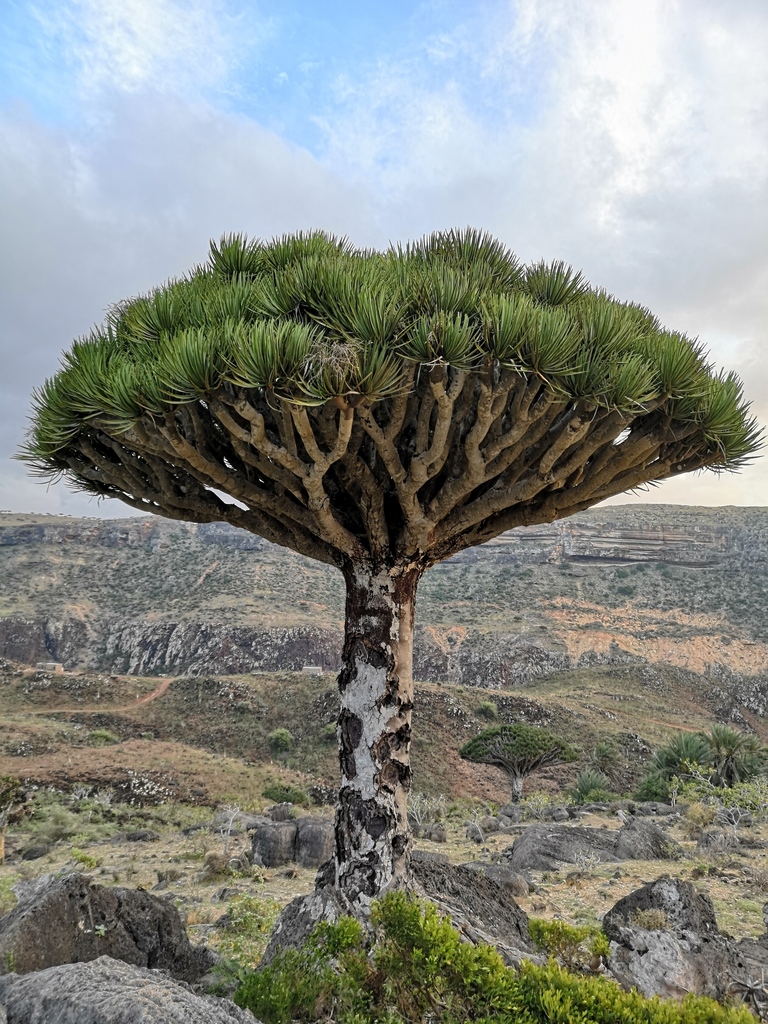
An umbrella-shaped tree found only on the island of Socotra, whose bark bleeds a deep red resin, the 'dragon's blood' traded across the ancient world. Its dense, upturned crown catches mist and shades its own roots in a harsh, dry climate.
Dracaena cinnabari, the Socotra dragon tree, or dragon blood tree, is a dragon tree native to the Socotra archipelago, part of Yemen, located in the Arabian Sea. It is named after the blood-like color of the red sap that the trees produce. It is also the national tree of Yemen. Wikipedia
What it can do
- iIts umbrella crown condenses mist and funnels water down the branches while shading the soil
- iiExudes a red resin (dragon's blood) when the bark is cut
- iiiSurvives on fog and monsoon moisture on dry limestone plateaus
- ivShades seedlings of other species, creating micro-habitats on bare ground
At the table
Not a food; resin is used medicinally and as a dye. Livestock graze seedlings.
In the medicine cabinet
| Tradition | Use |
|---|---|
| Socotri folk medicine | Resin applied to wounds and burns and taken for diarrhoea and fevers |
| Greco-Roman medicine (Dioscorides, as 'kinnabari') | Resin as an astringent for wounds and eye problems |
Weight of evidence
Traditional. Long historical use; little or no modern clinical evidence.
Active compounds
flavonoids, homoisoflavonoids, dracorhodin-type pigments
Fruit & seed
Fruit
Berry
Ripens: After flowering in early year
Small orange-red berries eaten by birds.
Seed
~5 mm
Round seeds 1–3 per berry
- Dispersal
- Birds
- Germination
- Sow fresh in warm, free-draining mix; germination slow
How to grow it
Hardiness (USDA zones)
USDA 10–11. Survives winters down to about -1 °C.
- Light
- Full sun
- Water
- Low
- Soil
- Very free-draining, mineral
- Propagation
- Seed
- To harvest
- Ornamental; extremely slow
- Climates
- Arid, Subtropical
- 1Sow fresh seed in gritty mix at 25 °C
- 2Grow on in bright light, letting it dry between waterings
- 3Keep frost-free; overwatering causes rot
- 4Be patient: it may take decades to branch
Can it grow where you are?
Where it lives
Recorded sightings
—
geo-referenced records in GBIF, from museums, herbaria and field observers.
Native range
Endemic to the Socotra archipelago, Yemen
Drag the globe to turn it. Dots are where records exist, not a range map; darker means more records.
In the old herbals & bestiaries
Woodcuts and engravings matched from the Source Library’s scanned books by name. Plates marked “relative” show a close kin rather than this exact species. Click a plate to read the page it came from, with translation.

The Great Herbary with all the figures of the herbs
1532 · p.299

Compendium of Materia Medica
李時珍 · 1596 · p.116

Collected Illustrations of the Three Realms: Plants and Trees
王圻, 王思義 · 1609 · p.50

Illustrated Herbal Primer
Chen Jiamo (陳嘉謨) · 1628 · p.210

Herbarium Portatile, Oder Behendes Kräuter- und Gewächs-Buch: Darinn nicht allein 1363. so wol Einheimische als Außländndische Kräuter mit Lateinisch und Deutscher Benennung abgebildet, sondern auch die meisten, so in der Medicin gebräuchlich, kürtzlich erkläret werden
Panckow, Thomas · 1656 · p.179
In the stacks
Searching the stacks…
Every page naming Dracaena cinnabari in the Biodiversity Heritage Library →
Marginalia
Socotra's resin is thought to be the 'cinnabar' of Pliny and the Periplus of the Erythraean Sea. A Socotri legend says the trees first grew from the blood of two brothers who fought to the death.
Curiosity
It branches only when its growing tip stops, usually after flowering, so the forks of its umbrella crown record the tree's flowering history.
Kinship

Fact-checked: 1 correction made to this sheet. Photographs: iNaturalist contributors under the licences shown. Records: GBIF.org. Historical plates: Source Library (CC BY-SA 4.0; originals public domain). Summary text: Nature Library editors and Wikipedia (CC BY-SA). Medicinal and edibility notes are historical and educational, not advice. iNaturalist taxon 124825.