 NL·0398
Herbarium of the Nature Library
- Name
- Carassius auratus
- Family
- Cyprinidae
- Native to
- Eastern Asia (China and nearby); ornamental and feral populations worldwide
- Habitat
- Ponds, Lakes, Slow rivers
Goldfish
Carassius auratus
Also calledJīnyú 金鱼 (Chinese) · Kingyo 金魚 (Japanese) · Sunehri machhli سنہری مچھلی (Urdu) · Peixe-dourado (Portuguese) · Pez dorado (Spanish)
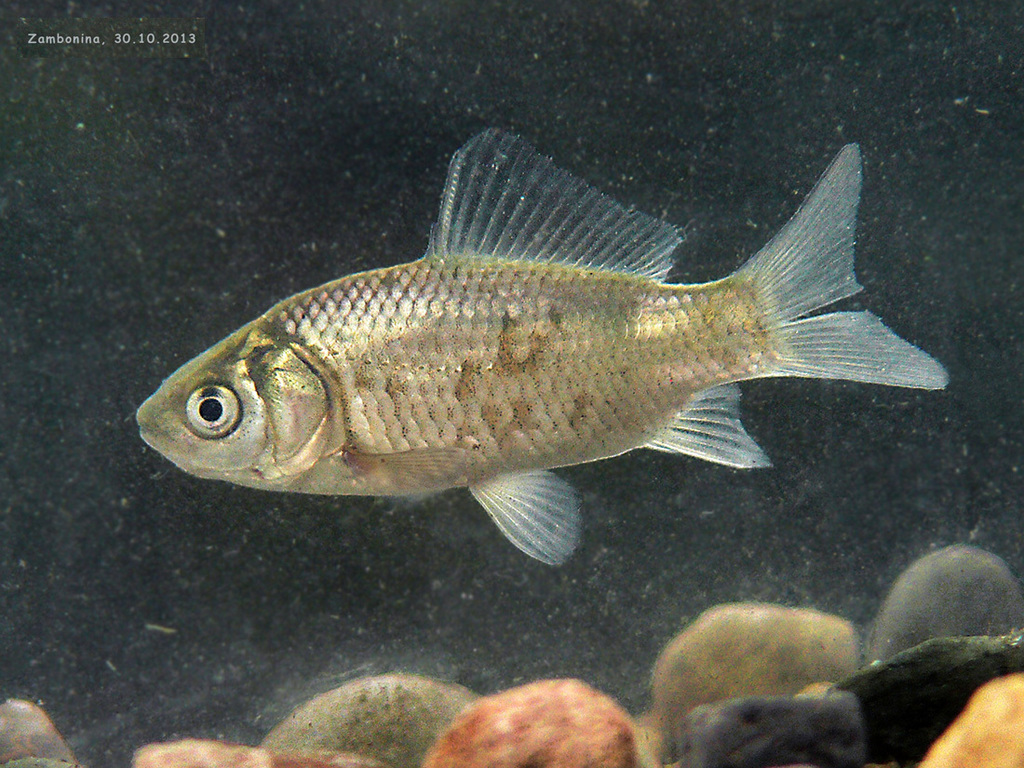
Domesticated in China from a drab olive carp over more than a thousand years, the goldfish was one of the first fish ever kept for beauty. Feral goldfish released into lakes revert to dull colours, grow large and become destructive invaders.
The goldfish is a freshwater fish in the family Cyprinidae of the order Cypriniformes. It is commonly kept as a pet in indoor aquariums, and is one of the most popular aquarium fish. Goldfish released into the wild have become an invasive pest in parts of North America and Australia. Wikipedia
What it can do
- iSurvives months under ice: in oxygen-free water it makes ethanol instead of lactic acid and releases it through its gills
- iiCan be trained to respond to sounds, colours and lights, and remembers the training for months (the 'three-second memory' is a myth)
- iiiBreeders have produced dramatic forms such as telescope eyes, bubble eyes, lionheads and double tails
In the field
Field marks
- aDeep carp-like body with no barbels
- bOrange, red, white, black or calico in ornamental forms; feral fish olive-bronze
- cLong dorsal fin with a serrated spine
- dFancy breeds with paired (twin) tails, long fins or modified eyes
- Not to be confused with
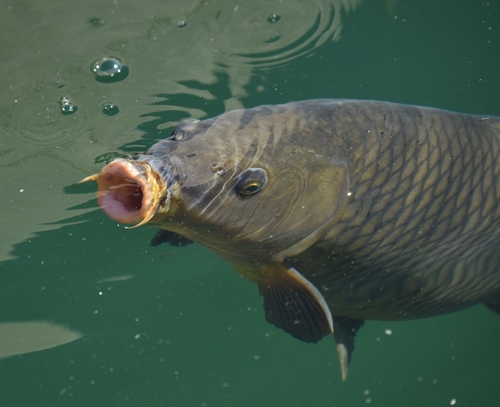
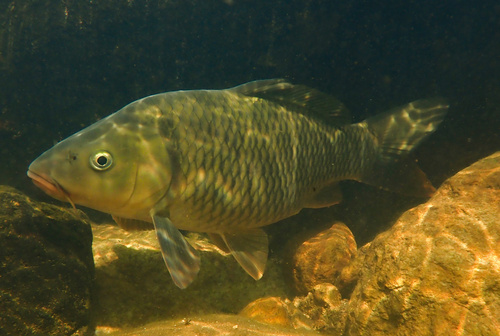
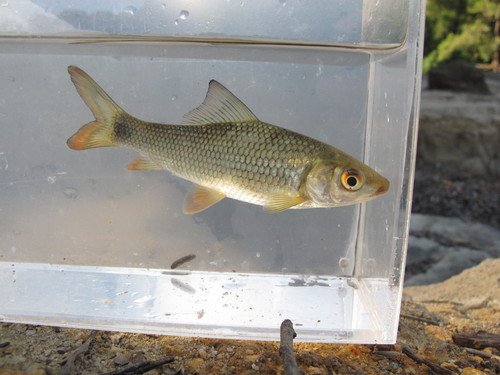
- Common carp and koi have two pairs of barbels. Crucian carp (Carassius carassius) has a more rounded, convex dorsal fin and a dark spot at the tail base in young fish. Prussian carp (C. gibelio) is the closest relative and is hard to tell apart without counting gill rakers.
- Where to see it
- Fancy-goldfish breeders in Hangzhou and Fuzhou (China) and Yatomi, Aichi (Japan); feral populations in Lake Tahoe and many urban ponds
- When
- Resident; spawns April–July
Life & habits
- Diet
- Omnivore: algae, plant matter, insect larvae, crustaceans and detritus
- Habitat
- Still, weedy ponds, lakes and sluggish rivers; aquaria
- Size
- Usually 10–20 cm; feral fish to 40 cm and over 2 kg
- Lifespan
- 10–20 years with good care; over 40 recorded
Grazes and sifts the bottom constantly. In spring, males chase females through plants until they scatter sticky eggs.
Where it lives
Recorded sightings
—
geo-referenced records in GBIF, from museums, herbaria and field observers.
Native range
Eastern Asia (China and nearby); ornamental and feral populations worldwide
Drag the globe to turn it. Dots are where records exist, not a range map; darker means more records.
In the old herbals & bestiaries
No plate in the Source Library names this exact species, so these show its closest relatives as the old naturalists drew them: same genus, or the same kind of animal. Click a plate to read the page it came from, with translation.

In the stacks
Searching the stacks…
Every page naming Carassius auratus in the Biodiversity Heritage Library →
Marginalia
Red-gold variants of the wild carp were kept in Buddhist monastery 'release ponds' in China by the Song dynasty (10th–13th centuries), and bowl-bred fancy varieties appeared by the Ming. Goldfish reached Japan in the early 16th century and Europe in the 17th, where Samuel Pepys saw them as a novelty in 1665.
Curiosity
Goldfish and crucian carp are among the very few vertebrates that make alcohol: in airless water their muscles turn sugar into ethanol so they can survive months under ice.
Kinship



Photographs: iNaturalist contributors under the licences shown. Records: GBIF.org. Historical plates: Source Library (CC BY-SA 4.0; originals public domain). Summary text: Nature Library editors and Wikipedia (CC BY-SA). Medicinal and edibility notes are historical and educational, not advice. iNaturalist taxon 58612.