 NL·0168
Herbarium of the Nature Library
- Name
- Camellia sinensis
- Family
- Theaceae
- Native to
- South-west China (Yunnan) and adjacent northern Myanmar, Laos and north-east India; cultivated in Asia, East Africa and South America
- Habitat
- Subtropical montane forest, Hill plantations
Tea plant
Camellia sinensis
Also calledChá (Chinese) · Chai (Hindi/Urdu/Persian/Russian) · Shāy (Arabic) · Cha (Japanese) · Çay (Turkish) · Té (Spanish) · Lahpet (Burmese, pickled tea)
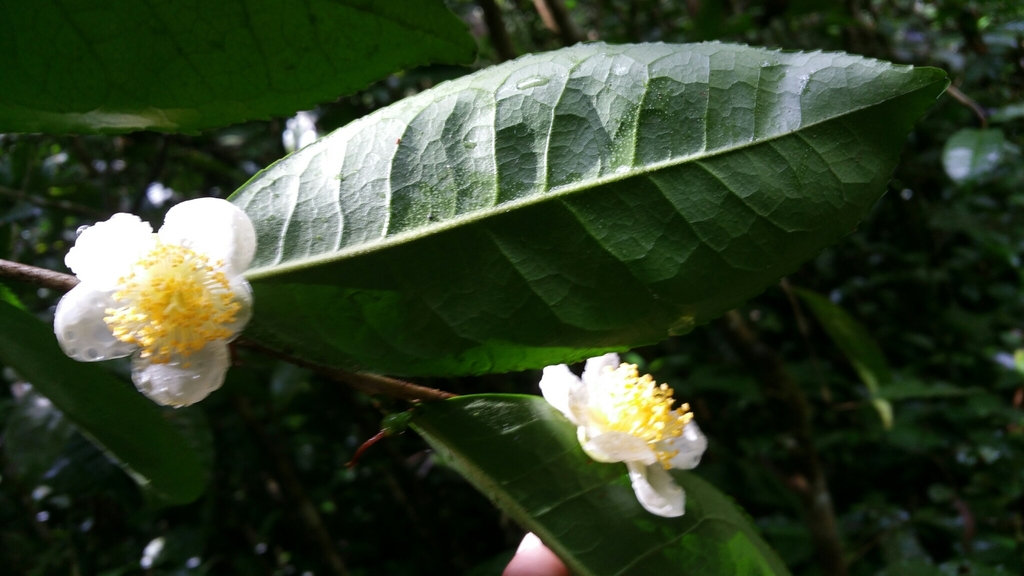
An evergreen camellia whose young leaves give every true tea — white, green, oolong, black and pu-erh differ only in processing. Left unpruned it becomes a tree; some Assam-type trees in Yunnan are claimed to exceed 1,000 years old.
Camellia sinensis, commonly known as tea plant, tea shrub, and tea tree, is a species of evergreen shrub in the flowering plant family Theaceae. Originally native to the highlands of the Hengduan–Purvanchal region between southwestern China, northern Myanmar and northeastern India, the leaves, buds and stems of C. sinensis are harvested by humans to produce tea, leading to its artificial introduction and cultivation as valuable cash crops in many other parts of the world, with China, India and Kenya being the three largest tea-producing countries. Wikipedia
What it can do
- iAccumulates fluoride and aluminium from acid soils in its leaves
- iiContains L-theanine, an amino acid almost unique to tea, which smooths caffeine's effect
- iiiCan be repeatedly plucked: the bush regrows a fresh 'flush' every few weeks
- ivTrees can live for many centuries
At the table
Eatenyoung leaves and buds (brewed) · leaves (fermented and eaten as lahpet in Myanmar) · seed oil (cooking oil in China)
Leaves are brewed or pickled. Very strong tea in excess can cause stomach upset and reduce iron absorption.
In the medicine cabinet
| Tradition | Use |
|---|---|
| Traditional Chinese Medicine | Green tea to clear heat, refresh the mind and aid digestion; described in Lu Yu's Classic of Tea (c. 760 CE) |
| Zen Buddhism (Japan) | Eisai's 'Kissa Yōjōki' (1211) promoted tea for long life and wakefulness in meditation |
| Modern medicine | Green-tea catechin ointment (sinecatechins) is a US FDA-approved drug for genital warts |
Weight of evidence
Strong. An approved drug, or consistent results in well-run clinical trials.
Active compounds
caffeine, L-theanine, epigallocatechin gallate (EGCG), theaflavins, theobromine
Fruit & seed


Fruit
Capsule
Ripens: Autumn (a year after flowering)
Woody, round to three-lobed capsule 2–3 cm, green turning brown, splitting to release 1–3 seeds.


Seed
1–1.5 cm
Round to hemispherical, hard, smooth dark-brown seeds 1–1.5 cm across, oily inside
- Dispersal
- Gravity; rolled and cached by rodents
- Germination
- Short-lived: soak fresh seed 24 hours, discard floaters, sow 2–3 cm deep at 20–25 °C; 1–3 months
Photographs from Wikimedia Commons under open licences; hover for the photographer, click for the file.
How to grow it
Hardiness (USDA zones)
USDA 7–9 (var. sinensis); 9–11 (var. assamica). Survives winters down to about -18 °C.
- Light
- Partial shade to full sun in cooler areas
- Water
- Moderate–high; at least 1,200 mm rain or regular irrigation
- Soil
- Acidic (pH 4.5–6), well-drained, humus-rich
- Propagation
- Single-leaf cuttings of selected clones, or seed
- To harvest
- 3 years before regular plucking
- Climates
- Humid subtropical, Tropical highland, Warm temperate
- 1Plant a rooted cutting in acidic, free-draining soil; in alkaline areas grow in a large pot of ericaceous compost.
- 2Mulch with pine bark or leaf litter and water with rainwater if tap water is hard.
- 3Prune back to about 75–100 cm in the second and third years to make a flat-topped, bushy 'plucking table'.
- 4Pluck 'two leaves and a bud' from new flushes in spring and summer.
- 5For green tea, steam or pan-fire leaves within hours, roll, and dry; for black tea, wither, roll to bruise, let oxidise 1–3 hours, then dry.
Can it grow where you are?
Where it lives
Recorded sightings
—
geo-referenced records in GBIF, from museums, herbaria and field observers.
Native range
South-west China (Yunnan) and adjacent northern Myanmar, Laos and north-east India; cultivated in Asia, East Africa and South America
Drag the globe to turn it. Dots are where records exist, not a range map; darker means more records.
In the old herbals & bestiaries
Woodcuts and engravings matched from the Source Library’s scanned books by name. Plates marked “relative” show a close kin rather than this exact species. Click a plate to read the page it came from, with translation.

De Indiae utriusque re naturali et medica
Willem Piso · 1658 · p.490

Exotic Pleasures (Persia and Asia observations)
Engelbert Kaempfer · 1712 · p.676

農業全書 11巻. [7]
Miyazaki Yasusada · 1697 · p.3

Compendium of Materia Medica
李時珍 · 1596 · p.84

Illustrated Compendium of Materia Medica (Vol. 32)
吳其濬 · 1848 · p.30

The Embassy of the Dutch East India Company to the Tartar Cham
Johan Nieuhof · 1665 · p.421

Kircher: China Illustrata (1667)
Athanasius Kircher · 1667 · p.247

Collected Illustrations of the Three Realms: Trees
王圻, 王思義 · 1609 · p.64

The Book of Household Management
Mrs Isabella Beeton · 1861 · p.952
In the stacks
Searching the stacks…
Every page naming Camellia sinensis in the Biodiversity Heritage Library →
Marginalia
Chinese legend says the emperor Shennong discovered tea in 2737 BCE when leaves blew into his boiling water. In 1848–51 the Scottish botanist Robert Fortune smuggled tea plants and seeds out of China for the East India Company, helping found the tea gardens of Darjeeling.
Curiosity
Almost every word for tea worldwide descends from either 'te' (via Dutch traders in Fujian, by sea) or 'cha' (by land along the Silk Road).
Kinship



Photographs: iNaturalist contributors under the licences shown. Records: GBIF.org. Historical plates: Source Library (CC BY-SA 4.0; originals public domain). Summary text: Nature Library editors and Wikipedia (CC BY-SA). Medicinal and edibility notes are historical and educational, not advice. iNaturalist taxon 123005.