 NL·0290
Herbarium of the Nature Library
- Name
- Bos gaurus
- Family
- Bovidae
- Native to
- India, Nepal, Bhutan, Bangladesh, Myanmar, Thailand, Laos, Cambodia, Vietnam, Peninsular Malaysia and southern China
- Habitat
- Tropical forest, Moist deciduous forest, Forest-edge grassland
Gaur
Bos gaurus
Also calledGaur (Hindi) · Kāṭṭerumai (Tamil) · Seladang (Malay) · Indian bison
The largest and tallest of all wild cattle, a black-brown forest giant with white stockings and a muscular ridge over its shoulders. India holds the great majority of the world's gaur, and in the Western Ghats herds have learned to graze tea estates and village edges.
The gaur, also known as the Indian bison, is a large bovine native to the Indian subcontinent and Southeast Asia, and has been listed as Vulnerable on the IUCN Red List since 1986. The global population was estimated at a maximum of 21,000 mature individuals in 2016, with the majority of those existing in India. It is the largest species among the wild cattle and the Bovidae. Wikipedia
What it can do
- iAdult bulls are so large that even tigers usually avoid them, taking calves instead
- iiShoulder ridge formed by tall spines on the vertebrae
- iiiClimbs steep forested hills up to about 2,800 m
In the field
Field marks
- aSilhouette: huge dark bovine with a high shoulder hump falling to the middle of the back
- bWhite or yellowish 'stockings' from hooves to knees
- cPale grey-buff boss of hair between the horns; horns curve up and inward
- dTracks: large cloven hoofprints about 13 cm long; dung like domestic cattle pats
- Not to be confused with
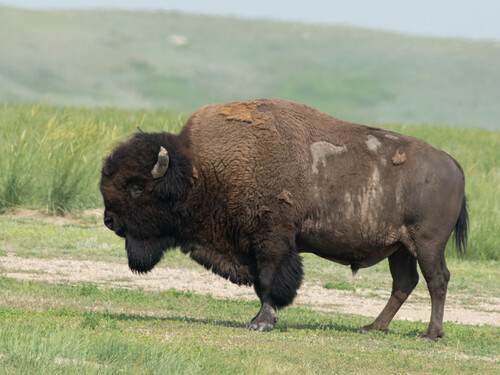
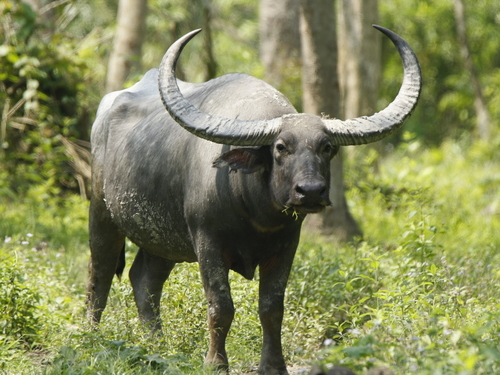
- Banteng (Southeast Asia) has a white rump patch and lacks the strong dorsal ridge. Wild water buffalo has flat, enormous swept-back horns and sparse grey coat. Mithun (domestic Bos frontalis of northeast India) is smaller with straighter horns.
- Where to see it
- Nagarhole, Bandipur (Karnataka); Kanha and Pench (Madhya Pradesh); Tadoba (Maharashtra); Periyar and Eravikulam (Kerala); Taman Negara (Malaysia); Kui Buri (Thailand)
- When
- Resident; herds visit forest meadows and salt licks in the dry season
Listen
Looking for field recordings…
Life & habits
- Diet
- Grasses, bamboo, shoots, leaves, bark and fruit
- Habitat
- Evergreen and deciduous forest with glades and water, usually hilly
- Size
- Shoulder height 1.7–2.2 m; bulls 650–1,500 kg
- Lifespan
- About 20–25 years
Herds of cows and young are led by an old female; bulls display by standing side-on to show their bulk, a broadside stance.
Where it lives
Recorded sightings
—
geo-referenced records in GBIF, from museums, herbaria and field observers.
Native range
India, Nepal, Bhutan, Bangladesh, Myanmar, Thailand, Laos, Cambodia, Vietnam, Peninsular Malaysia and southern China
Drag the globe to turn it. Dots are where records exist, not a range map; darker means more records.
In the stacks
Searching the stacks…
Every page naming Bos gaurus in the Biodiversity Heritage Library →
Marginalia
Gaur was the British 'Indian bison' of colonial hunting literature, and is the state animal of Goa and Bihar. Domesticated gaur, the mithun, are a measure of wealth and a sacrificial animal among Naga, Mizo and Adi communities.
Curiosity
A bull gaur can stand over 2 m at the shoulder, taller than an average man.
Kinship
Photographs: iNaturalist contributors under the licences shown. Records: GBIF.org. Historical plates: Source Library (CC BY-SA 4.0; originals public domain). Summary text: Nature Library editors and Wikipedia (CC BY-SA). Medicinal and edibility notes are historical and educational, not advice. iNaturalist taxon 74111.