 NL·0386
Herbarium of the Nature Library
- Name
- Basiliscus plumifrons
- Family
- Corytophanidae
- Native to
- Central America, from Honduras to western Panama
- Habitat
- Tropical rainforest, Riverbanks
Plumed basilisk
Basiliscus plumifrons
Also calledGreen basilisk · Double-crested basilisk · Jesus Christ lizard · Basilisco verde / Gallego (Spanish)
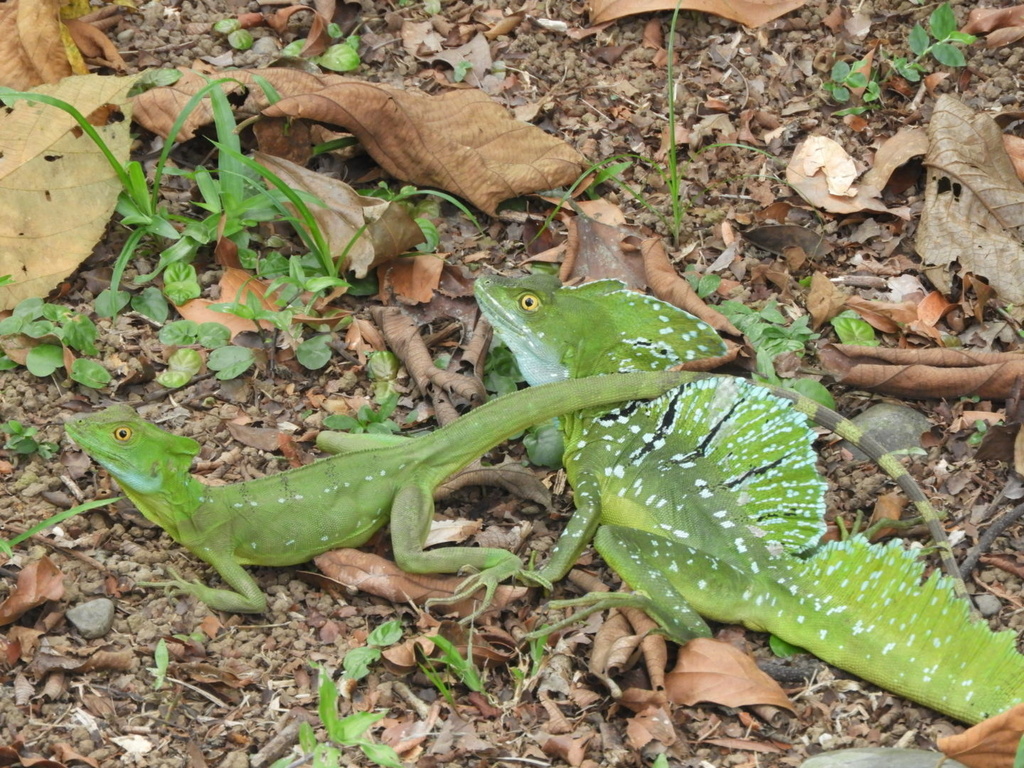
A bright green lizard of Central American streams, crowned with tall crests, that escapes predators by running across the surface of water on its hind legs.
The plumed basilisk, also called the green basilisk, double crested basilisk, or Jesus Christ lizard, is a species of lizard in the family Corytophanidae. The species is native to Central America. Wikipedia
What it can do
- iRuns on water for several metres by slapping its feet down and pulling them back before they sink
- iiFringes of scales on its toes increase the surface area of each step
- iiiSwims well and can stay underwater to hide
In the field
Field marks
- aBright green body with blue or white spots
- bMales have a double head crest and tall sail-like crests on the back and tail
- cLong hind legs with fringed toes
- dYellow-orange eyes
- Not to be confused with
- The common basilisk (B. basiliscus) and brown basilisk (B. vittatus) are brown with pale stripes. Young green iguanas are green but have a dewlap and no head crest.
- Where to see it
- Costa Rica's Caribbean lowlands: Tortuguero, La Selva, Sarapiquí; also Arenal
- When
- Resident
Life & habits
- Diet
- Insects, spiders, small vertebrates, fruit and flowers
- Habitat
- Trees and shrubs overhanging rainforest streams and rivers
- Size
- Up to ~90 cm including long tail
- Lifespan
- ~10 years in captivity
Basks on branches over water and drops in to escape. Young basilisks can run farther on water than adults, because they are light.
Where it lives
Recorded sightings
—
geo-referenced records in GBIF, from museums, herbaria and field observers.
Native range
Central America, from Honduras to western Panama
Drag the globe to turn it. Dots are where records exist, not a range map; darker means more records.
In the old herbals & bestiaries
No plate in the Source Library names this exact species, so these show its closest relatives as the old naturalists drew them: same genus, or the same kind of animal. Click a plate to read the page it came from, with translation.

Valeriano: Hieroglyphica (1575)
Relative · Pierio Valeriano · 1556 · p.219

Ortus sanitatis
Relative · 1491 · p.613

Garden of Health
Relative · 1507 · p.499

The Dialogue of Creatures
Relative · Anonymous · 1509 · p.54

The Hieroglyphics
Relative · Horapollo · 1551 · p.198

Cosmographey: das ist Beschreibung aller Laender
Relative · Münster, Sebastian · 1598 · p.1568

Ulyssis Aldrovandi ... serpentum et draconum historiae libri duo
Relative · Ambrosini, Bartolommeo · 1640 · p.377

Ulyssis Aldrovandi ... serpentum et draconum historiae libri duo
Relative · Ambrosini, Bartolommeo · 1640 · p.375

History of Animals, Book II: On Oviparous Quadrupeds
Relative · Conrad Gessner · 1586 · p.378

History of Animals, Book II: On Oviparous Quadrupeds
Relative · Conrad Gessner · 1586 · p.378
In the stacks
Searching the stacks…
Every page naming Basiliscus plumifrons in the Biodiversity Heritage Library →
Marginalia
The name comes from the basilisk of European legend, a serpent-king whose gaze could kill. Its water-running gave it the nickname 'Jesus Christ lizard'.
Curiosity
Researchers Glasheen and McMahon showed in 1996 that each slap and stroke of a basilisk's foot opens an air pocket in the water that holds it up, and that it pulls the foot out before the pocket collapses.
Kinship




Photographs: iNaturalist contributors under the licences shown. Records: GBIF.org. Historical plates: Source Library (CC BY-SA 4.0; originals public domain). Summary text: Nature Library editors and Wikipedia (CC BY-SA). Medicinal and edibility notes are historical and educational, not advice. iNaturalist taxon 33119.