 NL·0258
Herbarium of the Nature Library
- Name
- Aix galericulata
- Family
- Anatidae
- Native to
- Russian Far East, NE China, Korea and Japan, wintering in eastern and southern China, Korea and Japan; feral populations in Britain and elsewhere in Europe
- Habitat
- Temperate forest, Wetland, Riverine forest
On eBird ↗
Mandarin Duck
Live sightings near you, the range map, bar charts of when it is seen, and Macaulay Library photos and recordings.
Mandarin duck
Aix galericulata
Also calledYuānyāng 鸳鸯 (Chinese) · Oshidori オシドリ (Japanese) · Wonang 원앙 (Korean)
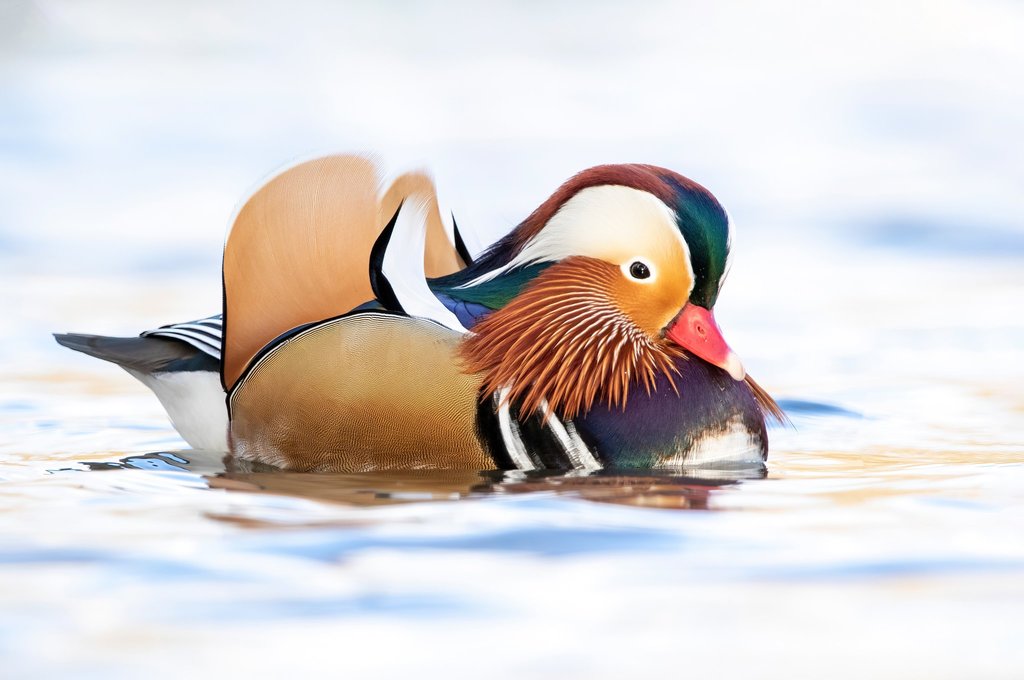
The drake is one of the most ornate birds in the world, with orange 'whiskers', a pair of upright orange sail feathers on its back, and a purple breast bordered by white bars. A symbol of married love in China, Korea and Japan, it nests in tree holes high above the ground.
The mandarin duck is a perching duck species native to East and Northeast Asia. It is sexually dimorphic; the males are elaborately coloured, while the females have more subdued colours. It is a medium-sized duck, at 41–49 cm (16–19 in) long with a 65–75 cm (26–30 in) wingspan. It is closely related to the North American wood duck, the only other member of the genus Aix. 'Aix' is an Ancient Greek word which was used by Aristotle to refer to an unknown diving bird, and 'galericulata' is the Latin for a wig, derived from galerum, a cap or bonnet. Outside of its native range, the mandarin duck has a large introduced population in the British Isles and Western Europe, with additional smaller introductions in North America. Wikipedia
What it can do
- iNests in tree cavities up to 10 m or more above ground
- iiDucklings leap from the nest hole to the ground within a day of hatching, unharmed
- iiiFeeds on acorns and other nuts, unusual for a duck
In the field
Field marks
- aDrake: red bill, white crescent over the eye, orange cheek 'whiskers', upright orange sail feathers
- bDrake: purple breast with two white-and-black vertical bars; golden flanks
- cFemale: grey with a white eye-ring and stripe behind the eye, white-spotted flanks
- dSmall, crested duck that perches in trees
- Voice
- Generally quiet; males give a sharp whistle, females a soft clucking
- Not to be confused with
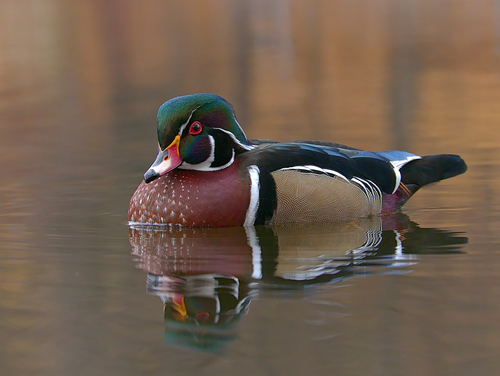
- Wood duck (North America; escapees elsewhere) male is green-headed without sails; female Wood duck has a larger white teardrop eye patch and no pale stripe behind it.
- Where to see it
- Ponds of Tokyo's Shinjuku Gyoen in winter, Seoul's Changgyeonggung Palace (Chundangji pond), Beijing's Summer Palace; feral in Virginia Water, England
- When
- Resident in Japan; migratory in mainland Asia, wintering Oct–Mar in southern China and Korea
Listen
Looking for field recordings…
Life & habits
- Diet
- Acorns, chestnuts, seeds, aquatic plants, insects and snails
- Habitat
- Wooded ponds, rivers and lakes with overhanging trees
- Size
- About 41–49 cm long
Males court females in groups with ritual displays of crest-raising, mock drinking and preening behind the sail feathers.
Where it lives
Recorded sightings
—
geo-referenced records in GBIF, from museums, herbaria and field observers.
Native range
Russian Far East, NE China, Korea and Japan, wintering in eastern and southern China, Korea and Japan; feral populations in Britain and elsewhere in Europe
Drag the globe to turn it. Dots are where records exist, not a range map; darker means more records.
In the stacks
Searching the stacks…
Every page naming Aix galericulata in the Biodiversity Heritage Library →
Marginalia
In Chinese the pair 鸳鸯 (yuānyāng) means 'devoted lovers', and mandarin duck carvings are traditional wedding gifts in China and Korea. In fact, pairs usually form anew each winter.
Curiosity
In summer the drake moults into a drab, female-like eclipse plumage, still identifiable by its red bill.
Kinship
Fact-checked: 1 correction made to this sheet. Photographs: iNaturalist contributors under the licences shown. Records: GBIF.org. Historical plates: Source Library (CC BY-SA 4.0; originals public domain). Summary text: Nature Library editors and Wikipedia (CC BY-SA). Medicinal and edibility notes are historical and educational, not advice. iNaturalist taxon 7106.