On eBird ↗
Merlin
Live sightings near you, the range map, bar charts of when it is seen, and Macaulay Library photos and recordings.
Merlin
Falco columbarius
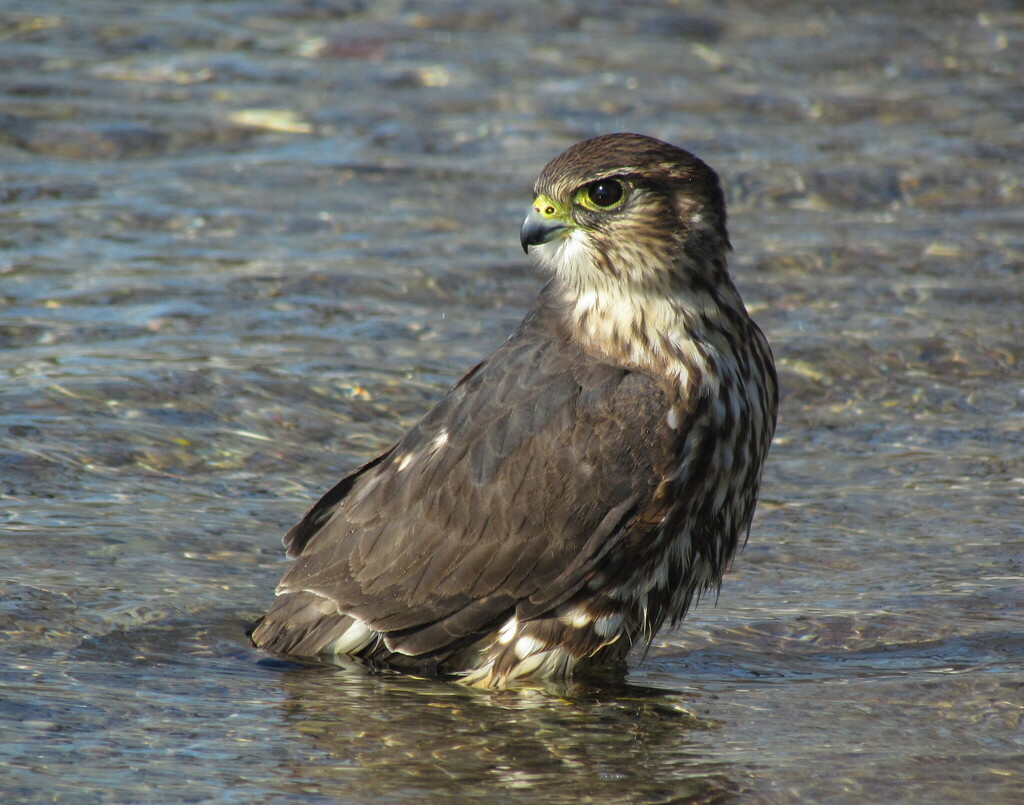
The merlin (Falco columbarius) is a small species of falcon from the Northern Hemisphere, with numerous subspecies throughout North America and Eurasia. A bird of prey, the merlin breeds in the northern Holarctic; some migrate to subtropical and northern tropical regions in winter. Males typically have wingspans of 53–58 centimetres (21–23 in), with females being slightly larger. They are swift fliers and skilled hunters, which specialize in preying on small birds in the size range of sparrows to doves and medium-sized shorebirds. In recent decades, merlin populations in North America have been significantly increasing, with some merlins becoming so well adapted to city life that they forgo migration; in Europe, populations increased up to about 2000, but have been steady subsequently. The merlin has for centuries been well regarded as a falconry bird.
From the article Merlin (bird) on Wikipedia (CC BY-SA), quoted section by section
Description
The merlin is 24–33 cm (9.4–13.0 in) long with a 50–73 cm (20–29 in) wingspan. Compared with most other small falcons, it is more robust and heavily built. Males average at about 165 g (5.8 oz) and females are typically about 230 g (8.1 oz). Considerable variation, however, is seen throughout the birds' range, and in particular in migratory populations, over the course of a year. Thus, adult males may weigh 125–210 g (4.4–7.4 oz) and females 190–300 g (6.7–10.6 oz). Each wing measures 18.2–23.8 cm (7.2–9.4 in), the tail measures 12.7–18.5 cm (5.0–7.3 in) and the tarsi measure 3.7 cm (1.5 in). Such sexual dimorphism is common among raptors; it allows males and females to hunt different prey animals and decreases the territory size needed to feed a mated pair. The male merlin has a blue-gray back, ranging from almost black to silver-gray in different subspecies. His underparts are buff- to orange-tinted and more or less heavily streaked with black to reddish brown. The female and immature are brownish-gray to dark brown above, and whitish buff spotted with brown below. Besides a weak whitish supercilium and the faint dark malar stripe—which are barely recognizable in both the palest and the darkest birds—the face of the merlin is less strongly patterned than in most other falcons. …
What it does
Merlins inhabit fairly open country, such as willow or birch scrub or shrubland, but also taiga forest, parks, grassland such as steppe and prairies, or moorland. They are not very habitat-specific and can be found from sea level to the treeline. In general, they prefer a mix of low- and medium-height vegetation with some trees and avoid dense forests, as well as treeless arid regions. During migration, however, they use almost any habitat. Most populations are migratory, wintering in warmer regions. Northern European birds move to southern Europe and North Africa, and North American populations to the southern United States to northern South America. In the milder maritime parts of its breeding range, such as Great Britain, the Pacific Northwest, and western Iceland, as well as in Central Asia, it merely deserts higher ground and moves to coasts and lowland during winter. The migration to the breeding grounds starts in late February, with most birds passing through the US, Central Europe, and southern Russia in March and April, and the last stragglers arriving in the breeding range towards the end of May. Migration to winter quarters at least in Eurasia peaks in August/September, while in Ohio, just south of the breeding range, F. c. columbarius is typically recorded as a southbound migrant as late as September/October. …
Wikipedia: “Ecology”
Listen
Looking for field recordings…
Where it lives
Recorded sightings
—
geo-referenced records in GBIF, from museums, herbaria and field observers.
Drag the globe to turn it. Dots are where records exist, not a range map; darker means more records.
In the old herbals & bestiaries

Hermann Schlegel — Traité de fauconnerie (1844)
Hermann Schlegel · 1844 · p.133

History of Animals, Book I: On Viviparous Quadrupeds
Conrad Gessner · 1554 · p.232

François Bouchard — Recueil de cent-trente-trois oiseaux des plus belles especes (1775)
François Bouchard · 1775 · p.91

François Bouchard — Recueil de cent-trente-trois oiseaux des plus belles especes (1775)
François Bouchard · 1775 · p.93

François Bouchard — Recueil de cent-trente-trois oiseaux des plus belles especes (1775)
François Bouchard · 1775 · p.95
In the stacks
Searching the stacks…
Every page naming Falco columbarius in the Biodiversity Heritage Library →
This page is assembled live from iNaturalist, GBIF, Wikipedia, the Source Library and the Internet Archive. It is not yet part of the hand-edited codex. iNaturalist taxon 4672.