 NL·0621
Herbarium of the Nature Library
- Name
- Phoenicopterus ruber
- Family
- Phoenicopteridae
- Native to
- The Caribbean (Bahamas, Cuba, Hispaniola, Bonaire), Yucatán Peninsula, northern coast of South America and the Galápagos; increasingly seen in Florida
- Habitat
- Saline lagoons, Mangrove, Mudflats, Salt pans
On eBird ↗
American Flamingo
Live sightings near you, the range map, bar charts of when it is seen, and Macaulay Library photos and recordings.
American flamingo
Phoenicopterus ruber
Also calledFlamenco americano (Spanish) · Flamenco del Caribe (Spanish) · Flamant des Caraïbes (French) · Chogogo (Papiamento)
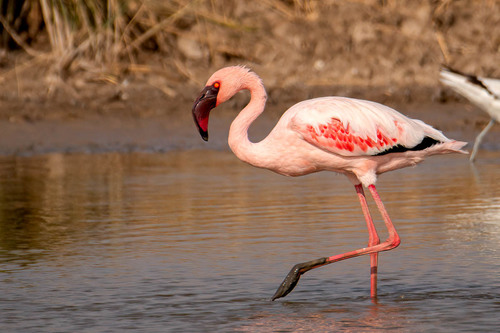
The most vividly coloured flamingo, a deep coral-pink bird that filters shrimp and algae from salty lagoons with its head upside-down. It is the national bird of the Bahamas.
The American flamingo is a large species of flamingo native to the West Indies, northern South America and the Yucatán Peninsula. It is closely related to the greater flamingo and Chilean flamingo, and was formerly considered conspecific with the greater flamingo, but that treatment is now widely viewed as incorrect due to a lack of evidence. It is also known as the Caribbean flamingo, although it is also present in the Galápagos Islands. It is the only flamingo that naturally inhabits North America. Wikipedia
What it can do
- iFilter-feeds with a bent bill held upside-down, pumping water through comb-like lamellae with its tongue
- iiGets its colour from carotenoid pigments in brine shrimp and algae
- iiiStands on one leg with little or no muscular effort, using passive locking of the joints
- ivBuilds mud-mound nests in dense colonies
In the field
Field marks
- aDeep pink-orange body, brighter than other flamingos
- bPale pink bill with the outer third black, sharply bent downward
- cVery long pink legs and neck
- dIn flight, black flight feathers contrast with pink-red wing coverts
- Voice
- Goose-like honking, given constantly in flocks.
- Not to be confused with
- Greater Flamingo (Old World) is paler pink with a pink bill with less black. Chilean Flamingo has grey legs with pink 'knees'. Roseate Spoonbill has a flat bill and short neck.
- Where to see it
- Inagua National Park (Bahamas), Ría Celestún and Ría Lagartos (Yucatán), Bonaire's salt pans, Galápagos lagoons; Florida Bay and the Everglades.
- When
- Resident year-round; Yucatán flocks largest Nov–Mar at Celestún
Listen
Looking for field recordings…
Life & habits
- Diet
- Brine shrimp, small molluscs, insect larvae, algae and seeds
- Habitat
- Shallow saline and brackish lagoons, salt pans and estuaries
- Size
- 120–145 cm; 2.2–2.8 kg
- Lifespan
- Over 40 years
Flocks perform synchronised 'marching' displays — head-flagging and wing salutes — that stimulate breeding.
Where it lives
Recorded sightings
—
geo-referenced records in GBIF, from museums, herbaria and field observers.
Native range
The Caribbean (Bahamas, Cuba, Hispaniola, Bonaire), Yucatán Peninsula, northern coast of South America and the Galápagos; increasingly seen in Florida
Drag the globe to turn it. Dots are where records exist, not a range map; darker means more records.
In the old herbals & bestiaries
Woodcuts and engravings matched from the Source Library’s scanned books by name. Plates marked “relative” show a close kin rather than this exact species. Click a plate to read the page it came from, with translation.

The Natural History of Carolina, Florida and the Bahama Islands, Vol. 1
Mark Catesby · 1777 · p.236

Jan Jonston — Naeukeurige beschryving van de natuur der viervoetige dieren (1660)
Jan Jonston · 1660 · p.221

Histoire Naturelle des Indes (The Drake Manuscript)
Anonymous (French) · 1586 · p.75

The Natural History of Carolina, Florida and the Bahama Islands, Vol. 1
Mark Catesby · 1777 · p.239
In the stacks
Searching the stacks…
Every page naming Phoenicopterus ruber in the Biodiversity Heritage Library →
Marginalia
John James Audubon's life-size plate of the American Flamingo, bent to fit the page, is one of the best-known images in The Birds of America (1827–38); Mark Catesby painted it a century earlier in the Bahamas.
Curiosity
After Hurricane Idalia in 2023, dozens of American flamingos were blown north and seen across Florida and as far north as Ohio and Wisconsin.
Kinship




Photographs: iNaturalist contributors under the licences shown. Records: GBIF.org. Historical plates: Source Library (CC BY-SA 4.0; originals public domain). Summary text: Nature Library editors and Wikipedia (CC BY-SA). Medicinal and edibility notes are historical and educational, not advice. iNaturalist taxon 4257.